Showing posts with label Julia Hartley-Brewer. Show all posts

Saturday, 16 July 2022

Of one mind


As discussed on the Open Thread, the controversial BBC risked rousing racial tensions on BBC Two the other day, during the women's football:
“All starting 11 players and five substitutes who came onto the pitch were white, and that does point towards a lack of diversity in the women’s game in England,” said the BBC's Eilidh Barbour.

In fairness to Eilidh, she was introducing a report from BBC star pundit Alex Scott on the subject - a subject doubtless chosen by someone higher up the BBC food chain. Plus, given that she was seemingly reading from a script, she may not actually have written those words herself. So Julia might have been better saying, “Just extraordinary that someone at the BBC - whether it be the presenter herself or someone else - can write this and still be in his or her job! 

Alex Scott's report, and the discussion that followed, worked from the assumption that all 16 players being white is serious problem. Not one person dissented from that position. It was a very BBC segment, from its introduction, through the report to the closing chat. 

Monday, 18 October 2021

Identity Politics


No, unfortunately they couldn't.

Wednesday, 27 May 2020

Fury, contempt and anguish


I see that Julia Hartley-Brewer, who thinks Dominic Cummings should go, is nonetheless as outraged as I am at Newsnight's blatant breach of the BBC's charter responsibilities: 
I’m sorry but this is TOTALLY unacceptable from Emily Maitlis, Newsnight and the BBC. The BBC is REQUIRED to be impartial. This is a clear breach of their own rules. Commentators (including me) can give their own opinions, BBC presenters cannot.
I hope a real head of steam builds up over this and that Emily Maitlis and Esme Wren are properly held to account over this because it's simply intolerable. 

Emily Maitlis broke the rules. The country can see that. And it would be shocking if the BBC could not.

Update (20:00): More from Julia Hartley-Brewer:
To all the people who are defending the BBC insisting  Emily Maitlis & Newsnight did nothing wrong: YOU ARE THE PEOPLE WHO WILL DESTROY THE BBC YOU CLAIM TO LOVE! You can’t have a broadcaster which is both taxpayer-funded *and* has a political stance. Pick one. You can’t have both.
That brought an interesting reply from Patrick O'Flynn:
I wouldn't mind watching a "Viewsnight" provided Emily Maitlis alternated her lib-Left slant with another presenter who highlighted pro-nation state, socially conservative outlooks. It might work quite well. But the political slant can't all be one way.

Saturday, 1 February 2020

"It is a very white crowd"


This is quite something:


The BBC reporter in question is Geeta Guru-Murthy. Was she trying to elicit a racist answer?

Julia Hartley-Brewer's comments on the matter are germane:
BBC reporter to Brexiteers celebrating in Parliament Square: “It’s a very white crowd”. When she reports at the Notting Hill Carnival, does she point out the “very black crowd” to the people she interviews too? 
And does the reporter also not understand that Brexit will limit immigration from largely *white* EU countries do has bugger all to do with skin colour anyway? 
Oh, and this is the only country in the world where the national flag is seen as a symbol of division not unity.

Thursday, 12 September 2019

This polarised world


I intended to listen to James Harding’s  “Impartial Journalism in a Polarised World’ on Radio 4 this morning at 9am, and for once I remembered to do so - (not that it really matters when there’s iPlayer) but listening to an ear-marked programme in real-time is always best. Here’s the blurb: 
“Polarised politics, cacophanous culture wars and the advent of unchecked, unchallenged news at the click of a button. Can impartial journalism win out in a world of alternative facts and the re-tweet echo chamber of Twitter? If it doesn't, what becomes of democracy? 
When radio arrived, it gave politicians the means of mass propaganda. Television brought us the politics of the soundbite and the twenty-four hour news cycle. But the digital age - unmediated opinion, unchecked sources - has put old-fashioned, impartial news itself under the spotlight. Are we - the BBC and others - any longer believed? Are we trusted? And what happens when we aren't? Do democracy and digital sit comfortably together or is one currently winning at the expense of the other? 
James Harding was editor of The Times and then took the helm at BBC News. After 2016, the Brexit referendum and the election of Donald Trump, he started to think that a different approach was needed, focused on slow news and opening up journalism. He set up Tortoise. In this noisy discussion, James and other journalists grapple with all of these matters, and attempt to navigate a digital future without losing our democratic past. 
He's joined by the political editor of ITN, Robert Peston; staff writer on The Atlantic, Helen Lewis; presenter of BBC Radio 4's The World this Weekend, Mark Mardell; Talk Radio host, Julia Hartley-Brewer; and Gavin Haynes, editor-at-large of Vice UK.

I enjoyed listening but I didn’t think any ground-breaking revelations were made.

Helen Lewis talks at break-neck speed, doesn’t she? She has an impressive ‘radio voice’ though. She made her mark as one of the regular news reviewers alongside Nick Watt on the BBC’s ‘Sunday Politics’ in its Andrew Neill era. Ms Lewis obligingly toned down her political bias a little then, but now, no longer constrained by the BBC remit, she’s an out-and-proud leftie and for all her bright, articulate and knowledgeable manner she can't conceal the limitations of bubble-dwelling. Maybe she can’t see it herself, but why should she? 

Also present were Mark Mardell and Robert Peston.  I want to like Robert Peston, but I can’t. His delivery is tailored to irritate us. You can almost accept the erratic pacing, but it’s that “That” of his that bothers me. It goes something like: “eh-ththutt”; a retch. Perhaps he’s overcoming a stammer. (?)

Where were we? Oh yes, Julia Hartley-Brewer, another hyper-fast-talker. She brought a little counterbalance to the consensus, but I felt she was holding back. 

The other participant was the chap from the edgy media outlet, Vice UK,  Gavin Haynes.   He broke a tacit BBC taboo by bringing Paul Joseph Watson, Carl Benjamin and ‘Count Dankula' into the mix. But for Gavin Haynes, I don’t believe anyone would have mentioned those hitherto unmentionable characters by name, let alone admitted that they might bear some relevance to ’journalism’, at any rate to the ‘polarised world’ compartment of it. (Apparently, Benjamin calls himself a social commentator, not a journalist.)

The discussion covered (pure) impartiality versus ‘due impartiality’ - ITBB has been over this many times, but briefly it (the ‘due’ bit) necessitates making a value judgement somewhere along the line, which Robert Peston called “evaluating”, meaning being sensible enough not to give equal weight to an ‘expert’ and a ‘nutter”. The BBC must be trusted to decide which is which. This leads us gently towards the knotty question of ‘no-platforming’.

Confirmation bias and the echo-chamber phenomenon were alluded to. “People rarely come into contact with arguments they disagree with,” said someone and it’s hard to argue with that. Mingling with the like-minded is reassuring, and comfort zones are just that. Places where you feel comfortable. Stumbling into a hostile environment is exhausting, especially when their default ‘truth’ hangs on a very shoogly peg. People on one side will say  “but you won’t even listen to the other side of the argument” which is precisely what the opposite side is thinking about them. (As Helen Lewis and Julia Hartley-Brewer demonstrate midway through the programme) 

The entire panel, including Julia H-B, was dismissive of Tommy Robinson following a short audio clip of him talking about the media’s lack of support of him as “a political prisoner“. They also played clips from that infamously curtailed interview between Andrew Neil and Ben Shapiro, and Emily Maitlis’s interview with Steve Bannon.  ‘Stranded’ and taken out of context, I thought these examples  - particularly the unrepresentative Ben Shapiro one  - were unhelpful. 

Helen Lewis described Tommy Robinson as having made ‘a whole career out of saying he’d been silenced’ and Mark Mardell called him “a peripheral figure with very little support”.

Julia H-B accused Mark Mardell and the BBC of “creating Tommy Robinson’ because they’d constructed a verbal ‘forbidden territory’ consensus around immigration, while she too skated around the aforementioned ‘forbidden territory’ with some carefully chosen language of her own.

Since much of the media’s bias and a considerable amount of actual news in this polarised world of ours concerns incidents and issues emanating from ‘Islam’, it is significant that the word itself wasn’t uttered at all.  This alone suggests that tiptoeing around this issue indicates that ‘due impartiality’ is as far away from achievability now as it ever was.

Tuesday, 5 March 2019

Liked


While Andrew's agreeing, Nick's liking...and taking Adam's side (surprise, surprise). 


If you were wondering, it all kicked off after Julia Hartley-Brewer agreed with Kate Hoey MP that broadcasters shouldn't call MPs like Jacob-Rees Mogg, Bill Cash and herself 'hardline' or 'hardliners'. Sky's Adam Boulton thinks it's fine to use such terms. 

Sunday, 3 March 2019

Language Julia!


Andrew Marr's introduction this morning ran as follows:
So another week and what has really changed? Theresa May offers a route to delay Brexit but without explaining quite why or what it's for. Jeremy Corbyn comes out for another referendum, even though he knows there probably aren't the votes for it. The Tory Brexit hardliners are beginning to crumble but in what is supposed to be the month we leave, we are in for a very wild week at Westminster. But of course even after we've left, there are still really difficult trade talks ahead, many think harder than what we've experienced so far. So what next? I'm joined by Liam Fox, International Trade Secretary. And as Tony Blair, the former Prime Minister, sees Theresa May perhaps getting her deal through, he is warning Labour MPs don't do it. He joins me for his first interview since 11 MPs broke away from their parties to form The Independent Group. I'll be speaking also to somebody who hasn't broken away, far from it, the Labour frontbencher Rebecca Long-Bailey, about what Labour voters will make of Jeremy Corbyn's call for another referendum.
As you'll guess, I picked up on the use of the word "hardliners" there. 

And talking of terms, here's a short exchange from the paper review:
Andrew Marr: Let's finish with another American taking off, in a different form. Elon Musk  has headed into space,  the first private space launch. 
Julia Hartley-Brewer: It is incredibly exciting. I mean, you know, Remoaners think we're not even going to be able to travel across the Channel...
Andrew Marr: (interrupting) Don't say 'Remoaners'! Or...
Julia Hartley-Brewer: I do. I choose my own words! 
Now, I suspect Andrew was going to go on and say something like "...or there'll be an almighty Twitter storm about it", given that he was on the receiving end of such a storm after using the term himself a year or so back, but I did think it interesting that he used the h-word earlier, without any apparent compunction. 

Sunday, 25 November 2018

Mayday (2)


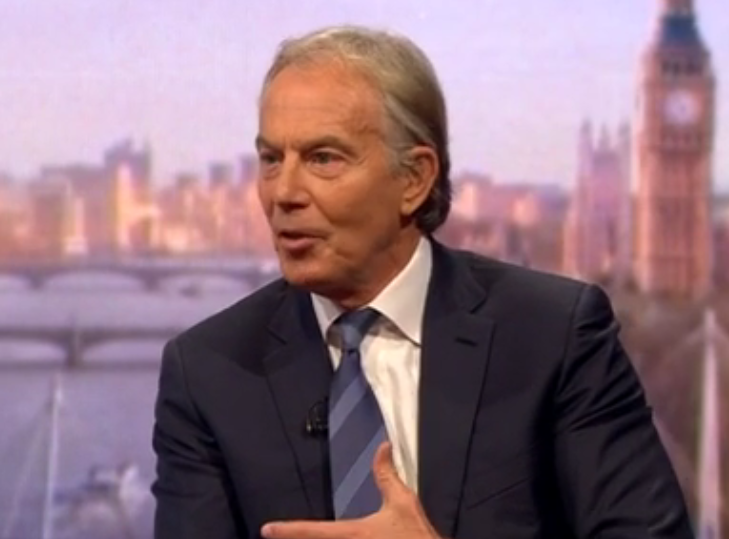
He's back: sincere face, 'trust me' hand gesture

Two more exchanges from this morning's Andrew Marr, starring everyone's favourite living former UK prime minister, accompanied by a couple of heckles:
Tony Blair: The curious thing is people say, well, look, if you have another referendum you are going to divide the country. It's the opposite, and I'll tell you why...
Andrew Marr: I want to come directly onto that, because the first referendum was an incredibly divisive moment for the country. Everyone got very,very angry. One MP was killed as a result. People got incredibly inflamed. And if you go back and you run it all again for month after month after month, don't you look at the prospect of that with some horror, what it would do, dividing families, dividing communities, dividing the country?
Andrew Marr: You are one, I think, of four living people who have done Theresa May's job. I just wonder, putting the politics to one side, what you make of her at the moment? Every day she gets up and is assailed again by criticisms from every single side, it may feel slightly familiar, goes into the House of Commons for a crucial vote, there's cabinet revolts back behind her. What do you make of her performance, as a practising politician looking at another?
Tony Blair: As a person I have a lot of respect for it. I think she has shown resilience, I think she's shown a degree of courage in standing up and getting on, and she's a decent person frankly surrounded by a lot of pretty unreasonable ones. The trouble is, the problem is, having said all of that, the deal's dodo. So this is the difficulty that she has. But in personal terms, you know, I've done the job, I know how difficult it is, I really respect the fact that she manages to stand up and get on with it. I think that's a great capability, a great characteristic...
Andrew Marr: A stand-up woman, yeah.
Tony Blair: Yes, I think she is. This is not a personal thing. Personally, actually, I can see a lot to admire in the way she handles herself. It is that literally this is the destiny of our country, and it is the wrong decision for our country. This is why we have to resolve it finally through the people.

Thursday, 13 September 2018

All around me are familiar faces


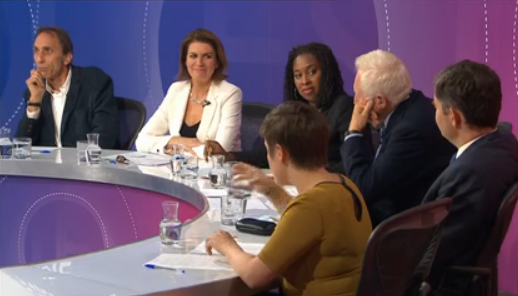
Oh dear, BBC Question Time's announcement that Julia Hartley-Brewer would be joining the panel tonight didn't go down well the Twitter mob. Not one bit.

Huge amounts of bile flew at the hated Julia and accusations of bias against the BBC spewed forth like vomit from the massed hordes of Hell (to go all 'Norman Smith' for a minute!).

Separate tweets actually went out announcing all five guests. The numbers of replies each got is very revealing:

Rory Stewart - 6
Chris Leslie - 68 
Theo Paphitis - 39
Faiza Shaheen - 36 
Julia Hartley Brewer - 491

They really don't seem to like right-wing women.

That said, Labour's anti-Corbyn MP Chris Leslie got the second-most-hostile response because, of course, he's "a Tory".

'In fact', according to many a Corbynista on Twitter overnight, there are actually"4 Tories" on the panel - five if you count David Dimbleby! (Now where have I heard that kind of thing before?)

A less heated take on this can be found in the following Twitter exchange, involving the BBC's famous head of live political programmes:
Minnie Rolfe: Return of 'Marr', Hartley Brewer on paper review, return of BBC Question Time, Hartley Brewer on panel, this is NOT balance. Who is responsible for this - Rob Burley?
Rob Burley: John Neal is the Editor of 'Marr', Hilary O’Neill of 'Question Time'. But the fact someone you don’t like is on either programme tells us zero about balance. Soz.
Minnie Rolfe: The BBC after a break has the return of two of its flagship political programmes. The programmes take place within days of each other and the same journalist is platformed on both programmes. My likes and dislikes are NOT the point, don't you see that Rob Burley?
Rob Burley: You are making a point about someone being on too much. That’s a view and it’s fair enough. But it has nothing to do with balance or bias.
Minnie Rolfe: 'Being on too much' isn't a good summary of my point. Neither of these flagship political programmes has been on for weeks, first week back, days apart, same journalist on both programmes. Does anyone at BBC have an overview of who is platformed to avoid this? it's not OK surely
Rob Burley: When say “platformed” guess you mean on telly. You seem to be asking, perfectly fairly, why 2 programmes have the same person on so soon after each other. And whether should be more coordinated. Perhaps so, variety is good. But this has nothing to do with bias or balance.
Minnie Rolfe: BBC has great reach and influence, so if a journalist or politician is more frequently or intensively platformed by BBC, or 'on the telly' if you prefer, their views and opinions are being signal boosted by BBC. This is about more than 'variety'....but variety is good.
Others noted that Minnie (no relation to Leyla Reynolds from the other night's Newsnight) might have missed something:
Ian Collier (to Minnie Rolfe): And Faiza Shaheen is OK I guess because she sings from the correct playbook?
Mike Davies: Yes - Faiza Shaheen was on 'Politics Live' earlier today.
Minnie didn't reply to that but the gents have a point there. Faiza has been on Question Time, Politics Live and the Marr Show over the past two weeks, but the mob haven't kicked up a fuss about her being "platformed" too often.

Anyway, the conversation continued:
dave M: Can you not get more people from a wider pool on all sides? It does get pretty nauseating seeing the same old faces jump from program to program.
Rob Burley: Have a watch of 'Politics Live' - loads of new faces.
dave M: Yep like the new format... but no one I’ve not seen from the studio circuit. Appreciate that's inevitable to a degree but QT has worst repetition.
Both are correct there, but only up to a point. Politics Live has featured some new faces but, as dave M says, most have been from 'the studio circuit'.

(I like the new format too, by the way).

And there's definitely something to his point that "the same old faces jump from programme to programme". Having "loads of new faces" might, indeed, prove refreshing.

Anyhow (he says, without blinking), guess who was on Newsnight for the umpteenth time last night? Yes, it's that man again!:

Sunday, 18 February 2018

Another view


Laura Perrins

On the subject of Brandon Cox, this is quite a statement from Julia Hartley-Brewer:


And what do you make of this from Laura Perrins in response?

  • What the story about Brendan Cox reveals is how ruthless and dishonest the MSM, especially the BBC are. They knew about these allegations (see @JuliaHB1) and yet were happy to use him 2 push anti-Brexit agenda.
  • The BBC&MSM knew Brendan Cox was in a weak position to begin with, and eventually would have been brought down. It is why he didn't run for Jo Cox's seat. They didn't care about that or the two young children in this family.
  • Brendan Cox was useful 4 the BBC at the time. Now, he and more importantly the family are just collateral damage in this entire anti-Brexit agenda. Some1 else will come along for them 2 push.
  • The BBC also used Brendan Cox to push the increase in hate crime agenda when we know the evidence is weak. The image of him they put across was dishonest. They manipulated the public for the last 18 months or so. Now the extended family have to pick up the pieces.
  • The BBC and the use of Brendan Cox and the family as a whole, in such circumstances known to them at the time, is despicable and disgusting. They knew the further destruction of this family was inevitable. BBC didn't care.


Sunday, 11 February 2018

A sad story but...


From this morning's The Andrew Marr Show...

Ayesha, Julia and Andrew

Andrew Marr: One of things that happens when you have a big story like this, is everybody starts to go in different directions searching for different aspects of sex problems, in this case in the charity sector. You've got the front page of the Mail on Sunday. A sad story but... 
Julia Hartley-Brewer: Yes, and I think it is important...yes, allegations against Brendan Cox, the widower of Jo Cox, of course. He denies these allegations. I have no information whether these allegations are true or not.  We do have this thing where I think the media a lot of the time pick and choose who they will expose (in their idea) for allegations, whether true or false. - not proven yet, certainly. 
Andrew Marr: For news value. 
Julia Hartley-Brewer: For news value and for political value, and I think we need to be really open about the fact that these are now being used, these allegations, whether it's about the President's Club, whether it's about Oxfam, whether it's about...that these are politicised things. And I do think we need to be very careful about people's anonymity. And I really do think that if you are going to be naming one person as opposed to another person and picking and choosing, well... 
Andrew Marr: Make very clear why you are doing it.  
Julia Hartley-BrewerWhy you are doing it. 
Ayesha Hazarika: Can I just say one thing on that? You must tread hugely carefully with these things, but sometimes, revealing the name of somebody brings forward other victims.  
Andrew Marr: Other people.  
Ayesha Hazarika: So there is a very fine line.  
Julia Hartley-Brewer: But we've also seen instances, such as with this Westminster so-called sex pest scandal where people have taken their lives, people are having their careers ruined. There are MPs currently who still don't know what the charges are against them.  
Ayesha Hazarika: Do also remember that there are thousands of people that never get justice and may never have their voice heard.  
Andrew Marr: We could talk all morning about this and it would be interesting but we must move on. 

Paging Katya Adler...


Katya Adler

Maybe Andrew Marr needs to send a memo to Katya Adler...
Andrew Marr: The Sunday Telegraph there has got a story from the other side of the Brexit debate - Barnier's aggression. He's been very, very aggressive this week, in many people's view, is risking a UK walkout with the beginnings of a fracturing of opinion on the European side of negotiations. You don't often hear about that, so that's interesting.
******* 
Andrew MarrDo you accept, however, that in a sense we pore over every split, every problem on the British government side, every inconsistency? On the other side we've got major nations who now disagree with each other about the terms of Brexit and stress between the national capitals on the one hand and Barnier's team in Brussels on the other, and we don't very often report this.  

Julia Hartley Brewer: Well, the BBC doesn't often report it, no! 

Thursday, 28 September 2017

Damned statistics


I knew I’d seen that image somewhere before.  Oh yes, here it is. (And here is a QT spreadsheet:)

Statistics are one thing; how they’re interpreted is another.  Julia H-B said she was fed up with being the only Brexiteer in the Q.T. village “most of the time”.

Guido says Julia H-B is right, and so does Craig, but not about “always being the sole Leaver on Q.T. panels”. 
Craig has found that she has been the sole Leaver only once, but she was correct in saying Remainers have dominated QT panels.

And Dimbles was wrong about Nigel Farage: “Every time you've been on this programme you've been with Nigel Farage as far as I can see.”  No. Julia H-B has never been on the panel with Nige.

I just thought I’d mention it.

Saturday, 16 September 2017

Committees and Panels


For those who are hoping that Parliament might closely scrutinise the BBC's output for bias over their Brexit coverage then the new composition of the Digital, Culture, Media and Sport select committee will probably prove a deep disappointment. 

It's eleven members all opposed Brexit in the EU referendum (though one of its members, Julian Knight, has subsequently taken up cudgels against the BBC's negative reporting of Brexit).

That almost makes BBC panels look balanced. 

Julia in the Remainers' Den

Talking of which, Julia Hartley-Brewer raised that very point about BBC panels on this week's edition of Question Time. The famous David Dimbleby naturally leaped in instantly (in the manner of all BBC presenters whenever the BBC is criticised):
Julia Hartley-Brewer: The reality is, that's not what the British people want, that's why people like me...and I note, once again, that I'm the sole Leaver on the BBC panel...
David Dimbleby: (interrupting) How often are you the sole Leaver on a BBC panel?
Julia Hartley-Brewer: Most of the time...
David Dimbleby: (interrupting) Every time you've been on this programme you've been with Nigel Farage as far as I can see. (Laughter from audience).
Julia Hartley-Brewer: I've never been on the panel with Nigel Farage.
David Dimbleby: Have you not? Have you not?
Julia Hartley-Brewer: Never. Never.
Checking back, Julia has been on Question Time ten times, first appearing in 2004, and, yes, David Dimbleby was wrong. She has never been on the panel with Nigel Farage.

That said, in the past ten years she's only once before been the sole Leaver on the QT panel (8 May 2015) and in the run-up to the referendum (25 February 2016) was actually on a panel where Leavers outnumbered Remainers.

But there are plenty of other BBC panels she's been on besides QT panels. She could be right about those.

Sunday, 8 January 2017

For lovers of Twitter conversations everywhere...


Julia Hartley-Brewer (talkRADIO): I'll have to drink heavily today. Tomorrow I'm on #Marr with Remoaners-in-chief Craig Oliver (sorry, Sir Craig) & Steve Richards. Dear lord.
Richard Osman (Pointless): If you go through the whole of the Marr show tomorrow without saying 'remoaner' I'll donate to the charity of your choice.
Julia Hartley-Brewer: How much?
Richard Osman: Depends on the value of the pound.
Julia Hartley-Brewer: Very good. Can I say Remainiac instead?
Richard Osman: Yep, that's much funnier.
Julia Hartley-Brewer: How about you double it if any of the contestants on Let It Shine actually hit the right note tonight?
Richard Osman: And that stage looks suspiciously like the EU flag.
Julia Hartley-Brewer: Genuine lol
Boho&Daisies (tweeter): How about he does the same for the two 'remoaners' on with you if they don't say 'xenophobia', 'racist' 'lies' & 'bus'
Richard Osman: I'll accept all of though conditions except 'bus'. Although this is now getting complicated.
Julia Hartley-Brewer: It's a deal.

It's got worse for Julia since. 

The Remoaners-in-chief she mentioned (Sir Craig Oliver, Steve Richards) have been joined on this morning's Marr by other Remoaners-in-chief: Ken Clarke and Nicola Sturgeon. And Remain-backing Tory Justine Greening is on too. That's a heck of a lot of Remainiacs for just one show! 

And just Julia Hartley-Brewer to put the other point of view.

Update: Andrew Marr called Julia H-B a "Brexiteer". (He didn't apply any equivalent label to, say, Steve Richards). Maybe Richard from Pointless should have tweeted him too.

Further update: Andrew Marr's attempt to make the resignation of Sir Ivan Rogers a big item on his paper review saw Steve Richards and Sir Craig Oliver 'big up' Sir Ivan and Julia H-B give him a right good bashing. The section ended with the following exchange.
Julia Hartley-Brewer: He's clearly unfit for the job. His emailed resignation made him clearly unfit for the job. And he should be out of the Civil Service, as he is. Goodbye! Good riddance!
Andrew Marr: We'll hear his side of the story a little bit more from Ken Clarke...
Julia Hartley-Brewer (interrupting): I think we already did, didn't we!
Andrew Marr: ...later on.

Friday, 25 September 2015

Leftie Hell

Will we see more articles called ‘My Leftie Hell” after last night’s Question Time? Probably no-one will bother. They’re resigned to it.

Like the ‘Any Questions’ that caused Allison Pearson such grief,  Q.T. came from the Cambridge area, and the audience was as surreally leftie as they come. 

On the panel were: Yanis Varoufakis, Ken Clarke MP, Chris Bryant MP, Suzanne Evans and Julia Hartley-Brewer. 

The question: “Should we take more refugees than we can cope with?”  
Note the way the question was phrased. Not ‘should we take in everyone in the whole wide world that fancies an easy life on benefits?’ Just the slightly loaded “More than we can cope with”.

Dimbleby turned to Suzanne Evans first, no doubt expecting her to make the familiar argument against this country taking in all and sundry, which she duly did.  It was greeted with deathly silence. After a suitable pause so we could soak up the hostility in the atmosphere, the chair turned to Yanis Varoufakis whose first words were “The opposite”. The audience erupted with whoops and cheers.
The overbearing Greek ex-finance minister proved popular with the audience. “Borders are an absurdity” he said.

We are all migrants


Suzanne Evans, Julia Hartley-Brewer, and a dully equivocating Ken Clarke unsuccessfully tried to reason with the audience, but the two remaining panellists agreed that we should take in anyone and everyone who wished to come because overall, migrants are of great benefit to the country. 

When it was suggested that their ‘welcome to all’ policy would put an even greater strain on our already over-stretched NHS, Chris Bryant said “If you see a migrant in the NHS it’s likely to be someone who’s treating you, not being treated.” The audience were in leftie heaven.

There is a parallel world. 

Leftie Hell and the BBC constitute one world; the rest of Britain constitutes the other. 

Saturday, 9 May 2015

Eat my kilt

If you spend too much time looking out for BBC bias you find yourself starting to spot bias everywhere. It’s under the bed with the fluff.
Oh how easy it is to get oneself radicalised. Here at “Is the BBC biased?” we pride ourselves on our moderate, centre ground approach, always ready to give credit where it’s due. 

There is only one area over which I freely admit I haven’t been able do this, but that is because the fault lies with ‘them not me.’ It’s the BBC’s coverage of the Middle East, specifically the Israel/Palestine situation. I sincerely believe the BBC takes a fierce and firm anti-Israel / pro-Palestinian approach, which I suspect stems from ignorance on the part of BBC management as well as their on-the-spot reporters and foreign correspondents. They get away with this bias because they assume (probably correctly) that the bulk of the audience is equally ignorant, and consequentially, has absorbed a negative attitude towards Israel, on the misguided, old fashioned understanding that the BBC is impartial. It’s surprising that so many viewers still take that on trust.


Apart from that, we’re very fair over here at “is”. (Fairness; hmm. Sounds vaguely familiar. )
Someone who seems to have taken the BBC bias theme a bit far is Leo McKinstry in the Daily Mail. He may have a point or three, but I fear he risks straying into the realms of paranoia. However, his article does contain one riveting clip. The  video captioned “ ‘For God’s sake!’: David Dimbleby loses his cool live on BBC”

I’m not sure what DD’s uncool ejaculation was in response to - I’ll guess he was basically cross that Labour seemed to be going down the pan - but I enjoyed the lady in the background unsuccessfully trying to keep herself out of shot by doing an exaggerated impression of Mrs Doyle, scurrying past the Great Man, bent double carrying what looked like a tray of beers.


McKinstry did mention something that had struck me as quite uncalled-for when I saw it at the time. 
Similarly, viewers caught a glimpse of the incestuous political bubble that operates at Westminster, as correspondents Nick Robinson and Laura Kuenssberg rhapsodised about the wonderful personal qualities of Ed Balls — in reality another bully and social-engineering zealot — after he had lost his seat”.
I didn’t see the Kinnock interview he mentioned, so he probably has a point there, but I didn’t really notice that “mourning over the ‘phenomenal losses’ "  apart from some understandable references to the ‘human cost’ of these unexpected and humiliating defeats.

I don’t expect any of the younger generation of furious left-wing Tweeters on the BBC payroll would ever regard a blog like this as any other than a ‘hate-site’. In fact they probably haven’t even come across it . 
I just feel sometimes that too much over-the-top bias-mongering is counter productive and dangerous to the health.

Now that Scotland Nationalism has ‘Roared’ I feel, in retrospect, that I wish the Scots had got their wretched independence when they had the chance. If they had, we might have been spared the endless, very unpalatable Sturgeon-mania. 

I feel sorry for Peter Brookes. No more Wallace and Gromit.  
Bye!

I keep missing the beginnings of programmes, and it was so with that excruciating election special Question Time. However I saw enough to conclude that the panel’s pathetic attempts to rationalise their pre-election wrong-headedness was, well, pathetic. But the BBC’s choice of panellists and, for that matter venue, showed that they’ve learned nothing from the election result. Back to square one. 

Paddy Ashdown. What is he like? His eyes have closed up altogether, when they used to be just slits. He specialises in getting things wrong, and is most unpleasant while going about it. 
As for Alistair Campbell, his pseudo psychoanalyses with that ‘I’m above it all, looking down on you lesser beings with my superior understanding of human nature” are simply boring and wrong. He has reneged on eating the kilt as well. Julia Hartley-Brewer was rather good, but  not good enough to sweeten the gloom. As for the audience - well what can one say?  (The cuts the cuts, Fatcher etc etc.)


The local council results must mean something. I wonder if +458 (conservative) and   +123 (Ukip) gains, and -164 (Labour) and -324 Lib Dem losses will translate into proportionate representation in the BBC’s political coverage? 

Either way I certainly won’t be promising to eat my headgear if you know what I mean ‘arry.