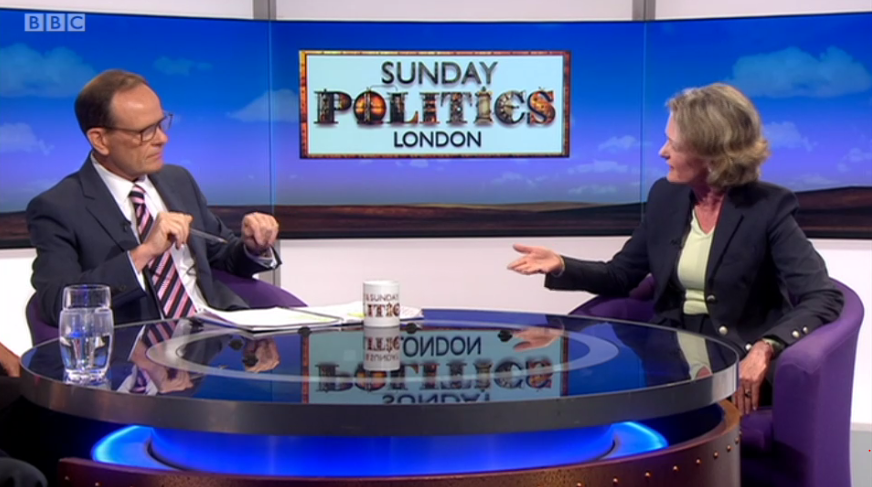
Showing posts with label The Sunday Politics. Show all posts

Saturday, 6 July 2019

More nonsense


Talking about nonsense, try this gem out:


Now, this wonderful video totals up the various commenters on the old Sunday Politics show and finds that the programme was dominated by the Right, with the Centre coming in second and the Left lagging way behind. It also find that there has never been two left guests on the panel. 


Damning, eh? Except that the chaps behind it chose to put Polly Toynbee, Helen Lewis, George Eaton, Steve Richards, Anushka Asthana, Rafael Behr, Gaby Hinsliff and Ella Whelan in the Centre column rather than the Left column and shoved everyone else not of the far-Left into the Right Column.

Now, if you move Polly & Co, back into the Left column, a very different story emerges. The Centre plummets and the Left soars, and it also turns out that there have been many occasions when there were two left-of-centre commentators on the same programme.

Actually, if you watch the dizzying sequence grow on that video, a proper trend does emerge. As the date gets nearer to today the frequency of the far-Left's appearances grows. (The show sadly ended before Ash Sarkar arrived on the scene!)

Sunday, 17 June 2018

Questions, questions


Norm

I usually try to post tidy-looking transcripts, but this one is too long and I'm running out of time today. So please find below a transcript of the part of today's London section of The Sunday Politics, hosted by our old friend Norman Smith. 

It's taken straight from TV Eyes, with a few corrections from me. I hope it's still easy to read. The bold bits are Norman Smith speaking. The non-bold bits are his various guests. I've indicated who is being questioned at which point by highlighting their names in red

I haven't marked out the interruptions though, but there were quite a few and you'll easily be able to guess where they came. (Look for the balance of bold lettering and non-bold lettering. The closer they are the more interruptions there were. And the longer the length of the non-bold lettering the more the interviewee got to make their point). 

This is for those of you here at ITBB who know a lot more about this than I do and will be able to spot any bias (or lack of bias) much better than me here.

So, dear reader....

Was Norman Smith as factually mistaken about everything as Elizabeth Campbell, from Kensington and Chelsea Council, implied in her often incredulous-sounding responses to his accusatory ('accuse-a-Tory'?) questions?

Did Norman go way too far for a BBC journalist in suggesting that Mrs May "misled" Grenfell survivors (i.e. lied)?

Did Norman's questioning of his two Labour guests provide proper balance? Was he as tough with them as with his Conservative guests? 

Here then is the transcript:


Joining us now is Elizabeth Campbell, from Kensington and Chelsea Council, who took over as leader in the immediate aftermath of the fire. Elizabeth Campbell, your predecessor when he quit, said he was resigning because of the perceived failings of the council. Now, do you think the failings of the council are perceived or real? Well, I think we have to wait for the inquiry. You don't know? Well, soon as I took over as leader the first thing I did was to apologise and to say that actually the council did not cope well enough in the face of an overwhelming national tragedy and I still hold to that. We obviously didn't cope well enough. But as to the details, that's what the inquiry's for. Let me put it to you - the failings are not historic in terms of the immediate aftermath, which many people would say the council failed to get a grip on the situation. They're current in terms of your failure to rehouse residents, and as you yourself promised to do within a year, something like half are still in temporary accommodation. Well, I don't accept that because about 90... But you've broken your promise. You said you would get them... Hold on, let me just finish. 90% of those who need to be rehoused have accepted permanent accommodation now. But the accommodation is not available or suitable. Again, I don't agree. Well, why are they not in the properties then? Because it's complicated. It's very complicated and it's difficult and, you know, having been at the commemoration hearings every day, if you've got a family and you've had the opening of the public inquiry, well, the commemoration hearings for two weeks, then you have the opening of the public inquiry, you've got Ramadan going on at the same time, and yesterday you had the first anniversary. Meanwhile, the children are doing A-levels. When people are ready to move they'll move and we are doing everything we can to support them, help them, to encourage them to take up the flats and properties that are available. Let me put it to you, the facts are against you. If you have a situation where you have 200 or so households and only 80 or so after a year have been permanently rehoused, how in any way can you be satisfied with that? I'm not satisfied with it but I'm saying that it's... There are reasons for it. These aren't just figures that you can just move from one side of the sheet to another. They're individuals and they will have individual reasons. And I'm saying that... Yesterday I was speaking to quite a lot of our staff in the resettlement team, the allocation team, we know everybody, we know them very well. OK, but let's get a sense then, here we are one year on, half have not been put in permanent housing. How long do you think will it be before you will be able to ensure all of them are in permanent housing? Well, I'd just like to pick you up on what you said. You said "When they will be put". It's not a question of us putting them in. Yes, but you know the You know the thrust of my question. Yeah, I do, but I think... I don't think it is about having fake deadlines. But if you are a resident you want to know when you can expect to move into a permanent home. That's not an unrealistic ambition. Well, 90% have accepted it. So when will they actually be in housing which they can go into? They will move when they are ready to move. Well, when you can supply housing that is fit to go in because as you will know there has been criticism that much of the housing you have bought is inadequate, requiring repairs, damp, not suitable for people with disabilities etc etc. Again, I think the story is more complicated than you make out. You know, we went out and we bought 307 properties so everyone would have a choice. Then we have a duty to make sure that those properties are absolutely the best they can be, whether that's from fire regulation, whether that's from gas, whether that's from electricity. If people came to us and said, "Actually, I don't want to have gas in this flat." We'd say, "Fine, OK, we will change it." This is about getting homes for people. It's not just properties. I understand it's complicated... And if people want to say to us, "OK, I'd like a new kitchen, or I'd like a different tile, or I want to change that carpet. You seem to be suggesting that somehow it's the residents who are the problem, that they're too picky and finickity about what they want. No, I haven't said that. I've said... You're saying if they want a different kitchen... I don't think that's being picky. I think if you've lost your home, I think that's fair enough. All right. All I'm saying is that we're doing absolutely everything we can to make sure that, you know, having lost everything that they can have a home that they wish to move into. OK. But if you are a resident you would accept that you would want to have some sort of timeline in which you would feel confident that your family could move into permanent housing. Can you give them any reassurance that by the end of next year or whatever this will be sorted? 90% have accepted their flats. You're not answering the question. I think I am. Because you're trying to say that it's their fault. If I'm a resident I would want to know when I can move into permanent housing - confident that I'd be able to get into it. You can move in when your flat is ready. 90% are ready to move into as well. So, the flats are there. It's up to us to try and encourage people, to support them. Having been to the commemoration hearings, having been to the services yesterday, imagine it was you, imagine you've been married 30 years and you've lost your wife and you're going out buying, I don't know, towels or things for your flat and you're moving in on your own. That's quite a difficult... Let me... Bob Blackwell, let me bring you in. I mean, Theresa May her record too does not stand close examination does it? Because in the immediate aftermath she said, "Don't worry, you will all be permanently rehoused within three weeks." I mean, what a preposterous thing to say! Well, I think Theresa as Prime Minister has apologised. Not for that. Not for that. Not for that. She's apologised for her reaction in the immediate aftermath. In the immediate aftermath. But not for misleading residents about when they would be rehoused. But I do think that we have to empathise with the survivors of this terrible tragedy. We have to remember that they've lost absolutely everything. I understand that. They literally walked out in the clothes that they were wearing and everything else is gone. Now, when you're under those circumstances I don't think there's any council in the country that could have coped with that. Do you think Kensington handled it well? No, I don't they handled it well but I don't think any council in the country could have handled it well. Can I suggest... What I do think is important, however, is that we've got to give the survivors both the appropriate amount of time to grieve for the ones they've lost, and also to get a settled home, which they can call home after their recovery. The point is that we cannot ask the council or the Government to force people to go into homes. But can I suggest to you...? They've got to be offered a home that is suitable for them that they will then be able to regard as home. I don't think you can fix times. All right, but can I suggest to you, there is an obligation on political leaders in the aftermath of such a tragedy to be honest, to be candid with the sort of scale of reconstruction, and time that will be involved? And I would suggest to you that Theresa May, in effect, misled residents by giving them false expectations of when they could expect to be rehoused. And the Government has continued to do so. We have had quotes from Sajid Javid saying - you will be in by Christmas. I mean, that actually is unfair on the residents. Well, I think the clear point here is that the most important thing was that properties were being offered by the council, with assistance from the Government, for those residents to move in. Now, if they felt that those properties were not acceptable to them, they were either in the wrong place or the wrong type, and they rejected them. I think the figures are something like 866 offers made by the council to the 203 households. OK, let me... If that is the case, a lot of those residents have said... It depends what they are being offered. .."Thank you for the offer but it's not acceptable." OK, let me just bring Clive Efford in. I mean, the response of Jeremy Corbyn, too, is questionable, isn't it? I mean, he politicised an already utterly devastating and fraught circumstance for the residents by suggesting that somehow this was the consequence of austerity - the fault of the Government. Well I think that... I mean, clearly this is a... ..as a result of a local authority that quite frankly refused to listen to its local residents. That's not... Hang on a second. These people were disenfranchised. But on this question of austerity, Jeremy Corbyn blamed it on austerity. They are a disenfranchised working class community in a Conservative Borough that disregarded them. And there is no getting away from this. This is a council that couldn't even pick up the phones the following day to answer the calls from other local authorities who were offering assistance. I mean, it was a disgraceful state of affairs. Do you see this... But just let me finish because you've made that accusation. And also the standard of the work that was done on that block, we can only wait for the outcome of the inquiry and police investigations, but I think we all know what the answer to that is going to be. So I think it's wrong to suggest that Jeremy Corbyn politicised this. OK, OK. Now let's hear from the local MP for Kensington, Labour's Emma Dent Coad. The council has to accept that they can't deal with it. They don't have the capacity to deal with it. And they have made some huge errors. They must either invite the Government in to help them or the Government send in commissioners now. They need expert help now to deal with this. The council has made some terrible mistakes by buying the wrong kind of housing for the right kind of people. And this has to be dealt with. Otherwise, people continue to languish in hotels. Trust me, I've been in some of those hotel rooms. You don't want to be in a Premier Inn for a year. Joining us now is James Murray, the Mayor's Deputy Mayor for Housing. James Murray, what on earth has Sadiq Khan been doing? He seems to have been invisible throughout all of this. Right from day one, Sadiq was down there meeting people affected in the local area. What has he actually been doing? Whilst he was out there meeting people who were affected, his team, me and the other people at City Hall were there helping out with the local council, with the other councils who were drawn in to help out, the Government and so on. People from City Hall were seconded to help out with the response effort. And over the last year we have put money in to helping Kensington and Chelsea to buy replacement social homes. The Mayor has launched a fund to help local businesses. The mayor has secure an extension for people who are survivors trying to secure indefinite leave to remain. So, there's been a lot of ways in which the Mayor has been involved The Mayor has also, I think, really found it important to to keep up the pressure on the Government and the council to make sure they don't continue to let down residents. OK. Elizabeth Campbell, have you found the assistance of the Mayor's Office useful? Well, I certainly haven't had any personal contact from Sadiq Khan at all. No personal contact at all? No. But, you know, fair enough... Well, there we are, James Murray, here you have the leader of the Council on the front line of this issue, haven't even heard from you. I don't want to make it too personal here. It's not personal, it's just, are you actually in contact with them? Elizabeth and I have had a number of meetings together. That's fair enough. I've had meetings with her and with her cabinet member for housing both in Kensington Town Hall and at City Hall. Sadiq has been out there being visible right from the very beginning, meeting people, making sure that he's a leader in the local community. There's a broader issue in terms of tower blocks in London. Why doesn't the Mayor issue some sort of instruction, guidance, ultimatum, call it what you will, to say - no more cladding on the side of tower blocks, and that cladding that is there in London should be removed? Because at the moment it seems a lot of tower blocks have still got this cladding. So, let's be really clear the difference here between the Mayor's planning policies, which he has responsibility for, and building regulations which are national regulations. And the Mayor has been absolutely clear the Government needs to get on and issue new building regulations that people can have full confidence in to make sure they ban combustible materials. That they say sprinklers should be mandatory over 18 metres. To say, let's ban desktop studies. The Mayor has been very clear that building regulations need to be updated by Government as quickly as possible to give people that confidence. In the meanwhile the Mayor has some control over planning policy in London and what he set out there in publishing his new draft London plan is a way in which planning policy can ensure higher standards of fire safety. Can you explain this, which I genuinely don't understand, why have tower blocks got flammable cladding on the side of them? That would seem barmy to me. The Mayor has made very clear that he thinks that the combustible material should be banned. As someone who is involved in housing, can you tell me why on Earth it was put on in the first place? There has been a system of building regulations and building control which has not been fit for purpose for some time. And so what the Government needs to do is make sure that all those existing buildings are made safe and to make sure the building regulations for the future are regulations that we can have full confidence in. OK. Bob Blackman, when we had this review, the Hackitt Review, published recently, which seems to have caused more confusion than illumination, saying we don't need to get rid of the cladding. The Government has to act on this? Absolutely. And I think that both the previous Secretary of State and the current Secretary of State have made clear that the desktop studies are going to be either barred completely or very much minimised in terms of their impact. One of the problems we have to face in these tower blocks is, of course, that the reason for the cladding being put on is because of leakage and also the fact that these blocks are often very cold. That's one of the reasons why this was put on. Unfortunately, one of the problems here is to assess at what level materials are combustible. Clearly, we've got to look at what the inquiry says and what the outcome is. The regulations I'm afraid have been neglected by governments for 20 years or more and need to be completely updated. Clive Efford, you touched on this a few moments ago but I want to ask both of you. Do you regard what happened at Grenfell as, in effect, a modern morality tale? About how the poor, the disenfranchised, are treated by those in power? We haven't got much time. Yes, I do. And I think in the aftermath of Lakanal and the report from Lakanal there is no justification for that cladding having been put on that block. Bob Blackman? I think we've got to review this to make sure this never happens again but it could unfortunately have happened in any of the boroughs, which have these high-rise blocks. That needs to be put right urgently so that people don't suffer such a terrible fate anywhere ever again. And, Elizabeth, do you think it is, in effect, a modern morality tale? I think that, as Bob has said, it's something that could happen anywhere. We weren't unique and we just have to be really open with the inquiry. We need to find out what happened. And we just need to make sure that it never, ever, ever happens to anyone else again. Well, that's all we have time for. My thanks to Elizabeth and James, and, of course, to Clive and Bob. And with that - it's back to Sarah. 

Sunday, 25 March 2018

Growing into it

Sarah Smith was far more persistent on The Sunday Politics than Andrew Marr was this morning. This clip and the one in my earlier post are from Twitter and only show excerpts from the interviews with Tom Watson on the Marr show, and Corbyn supporter Andy McDonald MP on the Sunday Politics; you can see the whole of the 'antisemitism' part of the latter interview here. 

Andy McDonald took the same approach to defending the Labour leader as Tom Watson did with Andrew Marr. Jeremy didn’t inhale, but whatever he did was in the context of supporting freedom of expression.

Everyone now acknowledges the mural was ‘obviously’ vile. Vile at first glance, even. But Jeremy’s record is of opposing antisemitism and “all forms of discrimination” so there.

Andy has got it into his head that he’s talking to someone called Laura and is obviously quite rattled, and so he should be.  Sarah Smith was rather good. She’s growing into it. 

"Clumsily worded"


Watching The Sunday Politics, something struck me as I noticed Sarah Smith asking much the same question to her Labour guest as Andrew Marr had asked earlier, namely that they both got similarly-worded reply each time:
Andrew Marr: What is the difference between this situation and Diane Abbott, who was also calling for a second referendum, and Keir Starmer? 
Tom Watson MP: There was a difference between a letter that goes to a constituent which was clumsily worded, as was the case with Diane Abbott, and do an interview in the Guardian.
Sarah Smith: But the other thing which is not a first is a member of Jeremy Corbyn's Shadow Cabinet saying that we should have a second referendum, Diane Abbott had sent a letter around her constituents in Hackney where she said she would argue for the right of the electorate to vote on any deal which is finally agreed?
Andy McDonald MP: And I think the difference is that Diane Abbott has said that that was clumsily worded, that is not her position.
Both Sarah and Andrew left it there, but if you see the letter...


...you'll see that it's not "clumsily worded" at all. It couldn't actually be any clearer. Those Labour shadow ministers are telling an untruth. (Yes, I know! Shocking, isn't it?)

Clarity


Ellie Price's Sunday Politics report on the allegedly unethical practices of the precursor company to Cambridge Analytica, SLC Elections, is worth watching.

A leaked document sent to the BBC showed the company boasting of exploiting ethnic tensions in Latvia, encouraging voter apathy in Nigeria and spreading fake political graffiti in Trinidad and Tobago. They also boasted about their ease of access to the British government and, via Lord Hain (the report's only interviewee), the British government's links to SLC Elections will now be discussed in Parliament.

All I'd say in criticism of the report is that all its talk of "the British government" might have made viewers think that it's the present (Conservative) government who first employed Cambridge Analytica - a perception that Peter Hain's presence and demand for answers won't have dispelled. But I spotted the date 2008-9 on a statement from the government and then Googled...

The programme said that there have been at least six SCL contracts with the British government. I've found details of three of them: a communications project with the Foreign Office in 2008-9; a training project with the Home Office in 2009; and a data project with the Ministry of Defence in 2014-15. As you'll note, the first two took place when Labour were in office (and Gordon Brown as PM).

I think that should have been made clearer by the Sunday Politics.

Sunday, 14 January 2018

Sunday Morning TV.


Good grief, the Beeb’s Sunday Morning viewing provides a pot pourri of bad sights and peculiar people and peculiar sights and bad people.

Let’s take Emily Thornberry. It is said that Emily, or Lady Nugee, as they prefer to call her on Guido’s website, is positioning for Corby’s job. No, surely not! But worse things happen at sea. 


Admittedly she is thought to have eclipsed old Steptoe when she stood in for him at PMQs, but how hard is that?

Isn’t she a bit of a square peg in a shitround hole? I mean her demeanour is not that of your bog standard Labour M P. Unlike your standard, labourite, glottal-stop estuary English (gettin’ on down wiv the workin’ class) favoured by all Labour MPs during the Blair - Miliband era, Emily talks a bit posh, with her slightly Sloaney vowels and a hint of mid-Atlantic drawl; the sort of accent Beatrice and Eugene from W1A might pick up at the Golden Globes. She begins all her sentences with “I think”, confident that we care. At her most irritating she will blink and half-close her eyes, a look often given by the very smug after successfully making A Very Important Point.

On the Marr show she said:
“He is an asteroid of awfulness that has fallen on this world. I think that he is a danger an’ I think that he is a raycust.” “That shays that he doesn’t have a real grasp of what a trade agreement actually uhs.” 
Hmm. And I thought Trump was a businessman. Oh well. 

Watching the insufferable Meryl Streep was not pleasant. Nicola Sturgeon may not be my favourite politician, but she’s smart and articulate in a way that knocks poor Lady Nugee’s performance into the proverbial cocked hat.

Yippidee dooda, The Big Questions is back!! When you get your first glimpse of the ‘front row’, your immediate  challenge is to see how quickly you can spot the regulars. Today there were only two. Angela Epstein and Abdullah al-Andalusi

The debates were a little lacklustre, but when they turned their attention to the troubling question of the persecution of Christians I was relieved to see that no-one even mentioned Israel.  Thank goodness I didn’t have to write an infuriated blogpost about that, for once. Here’s a list of the offending top 50.


Put that in your pipe, Lucy Winkett, the Rev Stephen Sizer and Sarah Montague.

The Sunday Politics has lost its sparkle since Sarah Smith took over from Andrew Neil. I wonder if she gets equal pay? My attention wandered till Barry Gardiner came on. Garry Bardiner. Barry Gardiner painstakingly explained, as if to a class of severely mentally disadvantaged infants, the Labour Party’s policy on the single market and the Customs Union. I think he’s saying we want the best possible deal. We will be leaving the EU by the way. Let me be clear. What we want, what people voted for, what we’re trying to do, each “what” enunciated with a kindly but slightly patronising Barry Gardiner whoosh. When challenged about Jared O”Mara’s and John McDonnell’s obnoxiously misogynistic remarks  a steely look came into his eyes that sent a chill down my spine. Gentle Barry has a nasty side. 

Ukip! Poor old Henry Bolton. His girlfriend made him look enough of an idiot even before she said all that stupid stuff.  I don’t think even Nige could salvage what’s left of the party. But you never know what’s around the corner. Now I’m off to watch the Queen.

Friday, 13 October 2017

The Sun Doesn't Always Shine on Sunday Morning TV


The Sun


(The UK Press Gazette has the background to the story here).

The Sun piece originally claimed that Ofcom found that programmes like The Andrew Marr Show and The Sunday Politics have problems with balance when it comes to guest selection. The BBC says that Ofcom never said any such thing. And now the Sun seems to have acknowledged that (on the sly, so to speak):

Here's the 'Before'...


....and here's the 'After':


Ouch!

(Warning: This next sentence may contain sarcasm.)

The BBC, of course, never carries out 'stealth edits' to any of its online articles to cover up mistakes or embarrassments. 

*******

Rob Burley, AM editor. Not impressed.

But what of the Sun's original claims of anti-Brexit guest selection? 

The Sun's analysis found that The Andrew Marr Show has had 129 Remainers since last year’s referendum, compared with just 33 Leavers (84.6% compared to 15.4%) while The Sunday Politics had 78 Remainers compared to 37 Leavers (73.3% compared to 26.7%). 

Those are striking disparities. 

The first thing that puzzled me about those figures and percentages, however, is that they don't match. (Has anyone else spotted that? Or am I missing something?). Surely the AM percentages are actually 79.6% compared to 20.4%? And surely the SP percentages are actually 67.8% compare to 32.2%?

Still, the differences are clearly huge. Are they significant though? 

The BBC's defence is that the figures are spurious. (Andrew Marr called them 'fake news'). They issued a statement saying, "Not considering a Cabinet Minister or even the Prime Minister to be accountable for delivering the Government’s stated policy of Brexit is bizarre, especially when the Sun is willing to count Benedict Cumberbatch who talked about his acting career" and that “Nor was every politician interviewed asked about Brexit.”

Of course, any robust set of figures would have to only include interviews/press reviews where Brexit was raised. Did the Sun confine its analysis to just those interviews, or did they include every interview regardless of what was discussed? If they didn't narrow it down then they are guilty of giving us merely impressionistic findings rather than concrete ones, and the BBC has a point. I can't find the Sun's lists anywhere to check. (If you can, please let me know). 

Did the Sun include all those Remain-voting ministers who are now pushing for Brexit in their Remain figures? Where, for example, did they put Mrs May? Or Liz Truss? That was the BBC's first point and it is where things get tricky for such statistical studies post-referendum. Again, it would be interesting to see their lists. 

On the  Benedict Cumberbatch question, his inclusion would surely be relevant if and only if he was asked about/talked about Brexit as a known Remain supporter. The BBC says he only talked about his acting career during the Marr interview. Did he? Re-watching the interview today shows that the BBC is correct. Brexit never came up, so Benedict Cumberbatch should never have been included in the Sun's study. 

So yes, however much of a truth the Sun's analysis may point to its flaws appear fatal enough to me to render it pretty much dead in the water. You have to be fair-minded, ultra-precise and systematically show your workings for such a survey to hold water. (Not that the BBC's furious reaction suggests that they didn't take it seriously - or at least as a serious threat to their reputation!)

*******


P.S. The more I think about this and discuss it with others, and the more I see on Twitter about it, the more this half-baked Sun survey maddens me (in my usual mild way. Think of me as being like Droopy in that respect).

The BBC are correct about this one. The Sun's methodology was so sloppy and lacking in transparency that they've gifted the BBC an easy goal.

And, boy, from what I've seen on Twitter the BBC are certainly milking it!

Blogs like this one and sites like News-watch have made much of 'numbers' to demonstrate BBC bias - 'numbers' offered to their readers with total transparency, clear and (hopefully) watertight methodologies, a spirit of fairness and precision. When high-profile bunglers come along and botch their 'studies' then, alas, it risks giving the BBC all the justification in the world to slag off 'number-crunching' and 'clock-watching' - and I strongly suspect the BBC will be citing this rubbishy Sun 'study' for years to come. 

Sunday, 17 September 2017

The Sunday Politics


The swallows must be getting twitchy. Autumn will soon be upon us, and all the Sunday morning political programmes are now back.

The Sunday Politics looks much the same, except for having a new presenter - Sarah Smith.

Smiley Smiley Sarah Smith

She may have to work on her wit and whimsy lest she makes it a glum watch every week. Dullness doesn't make for enjoyable viewing.

Will she prove as even-handed as Andrew Neil? Only time will tell, but she seemed even-handed enough to me today...

...with one possible exception: It will be interesting to see how she handles Labour Party interviews, particularly if there turns out to be a pronounced difference in how she treats hard-left and centre-left Labour interviewees. The pro-Corbyn interviewee today certainly got much tougher treatment than the New Labour interviewee. We'll see if that's a one-off over the coming months.

Also on the subject of The Sunday Politics...


Thinking again about Julia Hartley-Brewer's complaint on Question Time that she's "the sole Leaver on the BBC panel...most of the time" (which wasn't true about most of her QT appearances), that must have come about, in part, because of her appearances on The Sunday Politics where the three journalists on the panel each week almost invariably consist of 1 Leaver and 2 Remainers.

Indeed, scanning through the episode list for 2017, there have been 25 editions this year. Only one panel has been 'two against one' in favour of Leave. The other 24 have been 'two against one' in favour of Remain.

That's a striking imbalance.

Even the dodgy defence that Andrew Neil is assumed to be a Leaver and, thus, somehow balances it out (dodgy because AN was scrupulously fair on the Brexit issue) will surely no longer hold now that AN is gone, and I doubt anyone seriously believes that Sarah Smith is a closet Leaver.

Monday, 29 May 2017

Get Douglas!


The Muslim Council of Britain has complained to the BBC about Douglas Murray's appearance on The Sunday Politics

They are trying to discredit him and influence the BBC. 

Simultaneously, Baroness Warsi has unleashed the 'ad homs of war' (and the racism card) on Douglas in her attempt to influence the BBC:


It looks as if a campaign to keep Douglas Murray off the BBC is underway. It's up to the BBC now to resist it and not to cave in to it. 

I'm not feeling too optimistic about that though. 

Sunday, 14 May 2017

As I said, my opinions about Rebecca Long-Bailey will be set out on Tuesday


I was going to post something unbelievably interesting about Andrew Neil's interview with Labour's Rebecca Long-Bailey on today's The Sunday Politics but you will have to be patient and wait until Tuesday. 

Just a couple of days to go. Be patient!

As I said, my full views about Becky L-B's encounter with Andrew Neil will be set out after Sue and I have published our manifesto on Tuesday.

I know you're probably all dying to know exactly what I've got to say about her and her Sunday Politics interview today now, especially as it's going to be absolutely fascinating, however the detail will be set out in the ITBB manifesto so I'm not prepared to go into detail until my views about her and this particular interview are formally laid out on Tuesday.

Again, sorry dear reader, but I'm afraid I'd not going to comment on this Rebecca Long-Bailey interview. You will just have to be patient. My take will be set out in our manifesto on Tuesday. And it will be fully-costed, Andrew.

Sunday, 29 January 2017

Reporting 'responsibly'


Samira Ahmed was impressed with today's The World This Weekend:


It met her criteria for responsible broadcasting by featuring only 'responsible' guests - namely, (a) an immigration lawyer, (b) a Democrat congresswoman, (c) an Iraqi activist, (d) a former Labour foreign secretary and (e) a Conservative MP, all of whom are opposed to President Trump's executive order on refugees/immigration. 

No 'irresponsible' defenders of the Trump order were given airtime - a situation the Newswatch presenter appears comfortable with, however one-sided the resultant coverage might be. 

In fact, this edition of TWTW has been typical of most of what I've seen and heard on the BBC over the past day. 

Last night's PM on Radio 4 was just as 'responsible' in its 'guest choices', featuring three interviews in a row about President Trump's executive order on immigration - one with an Iraqi politician, one with an American Muslims campaigner, one with a British MP - all of them appalled by the presidential order. Again, there were no 'irresponsible' balancing voices to be heard.

On Radio 4's Broadcasting House's paper reviewa similar uniformity of view prevailed. Oddly, the earlier debate between a Guardian and an Independent journalist provoked the most disagreement on any of these programmes. 

Watching this morning's The Andrew Marr Show, every guest who expressed an opinion on the subject also expressed the same view. They too were all appalled by the order. 

On BBC Breakfast and the BBC News Channel early this morning, it's was also wall-to-wall critics of the order (often highly vehement ones) - from interviewees to press reviewers.

Only The Sunday Politics broke Samira's Law and invited on an 'irresponsible' Trump defender, Nigel Farage (someone Samira believes is on the BBC far too much anyhow. As she repeatedly writes on Twitter, she thinks he shouldn't be 'normalised').

The BBC is clearly as relaxed as Samira Ahmed about the narrowing of debate on this issue to merely various shades of one particular viewpoint (with very limited and controlled exceptions). 

Sunday, 22 January 2017

It is clear! It is clear! It is clear!


Diane Abbott was on The Sunday Politics again today. Andrew Neil, alas, didn't take the opportunity to introduce her by saying:
Hello, and welcome to The Sunday Politics. On the show this week: a hamster who controls people's minds through telekinesis; an aspidistra which has the power of speech; ...and DIANE ABBOTT!?!?
 Naturally, it was a car-crash interview. It always is. 

Sunday, 6 November 2016

Jo Coburn incites Polly Toynbee into smearing Nigel Farage


JoCo holds court

Talking about today's The Sunday Politics, I've read on other sites criticism of Polly Toynbee for accusing Nigel Farage of 'inciting' violence on the streets during his Marr interview. What they missed was that the accusation first came from Jo Coburn. Polly was merely answering (and running with) a point first suggested by the BBC presenter: 
Right, Nigel Farage says, "Believe you me, if the people in this country think that they’re going to be cheated, they’re going to be betrayed, then we will see political anger the likes of which none of us in our lifetimes have ever witnessed in this country". Does that sound like he's inciting some action on the streets?
Why didn't she quote what Nigel said almost immediately after the bit she quoted?
Let’s have peaceful protest and let’s make sure in any form of election we don’t support people who want to overturn this process.
 That was really quite disgraceful from Jo Coburn. 

Contrasts


Jo Coburn

One thing that's often said about Andrew Neil is that, regardless of his own views, he's a fair interviewer, tough on politicians of all persuasions. 

The same can't, however, be said of many other BBC interviewers. 

Today's Sunday Politics saw Jo Coburn take the helm (Andrew Neil being away in the USA). She interviewed a pro-Hillary Conservative MP, Simon Burns, and a pro-Trump former UKIP leadership contender, Raheem Kassam. I bet you can guess how that turned out...

The contrast in tone and treatment was dramatic. Mr Burns got a gentle, friendly interview. He was only interrupted once and Jo apologised for it and didn't even go ahead with her question. Raheem, in contrast, was interrupted five times (with no apology) and received tougher questions and a far less friendly tone. The Simon Burns interview ended with Jo saying "Simon Burns, enjoy election night!", the Raheem Kassam interview ended with Jo saying, "All right, Raheem Kassam. I'm going to have to stop you there but thank you very much."

I believe that Andrew Neil would have treated his guests fairly. Not so Jo Coburn. 

Tuesday, 1 November 2016

The horns of extremism


Unfortunately my usual Sunday morning wall-to-wall TV binge-watch was patchy last week due to unforeseen circumstances and I’m just catching up with the bits I missed. This topic may have gone off the boil, but it’s definitely worth a recap.

Typical!  The particular bit I was interested in was the very bit I missed; it was in the Sunday Politics, where they tackled Imam Shakeel Begg’s failure to win his court case against the BBC. Begg sued the BBC for describing him as a extremist, and he lost. 

Of course it wasn’t the Islamophillic British Broadcasting Corporation itself that called him an extremist, Andrew Neil did. It must have put the BBC in an awkward spot, having to decide whether to defend him or dump him. What a dilemma.  It must have been touch and go, because I hear that when Begg first made his complaint, the BBC upheld it. 
Would you believe that? Yes, you jolly well would, because you know the where the BBC’s priorities lie. 

The BBC decided to stand by their man and the Lewisham Islamic centre decided to stand by their Imam.  Anyway it was obvious that if anyone from the BBC was going to deliver a debriefing on the court’s ruling it would have to be Andrew Neil.

Harry’s Place has posted quite a few articles about Shakeel Begg, and the most recent one focuses on the disturbing fact that despite the court’s findings the Metropolitan police are still consulting Begg about community relations and are retaining his services as an advisor.  Some advisor.

Of course it might be argued that the Met sees this as expediency, given the facts on the ground, namely that mosques and institutions like the Lewisham Islamic Centre are here to stay and someone’s got to deal with them.

However, the message this sends is that the police and the government have been seduced by the ‘public face’ of Imams like Begg - the Dr Jekyll side of the performance -  and are either turning a blind eye to the Mr. Hyde side, or are genuinely unaware of it, the tragedy being that Mr Hyde is running the show.

The bit in the Sunday Politics I missed included Andrew Neil’s interview with Haras Rafiq of Quilliam. He set out his take on the situation in simple terms, not very authoritatively if you ask me, but he’s on the right track. I’ve made a rough transcript, cutting out some of the waffle.

Haras Rafiq:
“He’s only the Imam of that mosque because he belongs to the same theological fundamentalist views that the mosque would portray. If they were to say he was an extremist they’d be in fact saying that they’ve allowed extremist preaching and extremist theology within their walls.
I think this is a very important judgment. These people like to operate under a veneer of respectability. Once that veneer is taken away there are a number of things that can happen. First of all the BBC did well to stand by their guns and say no, we’re not going to be intimidated by the threat of being taken to court - other people have capitulated - but this has exposed him and legally he is somebody who can be classified as an extremist preacher who promotes religious violence and the mosque really needs to take a step back and say are we going to be part of the problem, or part of the solution. 

Andrew Neil:
The judge said that Begg’s views were consistent with an extremist, Salafist view. What is Salfist Islam and how widespread is it?  

Haras Rafiq:
It’s a contemporary interpretation of Islam that comes from the Middle East; it’s spread from Saudi Arabia. It was born out of having an enemy - the old colonial Ottoman Empire. Salaifi fits into three main parts, there’s the quietest Salafist who will get on with their life, the revolutionary Salafists who try and convert others to their worldview, then the Salafi Jihadis like Isis and Al Qaeda etc. 
It has increased over the last few decades because of money coming in from the Middle East . Mixed with a Salafist ideology it becomes potent and dangerous. 

Andrew Neil:
Do we have a particular problem with this in Britain in our mosques?

Haras Rafiq:
Absolutely. Without Salafi theology which says that actually says hate other Muslims, let’s excommunicate other people, it’s okay to fight and it’s good to fight when you’ve got an enemy, we wouldn’t really have a Salafi jihadi problem. That’s something we have to tackle because the number of mosques and religious institutions that have been supporting Salafism and Islamism has been on the increase. 

AN:
Do we have a problem too with what the judge called Jekyll and Hyde characters, that they hide their extremism except when they’re speaking to specific groups behind a carapace of moderation? 

HR:
Absolutely. One of the things we focused on a number of hate people who are now in prison - people like Anjem Choudary, and everybody focused on them, but there’s a whole range of people operating under that level, people who will show one face to the community because they actually need that for respectability for legitimacy, they need that to be able to operate. When they’re behind closed doors, when they’re talking to their constituency that’s when you see the real face of what these people believe. It’s an increasing phenomenon and we see that more and more and we’re going to carry on seeing it. 

AN:
Not just has the Lewisham mosque stuck by him, given the clarity of the judge’s ruling are you surprised that the Metropolitan police would wish to continue with Mr. Begg as an advisor? 

HR:
I’m absolutely shocked at that decision. What’s he going to do? Advise them on how to give extremist preaches and how to promote religiously motivated violence. I don’t know what he’s going to advise them on. I think that we now have a judge that’s ruled against him and actually classified him as an extremist, somebody who promotes religious violence, we actually have a possibility for the CPS to actually prosecute hime because there is a law that has been in place since 2005 called religiously motivated violence, and if he has been classified as someone who promotes this there is the potential of the CPS to prosecute. Also, I want to call into question other organisations as well, interfaith organisations, other Muslim groups, who say they want to fight extremism, I call on them to say this guy is an extremist preacher, we really should cut all our ties with him. 

AN:
Mr. Rafiq, this was a very high risk case for the BBC - if it had gone the wrong way the exposure could have cost over one and a half million pounds of licence payers’ money - will this now make it more difficult for Jekyll and Hyde characters to behave as Mr. Begg has behaved? 

HR:
Absolutely. It will do because one of the things that they will now have to make sure is that they are a lot more careful with what they say both to their own constituencies - but it won’r solve the theological problem, but it will stop other people from operating in this manner and allow other media organisations to have the confidence to expose them when they do.