Showing posts with label Today. Show all posts

Saturday, 28 March 2015

All the news that's fit to censor?


As noted in the comments of Sue's post, the BBC News Channel's The Papers failed to report one daily newspaper's front page last night. This one:


Every other front page was present-and-correct as usual. Only this one was missing.

And, curiously - unlike Sky News (which isn't censoring it) - this morning's The Papers on the BBC News website also completely avoids either showing or reporting that Daily Mail front page. 

Radio 4's Today also avoided mentioning it this morning.

Looking at Google News, it seems it's a Daily Mail scoop that certain parts of the press are reporting (including The Times) but others aren't.

It's their right to take either option, of course.

However, is it the right of the BBC to choose to vigorously censor the lead story of a major daily newspaper? And isn't that what the BBC is doing here?

Saturday, 21 February 2015

New Life of Brian


Fans and non-fans of Radio 4's Thought for the Day will have recognised a true master at work this morning in the ever-reliable Brian Draper, for whom everything turns out to be totally like Jesus (unless he disapproves of it - in which case it's not at all like Jesus).

Beginning with Oliver Sacks and his moving New York Times article about dying, written in the light of his terminal cancer, Brian recalled the film 'Awakenings'. This was based on an earlier memoir of Mr Sacks, and described how people were brought out of their catatonic state through a drug, thus (temporarily) offering them 'a new life'. 

That, inevitably, reminded Brian of Jesus, and the power of Jesus to 'awaken' people who are in a spiritual state of catatonia (agnostics and atheists).

Someone on Twitter described this as having "definitely won the prize for most blatant shoehorning of the year so far". (It's early days though.)

Oliver Sacks has previously described himself as "an old Jewish atheist", so I rather doubt that he would draw the same conclusions that Brian Draper drew.

Saturday, 27 December 2014

Laughing at North Korea and sexist jokes


Steve Evans, the BBC's correspondent in Seoul, was on Today this morning talking about North Korea's latest fulminations against that U.S. comedy film which mocks its (very) big baby of a leader.

The North Koreans have gone too far this time though, way beyond minor things like mass executions, horrific gulags, three-generation family punishments, threats of nuclear war, and the like. Yes, they've said something racist about President Obama and not even the BBC feels it can be neutral in the face of that level of offensiveness. It's wrong, and BBC reporters like Steve Evans are saying so.

Steve himself enjoyed the film at the heart of the story. He thinks it's a good film. He laughed at it, and even admitted to laughing at what he described as its many "sexist" jokes - though he added that he probably shouldn't have done so...

...which is a very BBC way of thinking. Why shouldn't he laugh at sexist jokes? Why all the public hand-wringing?

Of course, there's a whole world of even more po-faced offence-takers out there just gagging to be offended (some, no doubt, at the BBC itself), so maybe his caution is understandable.

Cue some righteous academic on Twitter:
Hmm, not so sure comparing Barack Obama to a monkey [something the North Koreans apparently do all the time] is all that "unintended", especially given North Korea's obsession with racial purity. But then again I'm no North Korea-defending academic, so what do I know?


Still, in the spirit of the BBC's reporting of those UKIP supporters who say the kind of things right-thinking people (like those at the BBC) reckon ought never to be said, can we please start a Twitter storm to get Steve Evans sacked for admitting to laughing at sexist jokes, when (obviously) he should have remained as stony-faced as that Rosa Klebb-like auntie of Fatboy Kim throughout every single one of them, and then publicly registered his unqualified disapproval of them on Radio 4 like a good boy? 

No, come to think of it, let's not do that sort of thing. Ever.

Anyhow, here are some North Korea jokes which might not be to Mr Wibberley's taste but at least he can breathe a little easier knowing (in advance) that they aren't sexist:
"So, how's life in North Korea?"
"Well, I can't complain."
North Korea is back online after internet outage. Sources say South Korea changed the wifi password.
Charlie Chaplin's "The Great Dictator" has been banned worldwide following fears it may piss Adolf Hitler off.
So Kim Jong-un is claiming he personally hacked into Sony's servers in retaliation to them broadcasting a spoof interview. Is there no end to this Olympic gold Medallist's talent?
The bad news is that North Korea have built an atomic suitcase bomb that they could slip into this country. The good news: Ryanair lost it.

Wednesday, 24 December 2014

Unconnected incidents

With the assistance of Camille Grand of the French think tank FRS, Justin went to enormous lengths this morning (7:20) to distance the recent ‘unconnected incidents’ in France from the religion of peace.
"Three very different events"
"very unpleasant for French Muslims"


Tips: 
Don’t mention: 1) Muslims; 2) Allahu Akbar; 3) Isis flag; 3) ‘Car Jihad’  (i.e.driving cars into people)

Do mention: 1) Deranged lone wolf; 2) Marine Le Pen. 

JW: What’s happening in France this Christmas? There are 300m soldiers on the streets along with the usual police of the security forces. It follows 3 very strange and unconnected attacks in which individuals have driven vehicles into crowds apparently trying to ... kill people. And Camille Grand is head of the French  Defence and Security think tank FRS and is on the line from Paris. Good morning to you.

CG: Good morning how are you?

JW: Well thanks. there is no suggestion, is there, that there is anything organised going on, but nevertheless there is enough going on for people to be worried.

CG: Those are three very different events it seems. I mean the little we know about the 2 first attacks - one has a clear radical Islamic connection ...er.... there is a man who attacked a policeman and got shot while trying to attack him with a knife, then we had a car attack in Dijon and this man seems to be simply insane and he doesn’t seem to be a terrorist event and we had a further car attack in Nantes. So in three very different locations, and it’s unclear that the later two had any terrorist background whatsoever, but of course there is a fear that the combination of insane people and would-be Jihadists starts creating those lone-wolf events across the country.

JW: Is it enough of a fear to have an impact on the way French people are behaving this Christmas and in the run-up to Christmas?

CG: Not so much to this point. the government have taken some measures, putting 300 soldiers on the street, and adding - calling for caution and things like that, but in practice these events seem very difficult to prevent anyhow and the French have experienced, as the Brits, waves of various forms of terrorism in the past so... people are shopping for christmas and wandering around.

JW: Very unpleasant for French Muslims too. There are many who are also trying to go about their business and, and have this sort of... backdrop, now, context to life, that they could do without.

CG: This is why both the president and the Prime Minister have been very cautious in calling these attacks terrorist attacks, first of all because it’s absolutely unclear whether more than one of them has any connection whatsoever with terrorism, and the second thing is that there is a fear that we create this sort of ambivalent feeling towards the Muslim population, which is absolutely peaceful, or 99.9% of them, so this is the situation we face and the government has been very careful in not making that connection, even though some politicians including Madame Le Pen from the National Front have been doing so.


JW: Oh really, have they? So is there a risk that this becomes part of a political discussion
although as you say it would appear that at least in a couple of these cases the people were simply deranged.

CG: Most mainstream parties have been very careful in not making such a connection, but Mrs Le Pen did so immediately. This is one problem with French politics at the moment, that she was very vocal about this immediately and made the connection which proved to be incorrect.


Sunday, 7 December 2014

Hold the front pages!: The BBC's James Harding thinks the BBC is getting it about right


Sunday radio and TV programmes usually contain a newspaper review, so why shouldn't we?

Opening up this morning's Sunday Telegraph (on the computer) and there's a prominent piece by James Harding, the BBC's Director of News and Current Affairs. It's a response to Wiganpiergate. 

He argues that rows between governments and the BBC are nothing new and that the relationship between them should never be cozy (indeed). He insists that the BBC has been covering the economy in a balanced way and that the BBC wouldn't have been failing in its job this week if it didn't focus on the big spending cuts to come. The job of the BBC is to report, analyse and hold politicians to account, regardless of their party, he writes. 

He says, quite correctly, "In fact, it is not the BBC that pointed out that reductions in public spending proposed by the Chancellor on Wednesday amounted to a return to state spending on citizens last seen in the 1930s. That was the point made by the Office of Budget Responsibility..."

He then moves on to the casus belli of the present row - Norman Smith's remarks on Today:
And if some people thought his reference to George Orwell’s Road to Wigan Pier was a tad strong, his editorial judgment was exactly right: spending cuts to reduce the deficit will be a central argument of the election. It’s clear it will be an issue irrespective of whichever party wins.
The phrase "and if some people thought" is James Harding's way of not blaming Norman Smith whilst leaving just enough wiggle room for readers to think that he is half-conceding that, in fact, Norman Smith did go "a tad" too far. Of course, "some people" didn't just think his reference to Road to Wigan Pier was a "a tad strong"; they though it was out-and-out hyperbole and indicative of 'lefty bias'.

Plus, put like that - "spending cuts to reduce the deficit will be a central argument of the election. It’s clear it will be an issue irrespective of whichever party wins" - no sensible person could argue with James Harding. Except that that's not what people were attacking the BBC for here. They were attacking the BBC for pushing a biased agenda, whether that be an anti-Tory agenda or a more general anti-cuts agenda - and for grossly exaggerating (hopefully) the costs of cutting public spending back to 1930s levels. James Harding fails to answer that point - that Norman Smith's language, especially that use of "utterly terrifying", was an editorial judgement that leaped right over into being a (possibly scaremongering) political opinion - which, as things stand (ya know, BBC editorial guidelines 'n' all), he's not supposed to do. 


Mr Harding failed to meet the central thrust of the specific criticism here. He chose to sidestep it instead.

His closing paragraphs attempt to place the BBC right back at the heroic heart of British democratic broadcasting:
The BBC, like any news organisation, makes mistakes. No doubt, in the hurly burly of the election campaign in the coming months, we will make some. When we do, we will try to get to the bottom of them quickly and correct them. Politicians can and do complain – often very publicly – about how challenging interviews are conducted. This particularly happens around elections when the stakes are high. In the coming months, there’s likely to be a lot more of it from politicians of all parties. And the closeness and unpredictability of this election is likely to amplify that like never before. So, it’s more important than ever that the BBC is undeterred by such complaints and defends its independence from political pressure from wherever it comes.
The BBC’s job is to keep reporting and analysing the news, questioning politicians, investigating the issues, and pressing for the real story. The election campaign has begun. The BBC will, undeterred, do its job. A meek BBC wouldn’t be fulfilling its role for the public.
It certainly is right that the BBC should defend its independence from political pressure from wherever it comes. People outside of the BBC - and not just politicians - will, however, keep pointing out the BBC's mistakes, and their biases, and questioning and investigating them. 

The fact that the BBC pretty much always responds to such complaints with the line, "No, we disagree. We think we got it about right", is part of the problem with the BBC. James Harding's piece here is a lengthy version of exactly the same answer.

******


Turning to the Sunday Times and to Rod Liddle, the former Today editor has a few thoughts of his own about this very story. He ignores the fact that the 1930s thing [though not the Road to Wigan Pier reference or the loaded language] came, as Mr Harding says, from the OBR rather than from the BBC, but still - as ever - it's a fun read: 
Meanwhile, the BBC has been criticised for its “hyperbolic” and biased response to the chancellor of the exchequer’s autumn statement. But why? The BBC’s assistant political editor, Norman Smith, merely said that we were heading right back to the 1930s, facing spending cuts on a “colossal scale”, that the forecasts read like a “book of doom” and that we were back on the road to George Orwell’s Wigan Pier.
Where’s the bias in that, I ask you. And Norm was supported by Yoda himself — ie, Evan Davis — on Newsnight. It’s the Thirties again, he said. We will have to eat one another, out of hunger, and burn the children to keep warm. Fat children are particularly good as winter fuel — they burn for longer, if you can bear the sizzling. That’s what we shall be reduced to.
I have lost count of the number of times the BBC (or The Guardian, or The Independent) has told me that we’re heading back to the 1930s. A freeze in child benefit and housing benefit for two years, or the cut of a grant to some drop-in centre, and all of those conduits of impartial information will shriek at you that, as a consequence, we’re heading back to the 1930s posthaste. I must have heard it a thousand times since May 1979.
But if only we were heading back to the 1930s. The licence fee then was 10 bob. No Russell Howard, no Danny Cohen, no Evan Davis. I want to stand up for the BBC. But it becomes more difficult with every week that passes. 

Wednesday, 13 August 2014

Nanu nanu


Like any other self-respecting blogger, I only (quite rightly) give credence to reports and opinion polls that back up my own beliefs, so I'm pleased to say that YouGov has it right over Robin Williams:
Nine in ten British people say Robin Williams made them laugh...
He certainly made me laugh in Mork and Mindy. (Not so much in The Fisher King though). 

I was a mere boy when he first called Orson and said 'Nanu nanu' to Mindy's motorcycling granny, but I remember enjoying his performance at the time, and then enjoying re-watching him in my teens (though, as a teenage boy, I think part of the appeal of watching Mork and Mindy might possibly have been 'Mindy'.)

Reinforcing my own Morkish tendencies, I was driven by reading comments 'at another place' about there being too much Robin Williams coverage yesterday to do a classic 'Is' study into exactly how much time Radio 4's main news programmes gave to the death of this much-loved star. (There were complaints that the BBC was going OTT about him at the expense of what the complainants considered much more important stories like the genocidal goings-on in Iraq).

So for geeks and Orkans everywhere, here's a run down of yesterday's Radio 4 coverage. What did they cover? (Beam me up, Mindy!)


6.00 News & weather
6.07 Morning papers
6.10 Death of Robin Williams: Clips
6.13 Iraq: Interview with the BBC's Aleem Maqbool
6.16 Business News
6.30 News summary
6.32 Death of Robin Williams: Interview with the BBC's Alastair Leithead
6.36 Iraq: Interview with the BBC's "Ramir Ruhyim" in Erbil
6.40 New rules to promote British values in the wake of the Trojan Horse affair: Interview with the BBC's Alex Forsyth
6.42 Morning papers
6.45 Guns on campuses in the U.S.: Report from the BBC's Rajini Vaidyanathan
6.50 Why women seem less supportive of Scottish independence: Interview with Rachel Ormston, ScotCen Social Research
6.54 A copyright case involving street artist Stik: Interview with Stik & Gilane Tawadros, Design and Artists Copyright Society
6.58 Weather

7.00 News
7.09 Death of Robin Williams: Interview with David Hasselhoff (The Hoff)
7.13 Iraq: Interview with Kieran Dwyer, OCHA
7.19 Business News
7.22 Grouse shooting & hen-harriers: Interview with hen-harrier enthusiast Chris Packham & Amanda Anderson, Moorland Association
7.27 Sports News
7.31 News summary
7.33 New rules to promote British values in the wake of the Trojan Horse affair: Interview with Colin Hart, Christian Institute & Ghaffar Hussain, Quilliam Foundation
7.40 Death of Robin Williams: Clip from Jonathan Ross interview with Robin Williams
7.41 Morning papers
7.43 Henry Thoreau and the idea of solitude: Interview with Michael Sims, author of 'The Adventures of Henry Thoreau'
7.47 Thought for the Day: Rev Lucy Winkett 
7.50 Prisoners' right to vote in the UK: Interview with the BBC's Danny Shaw
7.53 Prisoners' right to vote in the UK: Interview with Tony Kelly, acting on behalf of the prisoners
7.58 Weather

8.00 News
8.10 Iraq: Interview with an relief crew member in Iraq
8.16 Iraq: Interview with Marie Harf, U.S. State Department
8.22 Death of Robin Williams: Interview with Alexei Sayle
8.29 Sports News
8.33 News summary
8.35 Why women seem less supportive of Scottish independence: Natalie McGarry, blogger Tessa Hartmann of Hartmann Media
8.41 200th anniversary of the birth of Adolphe Sax, inventor of the saxophone. Interview with Astrid Herman, Brussels' Musical Instruments Museum & Soweto Kinch, saxophonist
8.46 World Humanitarian Day (aid workers who die in the line of duty): Report from Mike Wooldridge, BBC
8.51 Iraq: Interview with Dr Saeed Shihabi, friend of Haider al-Abadi (named as Iraq's new prime minister)
8.55 Death of Robin Williams: Interview with Peter Bradshaw, 'Guardian' & Jamie Graham, 'Total Film'
9.00


1.00 News
1.07 Iraq: Interview with the BBC's Caroline Wyatt, BBC World Affairs Correspondent
1.10 Iraq: Interview with Matthew Barber, University of Chicago
1.14 Iraq: Short interview with former Air Commodore Dai Whittingham
1.15 Iraq: Short interview with Dylan Winder,  ‎head of Humanitarian Response at the Department for International Development
1.17 Iraq: Interview with the BBC's Jonathan Beale, Defence Correspondent
1.19 Iraq: Interview with Sir Ming Campbell, Lib Dem
1.23 Death of Robin Williams
1.25 Death of Robin Williams: Interview with Giles Matthey, actor
1.29 Death of Robin Williams: Clip from an interview with Robin Williams
1.30 Death of Robin Williams - comedians and depression: Gordon Claridge, Emeritus Professor of Abnormal Psychology, Oxford.
1.32 Police chief constable served with a criminal/gross misconduct notice: Interview with the BBC's Danny Shaw
1.35 Use of untested drugs on Ebola virus sufferers - Interview with the BBC's Jane Draper
1.37 Politicians and soundbite pledges (universal free school lunches): Report from/interview with the BBC's Jon Manel
1.44


5.00 News
5.05 Ebola virus: Interview with the BBC's Tom Burridge
5.10 Use of untested drugs on Ebola virus sufferers: Interview with Charlie Chan, breast cancer specialist
5.14 Iraq: Interview with the BBC's Jonathan Beale
5.17 Iraq: Interview with Afzal Ashraf, RUSI
5.21 Advert
5.22 Scottish independence and the arts: Report from Vincent Dowd, BBC arts correspondent
5.26 Panda news - the panda is pregnant: Interview with someone from Edinburgh Zoo
5.30 News summary
5.32 Death of Robin Williams
5.37 Death of Robin Williams - Creativity and mental illness: Nancy Andreasson, neuropsychiatrist, University of Iowa
5.43 Protests in New York - Report from Matt Wells, BBC, on protests against curbs on pushy performers in Times Square
5.48 Advert
5.49 Amazon.com - heroes or villains? Interview with Milo Yiannopoulos, author, 'The Sociopaths of Silicon Valley' & Andrew Warren-Payne, Senior Research Analyst at Econsultancy
5.57 Weather
5.59 Sounds for a listener - sounds from rural Warwickshire (rain and thunder)
6.00


10.00 News
10.08 Iraq: Report from the BBC's Paul Wood
10.11 Iraq: Interview with Col. Cedric Leighton, former member of the U.S. Joint Chiefs of Staff
10.16 Iraq: Interview with Vali Nasr, former U.S. State Department official
10.20 The Neapolitan Mafia: Report from the BBC's Alan Johnson
10.26 The economics of pregnant pandas: Geoff Wallace, Professor of Applied Economics, University of Memphis
10.29 Tension in eastern Ukraine: Interview with Ewan Watson, Red Cross
10.33 Tension in eastern Ukraine: Interview with Mark Almond, Oxford University
10.37 Japanese population decline & "womenomics": Report from the BBC's Mark Whittaker
10.43 Death of Robin Williams: Short interview with Terry Gilliam
10.45


Well, Robin Williams' suicide certainly got a good deal of coverage, but then so did Iraq. The balance doesn't seem a problem to me. 

Interestingly, besides the tributes, Radio 4 went for the mental health angle on the Robin Williams story - as befits a channel that sees itself as an adult channel. Eddie Mair's  PM interview with Prof Andreasson was genuinely thought-provoking. I kept thinking about it throughout last night - one of my lesser thoughts being about how difficult it must be to talk neuroscience and celebrity suicide in the course of one interview.

Other thoughts struck me too - such as how eager I am these days to flee into escapism (probably escaping all the cognitive dissonance). Panda stories? Yes please. The story about the anniversary of the birth of the inventor of the saxophone, Adolphe Sax? Yes please (despite the fact that his actual anniversary doesn't fall until November). Henry Thoreau? An escape into solitude and nature? Yes please. (Oh my goodness, yes, yes, yes!)

BBC Bias? Ah yes, almost forgot about that! (Easily done on blogs like this.)

Getting fancy-footed commie comic Alexei Sayle and some Graun journalist to talk about Robin Williams may reveal something about the Today mindset. (Possibly.)

And what about dismissing the deeply worrying Trojan Horse affair (a proven Islamic plot) by bringing on some 'hardline Christians' opposed to the government's promotion of British values?

Well, yes - though giving 'hardline Christians' like the likable Colin Hart a place on 'Today' raises all sort of other dissonances, cognitively-speaking, and then putting him up against a 'pro-government, pro-British values' figure like the likable Ghaffar Hussain from the Quilliam Foundation sends those very dissonances into regions full of cognitive whirlpools, the waves of dissonance apparently which cancel each other out and leave me grabbing onto any available flotsam in their wake.

What then about promoting the anti-grouse hunting campaign of environmentalists like Chris Packham at the expense of the Moorland Association (supporters of grouse-hunting)? 

Well, yes, on 'The Glorious Twelth', giving prime airtime publicity to a 'greenie' campaign against 'landed' types certainly does smack of lefty bias, but the actual debate (on Today) between the passionate Chris Packham (who I've both met and like) and Amanda Anderson of the Moorland Association was (again) genuinely thought-provoking with both Chris and Amanda making good points and Mishal Husain giving Chris Packham the harder time. 

Chris, unlike some environmentalists (who are 'red' inside and 'green' outside, like watermelons), is genuinely interested in the plight of hen harriers. Unquestionably so. He loves sparrowhawks too. I, on the other hand, love sparrows, so I'm somewhat less keen on his favorites - though I too have gaped in admiration at them whilst they perch on the fence on the house next door, attempting (simultaneously) to stare them out and to steer them away from my chirpy little protegees. 

Sticking with yesterday's Today, Alan at BBC was sharply critical of John Humphrys for pursuing the angle that the 2003 US/UK-led invatsion of Iraq is responsible for the rise of 'IS' (not us, me and Sue, but the genocidal Muslim maniacs formerly known as Isis), and I can see Alan's point. Admirer though I am of him in many ways, John Humphrys has never really tried very hard to hide his disapproval of the Iraq War. (He could, of course, be right though. With hindsight). It's his especial bias, and these kinds of interview tend to bring that bias out.

What though of Mishal Husain's encounter with the lawyer defending the prisoners' demanding voting rights? Well, only one side of the argument was interviewed but Mishal was full of interruptive fire whilst interviewing him and countered him (to my mind) pretty well. (I'm not on his side).

Lucy Winkett's Thought for the Day told us that being nice to people who change gender is nice and that Jesus would think we're nice too if we had nice thoughts about other people, including people who change gender. Amen sister.

Women, women, women. Woman's Hour. Women. Today tackled 'gender' in relation to the Scottish independence debate (women ain't so keen on Big Eck's arguments in favour of Scotland's unique brawness as men, it seems ) and The World Tonight tackled 'womenonomics' in Japan. Women, women, women. 

Was The World at One showing anti-government bias in spending a fair while on Jon Manel's investigation into how the Lib Dems' 'universal free school meals' pledge, now being put into law, is causing chaos in some schools? Hmm, it's anti-government, boo!, but it's more anti-Lib Dem so, as a rightie, let's say "hurray!" Actually, let's say it was (I believe) simple reporting of a problem and that Jon Manel is one of the more unpredictable BBC reporters (i.e he's annoyed me on many an occasion and pleasantly surprised me on others). 

The ethics of testing un-trial-tested drugs on people (if they so choose) is one that always needs debating. The Ebola virus is bringing the issue back to the fore again. The Radio 4 discussions about it were involving and I'm still rather conflicted about the answer. Non-compulsion remains my touchstone.

PM 'went after' wicked capitalist success story Amazon but it gave that fine free-marketeer Milo Yiannopoulos a good go against an 'econsultant'.

Did you listen to these four programmes yesterday? What did you make of them? Were you seething about their bias? Or not?

For myself, I tried this as another 'Is the BBC biased?' experiment. What did I really find?

Well, some story choices that seems to reflect a left-wing way of thinking, but evidence of attempts to balance it with alternative views as well.

You, of course, have a few days of 'listen again' time to assess these four programmes for yourselves and to give an honest appraisal of them (as I've tried to do). What gets your goat? What delights your sheep? Please feel free to share (in more than 140 characters).

Saturday, 19 July 2014

Has Lord Lawson been banned by the BBC?


For those of you following the story about the 'banning' of Lord Lawson from the BBC's airwaves, here's a letter you may have missed from this week's Spectator. Make of it what you will:
Sir: You write that the BBC ‘has effectively banned’ Lord Lawson from items on climate change unless introduced with ‘a statement discrediting his views’ (Leading article, 12 July). There’s a lot of muddled reporting of this story. Lord Lawson hasn’t been in any sense ‘banned’, and the Editorial Complaints Unit finding didn’t suggest that he shouldn’t take part in future items. It found fault with the way the Today item was handled in two respects: firstly that it presented Lord Lawson’s views on the science of global warning as if they stood on the same footing as those of Sir Brian Hoskins, and secondly that it didn’t make clear to listeners that Lord Lawson represented a minority view. There is also no ban on other non-scientists discussing climate change. The BBC is absolutely committed to impartial and balanced coverage on this complex issue. Our position remains exactly as it was — we accept that there is broad scientific agreement on climate change and we reflect this accordingly. We do, however, on occasion offer space to dissenting voices where appropriate as part of the BBC’s overall commitment to impartiality.
Fran Unsworth Deputy director, BBC News and Current Affairs

Thursday, 15 May 2014

The Blame Game


Well, well, well (as Nick Robinson would say). Another day, another verbal assault on the Nigerian government on Today [at 2:36:59].

Justin Webb talked to Sharon Ikeazor of the opposition All Progressives Congress (APC) about the abducted girls, and she severely criticised the Nigerian government for its handling of the affair. 

That's understandable. That's what opposition politicians do (for good or for ill). 

He Justin turned to Kashim Shettima, governor of Nigeria's Borno state, and I expected to hear the other side of the argument - the government's side but - but, instead, Governor Shettima also very strongly criticised the government of President Goodluck Jonathan's handling of the affair too, agreeing with Sharon Ikeazor. 

It was like a two-pronged attack.


Checking Google, it turns out that Governor Shettima has been involved in a major blame-game with the government already, with each side blaming the other (and the president's wife, Patience, holding him responsible for the security failings in the state.) Plus his old party has now joined the opposition All Progressives Congress (APC), so he's of the same political group as Sharon Ikeazor.

Justin pursued the line that the government might have been neglectful out of a lack of concern for the region (i.e. a Christian-led southern government neglecting the Muslim north, though he didn't put it that way explicitly).

Strange, eh?

Even stranger, exactly 4 minutes and 52 seconds went by from the start of the segment until we heard the name 'Boko Haram' or the words 'Islamist group'. 

No one, not even Justin Webb, had mentioned them up till that point. 

Monday, 24 March 2014

Gay and Muslim

When the BBC censored the debate about gays and Islam on the BBC3 programme entitled ‘Free Speech’ so as not to embarrass their hosts for the night, a Birmingham mosque, it sparked off  considerable outrage. “Oh, the irony,” said everyone. “A programme entitled Free Speech ! Silenced by the BBC at the behest of the Muslims!”
The next day the issue was discussed on the Today programme.

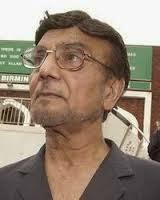
Dr. Naseem b.1924

A censorship row has broken out over the BBC Three programme Free Speech, after the Birmingham Central Mosque – where the show was being filmed – requested that the topic of being gay and Muslim was not discussed.  Dr Mohammed Naseem, chairman of Birmingham Central Mosque, and Terry Sanderson, president of the National Secular Society, debate the issue.

On the Today programme the Imam, Dr. Mohammed Naseem, sounded breathy and frail. He has been vilified for his stance over his ‘request‘ that they refrain from discussing the question “When will it be okay to be gay and Muslim?”, and he seemed vulnerable and exposed; like a rabbit in the headlights.

Later he wrote about it in the Huffington Post. On the internet people greeted his further remarks with derision. They accused him of digging himself into a deeper hole with these remarks :
“ It was apparent that Lahore, the Muslim drag queen featured in the programme, “does not know his religion and has not got much links with it,” [...]
“He would have, otherwise, known that it is prohibited in Islam. If he wants to persue [sic] his inclination then he is free to leave Islam and follow any ideology that suits him,” Naseem continued.

I think it is unfair to condemn Dr. Naseem for saying what he genuinely believes, especially as he seems to be making some conciliatory noises. Is Lahore, (and are all gays) really free to leave Islam?  Without having their heads chopped off, I mean? If so, that at least is a step in the right direction, since I understand in accordance with the strictest interpretation of Islam apostasy is punishable by death.
The poor man is nearly 90 years old. He has been brought up to believe that homosexuality is unIslamic and wrong. I’m not sure that, in the strictest interpretation of Islam, hosting a debate called Free Speech, “live on National Television”  in a marquee outside a mosque is all that Islamic either, so here the mosque is perhaps trying to reach out to the wider world. Yet in this age of liberalism-gawn-mad he is press-ganged into trying to get his head round the concept that homosexuality has become the new heterosexuality. 
Is it any wonder that he has trouble with this state of affairs? I confess I am not totally persuaded myself. Unless we deny all physiological gender difference and refuse to discriminate/distinguish between male and female in every conceivable (no pun intended) way, we’re the new racists. Personally I couldn’t care less what gays get up to as long as I don’t have to be told about it every five seconds. Unfortunately it seems I do have to, which causes me to resist that which I might otherwise accept, merely because I hate being told what to think.  Yet the current consensus is that I must like it or lump it, and I daresay even Dr. Naseem feels almost the same. Sort of resigned to it. The culprit is not Dr. Naseem. He’s a product of his times. Vilification of Dr. Naseem and his Islam-based homophobia is a distraction.
 The core issue is the BBC. It’s the BBC that was responsible for the whole fiasco. The stunt of using a mosque as a venue for a debate called Free Speech. A bad idea from the start. Another one of the BBC’s clumsy attempts to normalise Islam, which backfired in a big way.
Don’t blame the elderly reactionary Imam who was bound to think what he thinks. He wasn’t even obliged to offer a concession in the form of a free pass for those choosing to leave Islam, but he did so, almost generously.

The BBC tries to pretend that Islam is compatible with everything it is incompatible with, but in this case the BBC’s homophilia came head to head with the BBC’s Islamophilia. This time the latter triumphed, albeit temporarily. At least it has exposed the BBC’s delusional hypothesis that the two entities can live happily side by side for the sham it is. 

Saturday, 11 January 2014

"You’ve made that point well"


Matthew Holehouse, political correspondent of the Daily Telegraph, follows his article about BBC's Radio Merseyside 'biased' interview with David Cameron with another piece about biased BBC interviewing - this time Evan Davis on yesterday's Today programme. 

The article cites complaints of bias against Evan from three Conservative MPs and thirteen listeners. 

The main charge is that Evan Davis gave the pro-EU Lord Mandelson an easy ride whilst giving the Eurosceptic Lord Dobbs a rough ride. 

Matthew's article (and the complaints from the MPs) concentrates on the alleged pro-EU bias in the line of questioning Evan pursued with each guest. Evan's line of questioning with Lord Dobbs was to get him to admit that his referendum bill was a "waste of time" and a "charade". Evan's line of questioning with Lord Mandelson wasn't to challenge him about his reluctance to let the public have its say but concentrated on getting him to agree that pro-EU politicians aren't doing a good enough job in selling the benefits of the EU to the public. (Matthew helpfully lists all the questions put. I approve of that!)

The apparent bias is those contrasting lines of questioning is made worse by the fact that Evan Davis twice made complimentary comments to Lord Mandelson - "You raise an interesting issue" and "You’ve made that point well". No such complimentary comments were given to Lord Dobbs.

What the article fails, perhaps, to flesh out the contrast in tone and character between the two interviews. That seems to me why this seemed so "brazen" in its bias.

Lord Dobbs was subjected to an onslaught of interruptions and constantly challenged. He was given an adversarial interview. He was interrupted six times, never helpfully, and twice had to ask to be allowed to finish his point. Lord Mandelson, in contrast, was interrupted only one - and that was to be told "You’ve made that point well". His answers were allowed to go on and on.

That 6:1 ratio of interruptions appears even worse if you relate it to the length of the interviews. The interview with Lord Dobbs lasted 3 minutes and 22 seconds, while the interview with Lord Mandelson lasted 8 minutes and 1 second. [In terms of my old interruption coefficients that makes it 1.9 for Lord Dobbs and 0.1 for Lord Mandelson - 19 times tougher interviewing!!]  

Also Evan did that thing he sometimes does of continuing to contradict a guest as he's bringing the interview to a close, giving himself (and his contradiction) the last word - here rounding off Lord Dobb's contribution with the words “Unless it is repealed, which of course it might be,” the point he (Evan Davis) had been repeating throughout, and which he'd first introduced as a criticism made by Lord Dobbs's critics.

Finally, and just to amplify an earlier point, here's a schematic breakdown of both interviews.

The interview with Lord Dobbs ran as follows:

10:33 [after 8 o'clock!] Evan Davis
10.38 Lord Dobbs (1s answer)
10.39 Evan Davis 
10.42 Lord Dobbs (33s answer)
11.15 Evan Davis (interrupting)
11.18 Lord Dobbs (4s answer)
11.22 Evan Davis (interrupting)
11.25 Lord Dobbs (3s answer)
11.28 Evan Davis 
11.34 Lord Dobbs (11s answer)
11.45 Evan Davis (interrupting)
11.51 Lord Dobbs (2s answer)
11.53 Evan Davis (interrupting)
11.56 Lord Dobbs (39s answer)
12.35 Evan Davis 
13.07 Lord Dobbs (16s answer)
13.23 Evan Davis (interrupting) 
13.28 Lord Dobbs (20s answer)
13.48 Evan Davis (interrupting) 
13.55 interview ends
{Total amount of time Lord Dobbs got to speak without being talked over: Two minutes and nine seconds.}

The interview with Lord Mandelson ran as follows:

13.55 Evan Davis
14.01 Lord Mandelson (6s answer)
14.07 Evan Davis
14.13 Lord Mandelson (26s answer)
14.39 Evan Davis
14.58 Lord Mandelson (1m 53s answer)
16.51 Evan Davis
17.13 Lord Mandelson (27s answer)
17.40 Evan Davis
18.00 Clip of EU Commission VP Viviane Reding urging on pro-EU supporters and denouncing anti-EU "myths"
18:32 Evan Davis
18.47 Lord Mandelson (1m 43s answer)
20.30 Evan Davis (interrupting) 
20.32 Lord Mandelson (10s answer)
20.42 Evan Davis
21.03 Lord Mandelson (52s answer)
21.55 Evan Davis
21.56 end of interview
{Total amount of time Lord Mandelson got to speak without being talked over: Five minutes and 37 seconds.}

So, this was a deeply unbalanced interview on so many fronts. There can be no denying that - especially in terms of Evan Davis's treatment of his respective guests. It could hardly have been less fair in that respect. You can deny that pro-EU bias was motivating Evan Davis (as we can't read other's minds) but it was still biased interviewing, unquestionably not fair or balanced.

Needless to say, the BBC - flying in the face of honesty - flatly denies that. They can deny it. The Telegraph reports:
A BBC spokesman said: “Inevitably there will be disagreements about the reporting of any given political story, however we are satisfied that the views of both Lord Dobbs and Lord Mandelson were challenged and that our coverage of today’s story about the EU referendum bill was fair and balanced.”
Yeah right!

Sunday, 6 October 2013

Party Conference Watch 2013: The Conservative Party


Many of you may have been eagerly awaiting my latest dispatch from the party conferences. As usual it's running late. 

This week it's the Tories. 

As with the Liberal Democrat and Labour conferences, the Saturday edition of the programme didn't feature a Today presenter at the Conservative conference and contented itself with discussing a single proposal  here a plan to give tax breaks to married couples. 

A short (three minute) discussion with the BBC's Ross Hawkins kicked off the programme and a discussion on the same subject occupied the 8.10 spot. That discussion was held between Paul Johnson of the Institute for Fiscal Studies and Samantha Callan from the Centre for Social Justice think tank. 

As with the Liberal Democrat and Labour conferences, the coverage didn't begin in earnest until Monday. 

Monday's coverage began (at 6.32) with the customary (two minute) chat with the BBC's chief political correspondent Gary O'Donoghue. Sarah Montague talked with him about a proposal to toughen up Welfare to Work by compelling the long-term unemployed to do community work, spend 10 hours a week at the Job Centre (etc) or face losing benefits. "They want to send out the message that this is a very real threat". GO'D says that polling suggests the measure will be popular in the country, though the danger for the government is that it will shine a light on the question as to why their existing work programme isn't working sufficiently well that you would need another work programme after it.

At 6.52 Sarah discussed Nigel Farage's suggestion that local UKIP parties could do a deal with individual Conservative MPs, if they wanted, with Tim Montgomery of ConservativeHome and Peter Bone MP. Mr Bone is keen on the idea, commenting "Tim said, 'Well, they [Nigel Farage and David Cameron] don't like each other', but Churchill and Stalin managed to work together, so I don't know why it should be so difficult for Nigel and David to work together."

At 7.09 it was back to the 'work for welfare' proposal, though the interview was with a non-Conservative critic, Jonathan Portes of the NIESR (over three minutes). He said such proposals cost a lot of money but don't bring about any great results.

Then at 7.13 Sarah talked to Lord Ashcroft about the question "Is there any way the Conservatives could win outright at the next general election?" (for over three minutes) Lord Ashcroft says the next election is Labour's to lose.


The big 8.10 interview was with George Osborne. It lasted just over 12 minutes (with 15 interruptions). The topics discussed (and the percentage of the interview spent on them) were:
The work programme. Is it not working? Isn't it harming those with real problems? (29%)
George Osborne & Iain Duncan Smith. Did he say IDS is "thick"? (8.1%)
The cost of living (9.4%)
Are the Conservative Party "a party for the rich"? (9.6%)
The minimum wage & the increase in personal allowance (7.3%)
Green policies, the IPCC and tax incentives for energy saving (20.1%)
Deals with UKIP? (16.5%)
Nick Robinson then did his usual post-match review, talking about UKIP, then about the economy. saying that none of the parties has said which taxes they'll raise or what they'll cut to make good their promises to cut the deficit by 2018.

Tuesday's coverage dispensed with Gary O'Donoghue, unusually. The first feature was at 6.47 and consisted of a debate between Conservative MP Claire Perry and Justine Roberts of Mumsnet on the Conservative Party's problems with women. Justine described the results of her Mumsnet poll, showing bad news for the Conservatives since 2010 and said this seems to be because (a) of the cuts hitting women hardest and (b) because women see David Cameron's government as an old boys's network. Claire Perry began by respond saying "you could pick apart the poll" and seemed to be about the pick out some positives for the Tories, but we never got to hear them because Sarah Montague interrupted (after just 6 seconds) to say "Let's get to the more interesting thing" and talked about bad behaviour in the House of Commons [which seems to me less interesting]. Justine then went back to the stats, and the "Eton toff boy stuff" (without being stopped from doing so). [Eight interruptions made against Claire Perry].


The next feature came at 7.33, where Sarah Montague reported from Bolton West, a constituency that Labour only just held onto in the last general election. She talked to Chris Green, the Conservative prospective candidate there. She then talked to various locals. One said she'd voted Lib Dem last time but would probably voted Labour next time. A second denounced the cuts, and will vote Labour. A third didn't vote last time, but said she'd vote for Ed Miliband next time, but then changed her mind, as did her friend who said she'd vote Conservative. [None of them really sounded as if they thought much about politics]. A man denounced immigration, and said he was tempted to vote UKIP (having been "a Labour lad all his life"] and said he knows lots of people who want to be on the dole all their life, and loves the idea of cracking down on them - something that might make him vote Conservative. "I was struck by how easy it was to change those people's minds," said Sarah. She was quite right. I did seem very easy indeed. [Just imagine the power a national broadcaster with an overwhelming share of the news market in the UK, such as the BBC, could have then!]

7.50 saw a short discussion with Nick Robinson about Boris Johnson and his ambitions.

At 8.10 it was the big interview with David Cameron, conducted by Sarah Montague. It was a fairly challenging interview, lasting seventeen and a half minutes (with 21 interruptions), though the PM managed to get all his points across. The topics raised by Sarah M ran as follows (with, as ever, the percentage of the interview devoted to each subject added in parentheses): 
The U.S. shutdown (5.5%)
The economy, austerity & the cuts (14.6%)
"Where's the money coming from" for all the proposals made? (7.1%)
Help to Buy (23%)
Cost of Living (7.4%)
Syria and DC's leadership - his failure to get his own party to support him (20.5%)
DC's relationship with his backbenchers & the coalition (7.8%)
Boris Johnson (5.4%)
The Daily Mail (8.7%)

The last five or so minutes of the programme ended with a discussion about whether the Conservatives messages were "resonating as much as Labour's cost of living themes". The discussion was between Matthew d'Ancona of the Sunday Telegraph and Isabel Oakeshott of the Sunday Times. They also talked about Boris, the coalition's difficulties, and the boundary review and what it means for the next election. Both think David Cameron is in a better position than last year. 

Justin Webb had spent three days covering the Labour conference. Sarah Montague, however, spent just two days at the Conservative conference and was back in the studio for the final day of the conference, even though David Cameron's final speech was still to come. 

So James Naughtie did the 6.36 discussion with Gary O'Donoghue [two minutes]. GO'D anticipated a staunch defence of the market economy in DC's speech, and an attempt to build "a British version of the American dream" and create "a more egalitarian view" of the Conservative Party. "The difficulty of course is that if you look at the cabinet today it doesn't look like a land of opportunity in terms of the recruitment for the top jobs in politics." 

There was very little coverage later. The segment at 8.22 was a general discussion about party conferences and "this year's crop of social gaffes and media mishaps" with Sandi Toksvig and Matthew Parris of the Times, so (with the Daily Mail coverage kicking off in earnest) only the closing six minutes were devoted to the Conservative conference itself, taking the form of a discussion between Isabel Hardman of the Spectator and Nick Wood, a former Conservative press officer. They discussed the Conservatives' difficulties in winning an election, UKIP, the coalition and "the Daily Mail episode" [raised by James Naughtie].

Conclusions

As with its Labour Party conference coverage, you couldn't reasonably say that the coverage of the Conservative Party conference was biased against the party. Neither party got particularly favourable coverage [unlike the Lib Dems]. There were tough interviews and critical voices from beyond the party, but both George Osborne and David Cameron got a fair hearing. [Only Nigel Farage has had an unfair hearing over the conference season as a whole.]

The striking difference between the programme's coverage of the Labour and Conservative conferences, however, was the sheer amount of Labour Party conference coverage.

Justin Webb reported from the Labour conference over three days, Sarah Montague from the Conservative conference for just two. Moreover, if you compare the number of distinct segments on each on the Monday, Tuesday and Wednesday of both the Labour and Tory conferences, you find that there were 17 segments on the Labour Party conference compared to 12 segments for the Conservative Party conference. My tall of the total time devoted to each conference runs at 1hr 15m for the Conservative Party conference and 1hr 35m for the Labour Party - i.e. about twenty minutes more coverage [in total] for Labour.

Make of that what you will. [I, however, make of it that the programme had moved onto the furore over the Daily Mail by Wednesday.]

******

There is still Plaid Cymru and the SNP to go. I will try to catch those too. Whenever they happen.