Sunday, 2 March 2014

We're only making trains for Nigel


Next up on Broadcasting House, Paddy O'Connell mounted the 'Nigel Farage Express' following the UKIP leader's comments that, travelling on a train from London to Kent he found himself feeling awkward when he could hear no English being spoken.

We heard from four people on that train, doubtless carefully selected for broadcast and just as carefully ordered in Paddy's report.

The first man, whose name wasn't given [out of fear of expressing such views on BBC radio?], backed up Nigel Farage's point that, particularly at certain times of day, you do hear only East European accents and that this creates social divides with each nationality sticking with their compatriots. He agreed with Paddy that his view was that people should speak English as a sign of respect to the community you're wanting to move into. The man also said there's a very strong, vociferous liberal group in this country that tends to scream 'racism! bigotry!jingoism!', when that's not the case.

Then came a couple, Sarah and Mark - one born in Hong Kong, one born in London - who Paddy had heard speaking a Chinese language. Mark speaks English and Cantonese, Sarah speaks English, Cantonese, a bit of Mandarin and a Chinese dialect. Both are fluent, to-the-manor-born English speakers. Sarah loves the lifestyle in Britain and Mark (perhaps joking) likes the weather - that it's so cool! Sarah and Mark are the kind of immigrants no one objects to - charming, funny, very English-sounding and the kind who go to gourmet food markets. If you were crafting a pro-immigration propaganda piece to counter Nigel Farage's comments you could hardly have chosen a better couple.

Finally, giving the final point of view, came Amanda from Kent who thinks thinks it's "very positive" that London is a multicultural city. "I'm very much in favour of a multicultural society", she said. "I think it has a lot to offer". She went on to say that British people are pretty lazy about other languages and had a go at those Brits who go to settle abroad and don't bother to learn the language. [I will admit that my right-wing, Guardianista-bashing instincts immediately kicked in at this point, as it was plain from her laughter that SHE hadn't bothered to learn to speak any other languages either, but still felt absolutely no shame in criticising her fellow countrypersonages for being lazy about learning other languages in contrast to immigrants into Britain.]

Now, Paddy's defence here will be that he provided BBC listeners with a balanced pro-Nige and and anti-Nige 'vox pop' (separated by immigrant voices) but (a) by ordering the sequence of vox pops in this way so as to immediate counter the first, pro-Nige vox pop with a pair of 'good' immigrants and (b) by then giving the anti-Nige vox pop the last word, and (c) by not humanising the first speaker with either a name or any personal background so as to endear him to the listener, and (d) by chipping in and undermining the pro-Nige man's colloquialism about 'doing in Rome what the Romans do' with a crack that 'we're not in Rome', and (e) by selecting for broadcast the 'best case' immigrants Paddy could possibly find (in contrast to all the poor English speaking, non-British-weather-loving, non-gourmet-food-loving immigrants), then I'd say that Paddy's defence looks a bit ropey.

Still, the appearance of balance counts, and Paddy's report was followed by an interview with (for the BBC) 'the only right-winger in the village' Peter Hitchens and Bavarian-born Labour MP Gisela Stuart.

Their discussion began with these two questions, the first of which was distinctly loaded:
[To PH]: "If there are people here who, like we when we go abroad, don't speak the local language, Peter Hitchens, does it matter?"
[To GS]: "And, Gisela Stuart, is it a problem for you that growing numbers of people may be ['may be'? Surely 'are'?] speaking their own language rather than ours?" 

Now, and here again is where the BBC bias comes in, I noted that Paddy remained completely silent during Gisela's praise for Birmingham's multiculturalism but as soon as she started saying that being British means complying with the rule of law, respecting the institutions, in came Paddy's trademark, knee-jerk, uneasy 'OK' - as if that wasn't what he was wanting from Gisela Stuart. It shows the way he thinks, I think.

And the same sense of panic [a distinctly un-all right-sounding 'All right!'] entered his voice as Peter Hitchens made sensible point after sensible point.

Psychologists ('cod' or otherwise') on Channel 4's Big Brother used to call such things 'tells', in that they told us what the unconscious signaller is really thinking - and Paddy was giving off more 'tells' here than a Rossini overture.

Paddy then put a question that someone with his mindset might well think 'impartial' but which many other people (on a very different planet to Paddy) would find highly loaded in the way it places 'us' - native Brits, the British government - in the frame, and the way it seems to actively crave for 'state-sponsored integration':
All right, and do you both agree that we have a problem? We don't really know how to integrate. We leave it up to people, Gisela Stuart. We don't have any kind of state-sponsored integration?
Gisela didn't immediately give the answer Paddy wanted, so he interrupted her within two seconds. By this stage we'd clearly moved, 'tells'-wise, beyond a Rossini overture into a full-length Rossini opera. (Gisela's reply was characteristically reasonable: "As long as people live with each other, I'm fine. Once they end up living next to each other, I'm not fine."]

Gisela was given "the last word" after a particularly fine contribution from Peter Hitchens. She said he was "wrong", accusing him of "painting too bleak a picture" and adding that she's "sentimentally attached" to the BBC World Service (so, sadly, no chance of winning her round then to the idea of BBC bias then!)

Interesting guests, biased reporting/interviewing.

Later (after the midway news bulletin) Paddy read out an e-mail from Prague. Only e-mail mind. How many others did BH receive, and were they largely pro- or anti-immigration? We'll never know. Still back to Cathy in Prague (a keen Archers fan by the way), and Paddy's choice:
Here, Mr Farage's Czech version would complain about the amount of English to be heard on the Prague metro and trams. What goes around comes around.
Yeah, right.

Go West, Young Paddy


I thought Paddy O'Connell's first guest on Broadcasting House today, Lord West, spoke a good deal of sense about the growing crisis in Ukraine, saying that some people - and William Hague and Barack Obama were the two people he called out by name - are making "silly" statements about it, and that Obama's latest intervention is precisely the wrong kind of intervention, inflaming the situation rather than calming it down. 

My concerns lie (as ever) with Paddy (as this is a blog about BBC bias).

Paddy introduced him first as "the former head of the Navy, Lord West" and then with  the words, "Lord West fought the Falklands War. His ship was sunk beneath him" before going on later to ask him this question:
All of us are nervous perhaps when he hear a military person asking the politicians to slow down. What would be a commanding way for the politicians to slow this down?
Well, yes, but - especially given his criticism of William Hague - it might have been prudent on Paddy's part to point out that Lord West is a politician. He was a Home Office minister under Gordon Brown and sits on the Labour benches of the House of Lords. So Lord West is both a military person and a politician. Surely Paddy couldn't have been unaware of that? Why didn't he say it?

Anyhow, it was only last Sunday that I was moaning about Paddy doing his "Bliss is it this dawn to be alive, But to be a middle-aged BBC presenter is very heaven!" thing about the Ukrainian 'revolution'. 

And here he was again today, waxing wildly simplistic again - and betraying at least two biases in one sentence: 
Diplomacy also must recognise that democracy matters to us. It may be strategically important to the Russians to bang around Crimea but it's extremely important to the rest of us that democratic rights are upheld, and that's why the president was toppled.
As Lord West politely replied,
Well, absolutely, but of course the president actually won a democratic election, so these things get very muddied. This is very muddy water, and we need to be quite careful shouting 'Democracy!' 
Indeed. Ousted president Viktor Yanukovych won the runoff election in 2010 with 48.95% of the vote compared with 45.47% for Yulia Tymoshenko. Yanukovych may have become increasingly authoritarian, corrupt and - in the end - brutal, but no one has voted the new Ukrainian government into power yet. They seized power without waiting for elections due next year.

More Ukraine later.

Muslims, more Muslims, apps, gay rights, confession, pancakes and religious education


Right, that's the bacon and eggs taken care of. Now down to Sunday, and the pancakes.

This week's Sunday added two 'breaking news' features to its self-declared running order.

The first dealt with the brutal mass stabbing at a railway station in south western China which has left at least 33 dead and over 130 injured. With depressing inevitability, it's looks as if Muslim terrorists are the perpetrators of this savagery and the Chinese are beginning to describe the attack as their 9/11. 

Shelagh Fogarty talked to the BBC's Beijing correspondent Celia Hatton about it and, being the BBC, they concentrated on outlining the grievances of the the Uighur Muslims of north western China's Xinjiang province  - the way they resent having become an ethnic minority in an area they once dominated and the way (they claim) the Chinese government is suppressing their religion (banning them from wearing burqas, and the like). The adjective Celia used to describe the atrocity in Kunming was "well-coordinated". 

Then it was onto Ukraine, specifically the ethnic make-up of Crimea. 

Shelagh interviewed Roland Smith, former UK ambassador to Ukraine, and they began (being Sunday) by discussing the plight of the Muslim Tatar population there. Tatars, they said, were the dominant group in Crimea from the 13th Century onwards until Catherine the Great annexed the Crimean Khanate in 1783 and Russification began. At the end of the Second World War Stalin deported the Tatars en masse as many of them had actively collaborated with the Nazis during the war. The Tatars began returning to Crimea under Gorbachev's perestroika, and then came back in much larger numbers once the USSR collapsed. 


Looking into this a little further (as is my wont), there are now around 300,000 Tatars in Crimea, making up 3/5 of all the Muslims in Ukraine. (There are 500,000 Muslims in Ukraine out of a population of just under 46 million.) 

Mr Smith said that the last thing they want is to be ruled by Moscow again and that they want to be in an independent Ukraine. He said that, though they are Sunni Muslims, radicalisation hasn't happened. Yet. 

Mr Smith is very clearly on the Ukrainian nationalists' side rather than the Russians (and pro-Russian Ukrainians). He says Moscow is being "ridiculous" and thinks that ethnic Russians have been well-served by Ukraine, especially given that Crimea has been autonomous since Ukrainian independence. He says that Russians there haven't really felt oppressed. He predicts that Ukrainians speakers in Crimea, however, will soon "see the heavy fist of Russia".

After that unplanned foray into foreign affairs, Sunday returned to its scheduled itinerary, starting with apps:  
Too busy for church? Not to worry because the Church of England have devised an app which allows you to pray on the move. Charles Carroll roadtests prayer app on the London Underground. But its not the only digital religious tool on the market. Wired magazine's Andy Robertson joins Shelagh to discuss the range of religious apps and how they work.
Apps, as the technologically-minded among you already know, are muscles in the abdomen which allow you to use computers, phones, treadmills, etc to perform particular functions, like playing video games. Long periods on the computer playing such games can lead you into obtaining what's known as a 'six pack' - or, if lager isn't your tipple, you can always reach for a bottle of wine instead. 


The Church of England's new app is intended to help commuters observe morning and evening prayers with daily texts from the 1662 Book of Common Prayer. So, if you're alone on the London underground, you can you pop out your mobile phone and, lo, a prayer will wing its way to you at the click of a button. 

Shelagh was keen to find out if other faiths have taken them up. 

Then it was onto that perennial Sunday favourite - gay rights in Africa:
Uganda has passed an anti-gay bill which sentences people to life imprisonment for gay sex. Rahul Rao is an expert on the development of anti-gay feeling in Uganda and explains what role religion has played in the Bill. Scott Little is an American evangelical anti-gay activist who has advised the Ugandan government. He explains the rationale for his beliefs.
We heard first from Scott Little...er Scott Lively, in fact...a man of 'the Christian Right' who has indeed advised the Uganda government and who believes that aggressive Western gay rights activists have imposed their agenda on countries like Uganda and are undermining the traditional family in such countries. Even though he says that most of the new laws in Uganda are "too harsh", he supports their general thrust (so to speak). Shelagh heard him out without interruption, which is most unusual for a BBC interviewer when faced with interviewees who holds such opinions - though her tone of voice betrayed the fact that she was interviewing Mr Lively whilst metaphorically wearing surgical gloves and wielding a pair of lab tongs. 


Her tone warmed perceptibly though when interviewing Dr Rao, who she interviewed as an expert. He argues, in complete contrast to Mr Lively, that it's conservative evangelical Christians like Scott Lively who are in fact imposing their Western agenda on places like Uganda, saying that there was never an issue about homosexuality in Uganda until 1997 when, in the run up to the Lambeth conference, conservatives, feeling they were losing the culture wars at home, reached out to Africa and began foisting their own concerns on countries like Uganda, raising a phenomenon called "anticipatory homophobia".

What's next? Well, Sunday's favourite Catholic bishop - the go-ahead Bishop of Arundel and Brighton - was back after a surprisingly long absence:
Bishop Kieran Conry is encouraging Catholics to return to the confessional in the lead up to Lent. But what role does confession play for Catholics in the 21st century? He joins Shelagh Fogerty [sic!] to explain.
Pope Francis has been encouraging Catholics to return to the confessional, and Bishop Kieran is echoing that call. He says the most confessions are face to face now, and the old cinema image of confession (the grill, the black box, the curtains) isn't an accurate one any more. 

Shelagh based many of her questions on ultra-liberal Catholic writer John Cornwell's criticisms of the Church. (His book denouncing traditional Catholic confessions also formed the starting point for a recent Start the Week.) Bishop Kieran thinks that John Cornwell, who he admires, is exaggerating the downsides of confession, though he concedes his point that children under 12 shouldn't be encouraged to go to confession. For him, their is a joy in unburdening yourself and being told that you are forgiven.


Plus he also likes Woman's Hour. (I suspected he would).

Imagine a Homer drool.....Mmm, pancakes!
Next week is Shrove Tuesday - but what is the spiritual element of making pancakes? Sister Cathy Jones joins us in the studio to demonstrate.
Sr. Cathy and Shelagh Fogarty gave us a brief reminder of why we eat...mmm...pancakes and why Lent is still important as a time for reflection and abstinence. 

Shelagh then ate one of the pancakes Sr. Cathy had prepared, speaking with her mouth full of food live on Radio 4!

The word 'Shrove' is the past tense of 'shrive', meaning either to hear (as a priest) the confession of, assign penance to, and absolve someone or to present oneself to a priest for confession, penance, and absolution. It comes from the Old English word scrÄ«fan, meaning ‘impose as a penance’, and is of Germanic origin.

Of course, you're all doubtless well aware of why Christians fast during Lent because you were all taught RE at school. Correct?

Well, that was the subject of Sunday's closing segment:
In October last year OFSTED released a damning report on the state of Religious Education. This week the government have been accused of discriminating against the subject by failing to provide training bursaries for new teachers in the subject. Bob Walker investigates if RE is under threat.
Yes, government cuts and Michael Gove's Department of Education are under fire and here was Sunday reporting the complaints of four charities about those bursary cuts to trainee RE teachers.


Bob Walker's report began with the story of a trainee teacher who is struggling without a bursary, adding an extra £13,000-worth of debts on top of her existing £20,000 student debts. She's struggling to afford food. The Head of RE at an academy in Nottinghamshire says RE is crucial and a non-specialist RE teacher at her school agreed with her. A spokesman for a pro-RE charity then attacked the Department of Education, saying there's no good reason for their actions. Bob put various counterpoints to him and read out a short quote from the government insisting that there's no problem with RE, but the man from the charity came straight back saying that the government's numbers are "misleading". Last years OFSTED reported on the state of RE in schools, and was highly critical of it. A pupil said RE's just as important as any other subject and that specialist teachers are needed, echoing her teacher. The pupils think it can improve community relations too, and went to parliament recently to tell such things to a parliamentary committee. So everyone in Bob Walker's report was in on this campaign. 

Ah well, there was time for an interview with someone who would put the opposing point of view:
Stephen Lloyd MP is the Chair of the All Party Parliamentary Group on Religious Education. He joins Shelagh to discuss the findings of our report and what the future of Religious Education in schools.
Mr Lloyd is a Lib Dem and far from putting the opposing point of view, he actually agreed with the campaigners, saying that RE is more important now than ever now because there's so much "misinformation" about other religions out there, especially  on the internet and in "certain newspapers" (hmm, wonder which religion he was talking about there?) and joining in their criticism of Michael Gove and the Department of Education, says it's a mistake & that Michael Gove said should change his mind. "This matters very deeply to you, doesn't it?", Shelagh asked him. Yes, it does, he replied.


All sounds very biased, doesn't it?

Ah but, the government were invited onto Sunday to respond to the criticisms of the campaigners. Shelagh said they'd declined to put anyone up though, so she read out a short statement from them and then invited Mr Lloyd to respond to it (which he did by disagreeing with it).

My response there is to wonder why, knowing for a few days that they were going to cover this story, Sunday didn't make more effort to find someone - anyone - to represent the other side of the argument (the side that thinks that RE may be important but thinks in this time of austerity that there are more urgent priorities for government funding, such as Business Studies perhaps). Why didn't they have a 'contingency plan' guest at hand to make that case just in case the government was unwilling to put up a spokesman? 

Well, that's this week's Sunday disposed of. Sunday, a BBC programme named after the day of the Christian Sabbath.
Sabbath (n.)
Old English sabat "Saturday as a day of rest," as observed by the Jews, from Latin sabbatum, from Greek sabbaton, from Hebrew shabbath, properly "day of rest," from shabath "he rested." Spelling with -th attested from late 14c., not widespread until 16c. 
The Babylonians regarded seventh days as unlucky, and avoided certain activities then; the Jewish observance might have begun as a similar custom. Among European Christians, from the seventh day of the week it began to be applied early 15c. to the first day (Sunday), "though no definite law, either divine or ecclesiastical, directed the change", but elaborate justifications have been made. The change was driven by Christians' celebration of the Lord's resurrection on the first day of the week, a change completed during the Reformation. 
The original meaning is preserved in Spanish Sabado, Italian Sabbato, and other languages' names for "Saturday." Hungarian szombat, Rumanian simbata, French samedi, German Samstag "Saturday" are from Vulgar Latin sambatum, from Greek sambaton, a vulgar nasalized variant of sabbaton. Sabbath-breaking attested from 1650s.

Saturday, 1 March 2014

What did the BBC do for me this week?


So, following through on the spirit of the previous post, what did the BBC do for me this past week?

Well, it gave me an episode of Nature on Radio 4, Bewitched by Dragonflies, which made me want to sit by the semi-stagnant waters at the end of the falling stair of locks at the end of the sadly-blocked-off segment of Lancaster Canal (over the road from the Longlands Hotel at  Tewitfield, near Carnforth, should you fancy a visit) in order to re-watch the dragonflies I saw there - so large and so in-yer-face yet so beautiful. (I also saw an owl there, for good measure, in broad daylight).


The programme, a beautifully-constructed parade of voices, featured dragonfly enthusiasts and scientists, and was so full of fascinating facts about dragonflies that I'm quite sure I failed to take them all in - though, pausing, I can certainly remember certain things, such as the contrast between hawkers (which behave like hawks and follow and swoop on prey) and darters (which sit on things like reeds and then leap upwards at passing prey) for example. 

I didn't know I wanted to know so much about dragonflies.

The enthusiast, Ruary Mackenzie Dodds, was so vivid and poetic in his descriptions that the British dragonfly population should seriously consider making him their ambassador to the world. 

He was wonderful, and so were the two scientists - biologist Robin Wootton, who made a very good case that the dragonfly's motion was comparable to that of a helicopter's, only much better, and PhD student Milly Sharkey who discovered that larval dragonflies are able to see (and exploit to their advantage) polarized light (useful in murky water). 

Then there was Tuesday's The Life Scientific, in which Jim Al-Khalili interviewed forensic anthropologist Sue Black. 

She's a deeply likeable woman, whose line of work takes her to places most of us just couldn't face going to, in so many ways. 

She loves anatomy, and described the contrast between the many bones of a child and the far fewer bones of an adult, and the challenge of tracking those bones as they develop in a growing child. She also described her early experiences of working in (and learning from) a butcher's shop.


She went on to describe her experiences of investigation and identifying corpses in Kosovo, and I don't think I've ever heard anything so powerful as this on the radio before. 

She was, as seems to be her nature, so matter-of-fact yet so humane in her description of her work there. As well as her main role, she also acted as 'mum' to the others there, including to the British soldiers, some of whom found themselves overwhelmed by what they were witnessing - such as the soldier who imagined his own daughter's face on the body of the corpse of a two-year old Kosovan girl (shot in the fields by Serbs) and broke down in response. He was then hidden by colleagues behind a row of boots before Sue Black cottoned on to what they were doing and went to the soldier and allowed him to cry on her shoulder, thus helping him to see that it wasn't his daughter and that he shouldn't feel guilty about the girl lying in front of him. That's the kind of story you don't forget in a while.

Also wonderful - and not dissimilar in the scientific field of its subject - was the episode of Desert Island Discs with Professor Hugh Montgomery, an intensive care specialist who, besides his intensive care work, also managed to find time to discover the 'ACE fitness gene', climb Everest, run extreme marathons, write children's books, break the world record for playing the piano underwater and, as a youngster, swim and investigate the wreck of the Mary Rose. Among other things.

What a man - and what an engaging man too! (He did claim that he couldn't change a plug though - not that I entirely believe him there).

His motivation?

Well, his father "used to say the worms will get you" and he was, probably as a result, conscious of the inevitability of death from childhood. Still, he didn't despair at that; instead he drew inspiration from it:
"I've learnt that life can end randomly and pointlessly at any time. I don't want to be on my death bed and think 'damn! I wish I'd learnt to paint and write songs'"

He told of how patients with terminal diseases really can survive longer by refusing to give in and told the touching story of a patient who seemed to be hanging on to life because he didn't want to let him down.

His taste in music was interesting too. He chose one of my favourite songs, Kate Bush's The Man with the Child in his Eyes. That shows taste.

Still, whether Kirsty Young should have allowed him a fish-spearing kit as his luxury item is highly debatable. Tut, tut. Rules are rules after all.

Three of the best then, and all worth bouquets. 

Positive feedback?


All that enthusiast pro-BBC feedback which Feedback is so keen to report really shouldn't come as a surprise. (Does it to you?)

It's only the fact that I tend to spend a lot of time writing about BBC bias and reading blogs where the sheer awfulness of the BBC pretty much seems to go without saying - and where the BBC's redeeming features only rarely get a mention and, even when they do, only grudgingly and heavily accompanied by caveats - that....if you're still following this long, Henry James-like sentence...it still does come as a bit of a shock to hear viewers and listeners enthusing about the BBC.

This failure on my part to keep remembering that most people don't share my intense negativity towards the BBC and that a large number of people - especially Radio 4 listeners - actually love it is something I'm going to have to try much harder to counter.

Both Sue and myself have been long aware of the 'constant negativity' trap and have tried to give praise where praise is due. (It was even in our 'mission statement' when setting up "Is"). 

But even we don't give praise where praise is due that often. 

Speaking purely for myself here, that could be because (and I know I risk sounding a bit daft here) it feels almost sinful to betray the anti-BBC-bias cause by saying nice things about the BBC. 

But it's surely perfectly reasonable to say, openly and without embarrassment, that parts of the BBC's output are truly wonderful (so wonderful that, if the license fee were abolished, plenty of people - including me -would willingly pay for it), but that there's an awful lot of dross too - and far, far, far too much bias. 

Perhaps if BBC-bias-related blogs (like ours) made their case less negatively some bridges could be built between the 17% of us who (according to that YouGov poll I keep citing) think the BBC is biased against the Right and the 83% of the population who just don't seem to agree with us (even though we know we are right and believe that either (a) almost everyone else thinks so too and that that YouGov poll is nonsense or (b) that everyone else bleedin' well ought to agree with us, and that they are merely brainwashed 'sheeple' if they are stupid enough not to do so).

Those Radio 4 listeners, for example, who love The Archers, Round Britain Quiz, Something Understood, Just a Minute, Start the Week, In Our Time, Ramblings (etc) may still share our unease about the BBC's biases over social and political matters - or may be persuaded to share our unease about such biases by compelling arguments (preferably backed by evidence) - but it seems (to me) very much less likely that they'll warm to our arguments (and evidence) if they think we are nothing but haters who dislike almost everything on the BBC, including all the programmes they feel so emotionally attached to, and that all we want to do is to take their precious radio programmes away from them and leave them with nothing but dross (which is exactly what many such people seem to fear if their beloved BBC Radio 4 is lost). 

As many of you are doubtless already sympathetic to my BBC-bias-bashing instincts, do you think the points I'm making here hold water, or not? I'd appreciate your input (though don't feel pressured to give it!)

The counter-thoughts that rush into my head are that, with the BBC's recent self-inflicted traumas, the growing antagonism between the BBC and much of the press - and the consequent growth of BBC bias awareness at widely-read online sites like those belonging to the Daily Mail and Daily Telegraph - plus the evident anger of some in the government at the BBC's partiality, the force may be with us, despite all of this pro-BBC sentiment. So just keep on bashing.

But that's, probably, to fall into several traps.

The first is the danger of believing that the BBC's recent self-inflicted wounds won't quickly be forgotten. 

The second is the danger of believing that those parts of the internet which you read so avidly are really representative of what most people think (especially if you can't bring yourself to believe that they actually aren't.) 

The third is the danger of relying on an aggrieved political party (the Conservatives), only part of whose parliamentary membership [the only ones who really count] actually seems to feel aggrieved, and which has a long record of being timid when it comes to seriously confronting the BBC, and which - whisper it if you dare - doesn't even seem that likely to win an overall majority at the next election (and, thus, be in any position to actually do anything about it).

So, if these traps are as real as I think they are, the BBC-bias-concerned blogger surely needs to think about how they project their message so that they aren't merely preaching to the converted and might instead strike a chord with those people who love the BBC, but don't love it blindly - people who may help us get what we want (whatever that is).

Hope you enjoyed the navel-gazing there!

Thought (for the day)

After the two world wars, at the time when many people were acclimatised to friends and family being slain right left and centre, the importance of our emotional and psychological ‘rights’ paled into insignificance.  Heaven help the young woman who found herself pregnant out of wedlock. It was almost as sinful to utter the word bastard as to be one. What life-long trauma for everyone involved, all for the sake of respectability.

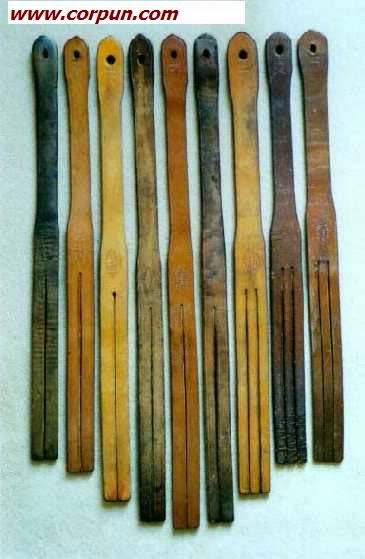
Right up until the 1950s  children were still being caned in schools and in some places beaten with something called the tawse, for misdemeanours ranging from disobedience to making a slight mistake. Scotland was renowned for this brutal practice. In the early 1900s left-handed children were routinely smacked with a ruler when they tried to pick up a pen with the wrong hand, which perhaps ‘trained’ them to use the right hand at the cost of instilling profound insecurity, guilt and low self-esteem.
 
tawse
Sir Alex Ferguson is probably not an expert on child psychology, and even if he did actually advocate the reinstatement of corporal punishment as the panacea for education ‘going forward’ during his interview with the TES, (which he didn’t) you’d hope that Emily Maitlis, Kathy Lette and Anne Atkins might have taken a more intelligent, more nuanced approach. 


At least more sophisticated than ‘spare the rod and spoil the child’ (Maitlis,) more enlightened than ‘Piaget’s and other dogs,’ (Atkins,) and less simplistic than whatever it was that Lette was trying to get across.  As it happens, of the three, I agree with her the most, which I suspect is not the position expected of me.  I’ve seen many an example of  a parent hitting a child while shouting “You. Must. Not. Hit” one whack at a time. Like dog-training, punishments that use fear and intimidation smack (excuse the pun) of Sharia. They bring about fear, sadism, anger; the opposite of helpful. 

A.S. Neill

People who are aghast at the idea of the progressive 60s and 70s should get things into perspective. it’s a pendulum thing. Stuff happens, then people realise it’s time for change; so things change, slide too far in the opposite direction. People realise what has happened and we swing back again. Some lessons are learned, many are not.

In the 60s we took a look at ourselves, with our perms and repressed attitudes. We pronounced ourselves misguided and unenlightened and looked to a brighter future. Along came rock’n’roll, long hair and Philip Larkin, and repression, prudery and buttoned-up puritanical disapproval went out the window. 

In the 70s various things, which we now view as outrageous, seemed like a good idea at the time. They seemed like progress. Some time later people realised that they weren’t much better off. In a different way, many people had suffered psychological damage, perhaps, who knows, an equal amount as their predecessors under the morally dictatorial regime that had been so carelessly dispensed with. 

Things began to change, and along came the new morality, political correctness and people calling for a general tightening up of  loose morals. But we mustn’t put the clock back without learning anything. Calling for the reinstatement of corporal and capital punishment ignores everything that should have been learned. Scientific and medical advances have been made in the last few decades, in case nobody has noticed.   
As well as being relevant to the deeply unsatisfactory item on Newsnight between Ann Atkins, Kathy Lette and Emily Maitlis, this preamble is also about the Harriet Harman paedophile scandal that was whipped up by the Daily mail and the media.
First, the title of the PIE  group “Paedophile Information Exchange” evokes sinister paedophile rings exchanging information (pornographic images) and passing them from pervert to pervert, when it seems it was in fact a lobby group, advocating the decriminalization of  child-adult sex. Not wholesome, not harmless, but not  actually criminal.  
 When it looked as if the BBC was in denial and wasn’t going to report the issue at all, Quentin Letts published a spoof in the Daily Mail: 
“Surprise, surprise, the BBC has ignored our expose of Labour's links to a child sex scandal. QUENTIN LETTS imagines its reaction if those involved were Tory” . 
The article was conceived when the BBC’s reluctance to tackle the Harriet Harman exposé was becoming conspicuous. Inevitably, something had to give, and.... out it burst with a vengeance.  Quentin’s piece was a bit long - he got the point across well enough in the first few paragraphs, but my prize for perspicacity goes to the last two:
“10.30: Time for BBC2’s Newsnight — and editor Ian Katz, formerly of the Guardian, has excelled himself. Jeremy Paxman is dressed as Whack-O! actor Jimmy Edwards with a cane. Kirsty Wark is in a dominatrix costume. Reporter Emily Maitlis visits a brothel in Chelsea to interview vice girls, who tell her about clients who are ‘Tory types wanting them to wear school uniforms’. 

Katz later wins a prize for his ‘no-holds barred’ reporting. No holds barred? If only that were true of the BBC and Britain’s Left-wing establishment when it came to the scandal that dare not speak its name: the true story of Harriet Harman and the Paedophile Information Exchange.”
The other night Newsnight even had someone dressed up as a magician to demonstrate the malleable properties of statistics. Or something like that. I mean, do they think we are all  infants?

I think David Aaronovich in the Times (£) “Sex, hugs and rock ‘n’ roll: how the 70s got it wrong”  took the right approach to the PIE affair, and so did Ed West  His final paragraph is spot on:
Nowadays no one would defend the rights of paedophiles even to lawfully campaign, and we’ve become much less permissive about this one area of sexuality, in some ways hysterical.

But the mindset still exists, and expresses itself in the way that Islamism is treated, with certain sections of the Left prepared to defend and pander to people with indefensible views and aims, and in the process harming the real victims – Muslim women, apostates unable to openly proclaim their atheism or Christianity in Britain, the moderates and modernisers.
The ‘allied groups’ are remarkably different, but the moral leaps and twists are pretty much the same. Maybe in 30 years’ time people will again be asking ‘how could they have supported such people?’


The BBC lags behind the thinking person. It’s slow to turn, like a gigantic tanker. Cumbersome and stagnant like a beached whale. If it’s going to turn around, let it do so thoughtfully and intelligently, and please don’t let it dumb down any more. 

Another BBC-bias-bashing blog!


I almost feel as if I'm spamming my own blog today, but here's another post...which, to prevent burying Sue beneath twenty foot of snow, I'll place underneath her latest post (through the magic of Google Blogger).

It's just to register another hat-tip to Alan at Biased BBC for spotting the return of a BBC monitoring blog I thought had vanished years ago - former BBC editor David Keighley's Newswatch.

Well, it's back and it looks to be doing sterling work again. 

The cottage industry of BBC bias related blogs continues to swell. As Mr Burns might put it, 'Excellent!'

It needs careful reading, but I'm already taken with the first two paragraphs of its latest piece about that (in)famous BBC-backed Cardiff Uni report which claimed to prove [astonishingly] that that BBC is biased in favour of the Right - something we at "Is" have written about several times before.

I'm especially taken with it as they echo my concerns about that Cardiff Report almost to a tee (which is nice).

I complained last August about the report's links to the BBC, detailed the left-wing activist academics behind it - and, I thought most persuasively of all (but then I would say that, wouldn't I?) - condemned it for the ridiculously small sample they used to support their contentions.

And, lo and behold, here's what Newswatch says by way of introduction:
Newswatch has investigated claims by senior Cardiff academics that BBC output is too favourable to right wing groups such as UKIP. Disturbing links between the Cardiff media department and the BBC haven been uncovered, and it has also been established that the research methodology is deeply flawed, with a minuscule sample from the BBC output used to justify the sweeping claims.
Well, I ain't gonna disagree with that!

Begging the Question...Is the BBC biased?


Alan at Biased BBC observes that the BBC, throughout the day, has been emphasising on all its news bulletins [in that word-for-word way the BBC goes in for when reporting such stories] that Moazzam Begg, the former Guardian/BBC-friendly Guantanamo detainee who just has been charged with 'terror offences' relating to Syria, "was never charged with any offence" before:
Why emphasise that?
Why is that relevant to this?  Surely of more relevance is that the US thought he was guilty of exactly the same offences he has been charged with now. He admitted attending terrorist training camps pre-9/11…but the BBC doesn’t find that relevant here.
The BBC has been accused before of being overly sympathetic towards Moazzam Begg (and his CAGE organisation), as any readers of blogs like Biased BBC will be all too aware.  

All I can add to to Alan's point is that I read the straight-down-the-line Sky News report on this story before reading the BBC News website's take. 

Sky News's very simply describes the day's events and then just as simply sets them in context. It's neither pro-Mo or anti-Mo. 

The BBC's piece, in contrast, is keen to report the protests against Big Mo's arrest. It then mentions midway [as Alan says] that "He was never charged with any offence", and then ends by reasserting [for added emphasis] that he's "never previously been charged with an offence" [just in case we didn't get the message first time round?]

Sky News mentions that Mo Begg was "detained [by the Americans] on suspicion of being a member of al Qaeda". BBC News, in contrast, omits that highly relevant fact [or at least it does as of 18:30 GMT on Saturday evening]. 

There's another difference in the way the two organisations describe CAGE that needs mentioning too. 

Sky News says that it's a group "which campaigns "against the War on Terror"" while the BBC describes it, far more congenially, as a group "which helps the families of people who have been detained", which sounds more positive, much nicer.

Those are definite differences in tone and substance.

They hardly help dispel the suggestion that the BBC is behaving in a biased manner towards Moazzam Begg.

Feedback


The BBC, as a public service broadcaster, is understandably keen to be seen to listen to license-fee-payers' concerns about its output...until serious challenges to its claims to impartiality come along - when it rolls up, hedge-hog-like, into a very prickly ball (as I know all too well).

Still, starting with BBC One's Points of View (begun as long ago as 1961), the corporation has provided various (usually short) programmes that give voice to viewers' and listeners' opinions of the BBC. 

Some of us call them 'fig leafs'.

Points of View has been a much-loved 50+-year running joke, even at the BBC (if Monty Python and Not the Nine O'Clock News's spoofs are anything to go by), in the way it promoted praise for 'Aunty' at the expense of criticism...

...and the Radio Times letters page was just as bad for that (when it was owned by the BBC).


I remember watching Points of View in the days of clubbable Barry Took. 'When I'm 64' by The Beatles was its theme tune back then. I recall wallowing in its warmth.

Radio 4 then got into the act with Feedback in 1979. 

I first started listening to that in the days of "Chris Dunkley of the Financial Times" (as they would invariably introduce him), and it could (I remember) be quite critical. 

Nowadays, as presented by Roger Bolton, it can still give voice to criticism and can still challenge BBC editors, but it usually seems like a paper tiger to me and (in my view) still pushes favourable feedback at the expense of unfavourable feedback. 

As evidence to back up that claim (and claims should always be backed up), just take the last two editions of Feedback, which spent most of their time voicing enthusiasm for sections of the BBC's output.

The one on 21 February featured an enthusiastic fan of Radio 2's folk music coverage, getting it on (though probably not in the T. Rex sense) with the BBC's Mark Radcliffe, and the one on 28 February heard Feedback taking a young Radio 1Xtra fan to rejoice in the channel's 'Access All Areas' "audience takeover". 

If Feedback is the 'good cop' then the BBC News Channel/BBC One's Newswatch must be considered the 'bad cop'. 

This was started in 2004 (after the Hutton Inquiry) as an attempt to appear more accessible.


Ray Snoddy was its first presenter, and his Hard Talk on Channel 4, a decade or two earlier, was (I remember, as I watched it keenly!) genuinely sharp. 

Ray Snoddy's Newswatch wasn't quite so sharp unfortunately but, still, it was - and remains under the estimable Samira Ahmed - better than anything else the BBC has provided as a forum for viewers' dissatisfaction. 

It still seems like a paper tiger to me, but a paper tiger that can (from time to time) give BBC editors a paper cut - and paper cuts can be pretty painful!

It lasts a mere ten minutes and appears at 8.45 on a Friday evening (party time!) on the BBC News Channel and at 7.50 on a Saturday morning (bed/hangover time!) on BBC One. 

Very few people will see it.

Hmm, why doesn't the BBC broadcast it in the old Points of View spot, at 8.45 on Friday night on BBC One? That would demonstrate a commitment to accessibility.

I  think the obvious answer to that is: Never going to happen!

He chortled in his joy


The Jabberingwocky

Sometimes good things happen when you least expect then, and life really is like a box of chocolates. 

I'd seen a tweet from Conservative.Home's Alex Deane yesterday listing who he was going to be on today's Dateline London will him today and it included the dreaded Twitter name '@abdelbariatwan'.

I'll be on tomorrow at 1130 with , , Nazenin Ansari of Iran’s Kayhan & Die Welt's Thomas Kielinger

So I tuned in today, expecting to see Dateline's favourite guest (that hate-filled, Saddam-admiring, Palestinian extremist) in full eye-bulging, arm-chopping flow but...

...he wisnae there, as Alex Salmond would say. (BBC's Russian specialist, Dmitri Shiskin, was there in his place.)

O frabjous day!

My stats show that his total number of appearances per year on the show are gradually coming down, year by year. He appeared on 14 editions in 2011, 12 editions in 2012 and 10 editions in 2013.

If that trend continues, we should finally be rid of him (from Dateline) by 2018! [He's (dis)graced our screens just once so far this years, so fingers crossed for a speedier exit!]

'Twas brillig too that there were no other ranting left-wingers on the show. What's going on? We've gone two weeks now without an obvious left-winger - and with right-wingers present on the panel in their absence. 

This is unprecedented. Have at least four years of blatant, by-a-landslide left-wing bias on Dateline's part finally come to an end? If so...

Callooh! Callay! 

'Newsnight' - 24-28 February 2014


Time flies. It only seems like last week when we did this last time. 

Yes, it's time again for Is the BBC biased?s now-regular listing of all the stories covered over the course of the week by BBC Two's Newsnight.

Here's what they chose to report this week:


Monday 24/2:
1. Labour's Harriet Harman tells Newsnight she doesn't think it was a mistake to be associated with a paedophile organisation in the past. Interview with Harriet Harman.
2. Moscow's "fury" at the 'coup' in Ukraine.
3. Sir David Nicholson, head of the NHS, is retiring next month. A personal report by Sir David on the state of the NHS, followed by an interview with him.
4. Scottish independence. David Cameron's "publicity stunt", holding a cabinet meeting in Aberdeen.
5. What's wrong with a butcher advertising where meat comes from? Why are we (allegedly) so squeamish about knowing? Interview with food writers Jay Rayner and Zoe Williams.


Tuesday 25/2:
1. Unite's Len McCluskey calls on Ed Miliband to rule as a minority government if Labour doesn't win the next election outright. Interview with Len McCluskey.
2. Laura Kuenssberg on the links between paedophile group PIE and the left-wing civil rights group NCCL, in the light of the row over Harriet Harman, Jack Dromey and Tessa Jowell's role in the 'scandal'. Interview with Professor Lawrence Gostin, former head of  the NCCL (now with the WHO).
3. An IRA suspect in the Hyde Park bombing trial is released because of assurances sent to him "by the British government" [it transpired later in the programme that it wasn't the present British government].
4. 'Conflict gold' [a story based on a whistleblower at Ernst & Young who passed on information to a campaign group who, in turn, passed it on to 'The Guardian', Al Jazeera and the BBC].
5. Spitting Image. 30 year anniversary. Interview with Spitting Image producer John Lloyd, victim of Spitting Image Edwina Currie & impressionist Rory Bremner.


Wednesday 26/2:
1. Angela Merkel is in Britain tomorrow. Will David Cameron get any concessions out of her?
2. Coalition 'machinations'.
3. The sentencing of Adebolajo and Adebowale for the murder of Lee Rigby. [Jeremy calls them "two Muslim fanatics"]. What should be done with them while they are in prison? Interview with Peter Neumann, Professor of Security Studies at King's College London.
4. Why are so many animals going extinct? Is this a sixth mass extinction - and are we to blame, via climate change? Interview with author Elizabeth Kolbert and Emma Duncan of the Economist.
5. How governments play fast and lose with statistics (following the telling off for the government for its dodgy 'spending on flooding' stats). Interview with Labour MP Chi Onwurah & Prof David Spiegelhalter, Professor of the Public Understanding of Risk at Cambridge University.
6. Jerry Springer on whether television serves up poor people as a freak show to the amusement of coach potatoes [based on complaints about Benefits Street]. Interview with Jerry Springer.


Thursday 27/2:
1. Did 187 letters to republicans nearly bring down the Northern Irish government? The collapse of the Hyde Park bombings trial. Interview with former Labour advisor Jonathan Powell, David Ford of the Alliance Party and Gerry Kelly of Sinn Fein.
2. Following a string of recent acquittals, should decades-old accusations be left to lie? Interview with Alison Saunders, Director of Public Prosecutions.
3. Why are some North Korean defectors now keen to return to North Korea?
4. 'The Triple Package': The controversial theory of Amy Chua and Jed Rubenfeld that certain cultural groups in America consistently do better than others because of three factors: 1. a superiority complex, 2. insecurity & 3. impulse control. Interview with Amy Chua and Jed Rubenfeld.
5. An exhibition at Sotheby's of various collected items, ranging from Nelson's teapot and Al Capone's cocktail shaker to, Rudolf Nurevey's coat-stand and the original script of Citizen Kane.


Friday 28/2:
1. Could Russia's sending of troops into Crimea escalate into war with Ukraine?
2. What are the links between the new government in Kiev and the far-right?
3. Why is Nigel Farage trying to shut down questions at UKIP's spring conference?
4. Corporal punishment. "Does a thrashing at school set you up for a successful life? Sir Alex Ferguson thinks so. Does anyone think he could be right?" Interview with Kathy Letts and Anne Atkins.

A few suggestions for Danny Cohen


Further to yesterday's post about those three diversity-seeking senior directors and controllers at the BBC who are going to ensure more women, more gays and more blacks on BBC comedy shows and dramas....

It's now the turn of Match of the Day to face BBC Director of Television Danny Cohen's diversity-loving ire. 

There are too many white men on MOTD he says, and that's gotta change. 

I agree, but I think he needs to go much, much further. 

For starters, there are far too many ex-footballers on Match of the Day. 

I propose that the UK's Olympic women's curling team should take over as pundits, in the interests of diversity. 

They drew large TV audiences, and attracted a lot of viewers to their sport after all. They'd be perfect to replace Alan Shearer and Alan Hansen (and aren't there too many 'Alans' on MOTD too, Danny?). I'd happily watch Eve Muirhead explaining the offside rule and Anna Sloan slagging off Manchester United's defence. 


Gary Lineker - white, male, straight, an ex-footballer - would have to go too. Obviously. He's just so wrong for the job, on all four counts.

Clare Balding would naturally be at the forefront of the BBC's mind when it comes to finding a replacement for him, but - alongside the programme's new pundits - that wouldn't solve Danny Cohen's 'too many whites' problem, would it? Maybe Christine Ohuruogu then? 

Perhaps Danny should start looking even closer to home though. 

You may have noticed that he and Ben Stephenson and Charlotte Moore - and the rest of top BBC TV and radio  bigwigs - are all hideously white too. 

Maybe he should start by sacking himself, and appointing The Sky at Night's Maggie Aderin-Pocock instead. 

She'd make a great BBC Director of TV. She could scrap The One Show for starters and replace it with The Sky at Night for example.

I'd be up for that. Onwards to maximum diversity at the BBC!

The new Crimean War, national socialists in Ukraine, UKIP, Wacko, and sturnus borealis


Last night's Newsnight was a classic of its kind.

First up, Ukraine and Russia's military activity in Crimea. The programme began by asking if Russia's deployment of troops in Crimea could escalate into war with Ukraine. Thankfully, diplomatic editor (and military historian) Mark Urban [who managed to survive Ian Katz's cull] was on hand to dampen down the sensationalism of its introduction. 


Gabriel Gatehouse's subsequent investigation into the role of role of the far-right in Ukraine was a case of Newsnight (and the BBC more generally) starting, very belatedly, to catch up with warnings many people online and in sections of the press have been sounding for weeks (and, at Harry's Place, for months). The BBC happily clapped while the 'revolution' was ongoing, downplaying or ignoring completely the pro-Nazi, anti-Semitic elements who spearheaded the anti-government violence and helped make the 'revolution' possible. 

Gabriel talked to several such groups, with individuals openly admiring National Socialism, and blaming the Jews and Russians for controlling the economy, and pointed to the 'Heil Hitler' iconography worn by leaders of the nationalist Svoboda party, which now holds four posts in the new government (including, rather worryingly, the defence ministry).

The BBC isn't usually slow to focus on far-right groups or to make them the centre of a story. The fact that they were so slow to do so here could again be put down to blindness (bias?) on their part, caused perhaps by their over-enthusiasm for the pro-EU/anti-Russian Ukrainian protests. 

From Svoboda to UKIP...

...a party which no sane person could ever accuse Newsnight of being biased towards - as this edition again so graphically demonstrated.


A report from their spring conference from Newsnight began with a stunt about a fruitcake and with Newsnight reporter Zoe Conroy asking Nigel Farage, "Are you a fruitcake-free party?", on the back of it. Then it was onto questions about why they'd "borrowed the BNP's 'Love Britain'" slogan. [Did they really 'borrow' it, Zoe? Or is that a smear?] Then Zoe, though reporting from this year's conference, showed clips of Godfrey Bloom at last year's conference, and recalled 'Bongo Bongo Land' and 'sluts' [without mentioning that he'd had the part whip withdrawn from him by UKIP]. Various UKIP figures then had to defend their party on camera before Zoe said the party "was in no dangerous of seeming too PC today" with Nigel Farage making "one of his strongest attacks on immigration policy". 

"But it was questions about the role of campaign director Neil Hamilton, the former Tory MP who took cash for questions, which got the party leadership rattled. Could he really be the face of the new UKIP?", Zoe said, before taking the lead in stirring up this little controversy, including at the press conference with Nigel Farage. Was she the journo Nigel accused of being "obsessed with it?". I think she was. 

Nigel Farage was due to be interviewed on Newsnight last night but (as Emily Maitlis put it), he cancelled the interview after that press conference. UKIP's press office said that was because they "didn't want to dwell on the wrong issues" - which, given Zoe Conway's report and Newsnight's past record of reporting UKIP, is exactly what Emily Maitlis would have made him do. 

Newsnight always treats UKIP this way. I blame it on the boogie bias.

Finally, it was onto the issue of corporal punishment and the question, 'So is beating character-forming, or is that just claptrap?' 


One of Ian Katz's all-women panels discussed the matter, with Emily interviewing "author" Kathy ('Am I right, girls?)' Lette and "novelist and parenting author" Anne ('Thought for the Day') Atkins. 

Poor Anne Atkins was talked over right, left and centre by Emily Maitlis and Kathy Lette, who really should have been taught at school to behave with more respect and wait her turn. (Alex Ferguson's teacher, Mrs Thomson, might have known how to deal with her!)

You can read what Sir Alex Ferguson actually told the Times Education Supplement here. Newsnight was guilty of sensationalising what he said.

Finally, it was the newspaper front pages: The Guardian, The Independent, The Telegraph and The Times (in that order), before ending with images of starlings swirling and the aurora borealis over Britain the night before, accompanied by hip music.