Sunday, 10 January 2016

Keep your distance

Did you see Ayesha Hazarika doing the papers this morning with Tim Montgomerie on the Marr show?   She reminds me of Lulu. She makes me wanna shout. No, not that - it’s her round face.
 But did you notice her casually referring to Pegida as ‘fascists’? Is that what she meant? I wasn’t quite sure. If so, she slipped it in good and proper, no-one batted an eyelid.
Marr said something about ‘what’s been going on in Cologne.’
Here’s what she said:
”Well absolutely and we all were horrified by the awful  events on NYE when lots of women were attacked, but what’s now happened is the fall-out from these events has been quite interesting because the far right has seized upon those attacks as, you know, as an excuse to say, look you can’t have migrants coming in to the west, they don’t agree with our culture - I mean, obviously that’s not the right way to approach this and interestingly, lots of women have now taken to the streets to march against the fascists, saying actually the police did not take the right action as well, and I think what we’re seeing, all these facts, that there needs to be a proper examination across the whole of Europe about how we actually deal with this migrant crisis.”

Marr
What really went on in Cologne and who was really responsible is a bit of a murky business....
 [..]

A H
It’s incredibly important in this very sensitive and complex situation  to not pitch race and religion against these attacks on women. I think that’s a dangerous game to go down.

Douglas Murray has written a memorable piece about Cologne, which touches on interesting immigration-related issues, namely Trump and Tommy Robinson.
At times we all feel the need to distance ourselves from certain other people. On Harry's Place, Sarah AB seems to need to do it with Douglas Murray when she’s in the process of agreeing with him, or conceding one of his more incontrovertible points. 
Almost everyone does it with forthrightly anti-Islam characters like Geert Wilders, Robert Spencer, Pamela Geller, and Paul Weston. In some cases a certain amount of distancing is appropriate, in other cases it’s less so. Pat Condell is another person with whom one must apologise for citing. Sorry Pat. But cite him one must.


Anyway, it’s Tommy Robinson time again. Tommy has distanced himself from the EDL and has teamed up with Paul Weston and Anne-Marie Waters to create a UK version of Pegida. The shocking thing is that after making this announcement, the police, or some mysterious body which believes it's contributing to social cohesion, has unearthed a charge against him which had previously been dropped.... and resurrected it. Presumably with a view to shutting him down - putting him back in prison again with some of his enemies, long-term violent jihadis with ‘nothing to lose’. Goodness knows what would happen if they succeeded in murdering him. 

While in prison for eight days recently, on what seems to have been a vexatious / frivolous sentence for ‘mortgage fraud‘, Robinson preemptively punched another prisoner who later accused him of racially motivated assault. The punch in question was  to prevent an arranged ‘boiling sugar-water’ attack on him at the behest of another dangerous prisoner. The police have decided to reverse their decision to drop the case, now that Tommy Robinson has started “causing trouble”.


If the state or the police are capable of trying to ‘no-platform’ Tommy Robinson by maliciously throwing him into prison every time he tries to make his voice heard, it’s an absolute scandal.  You can see more about this on Breitbart - a site I usually try to distance myself from a little. Sometimes they seem to be a bit too keen on digging things up and spinning them in a particular way. But sometimes I think that’s what needs to be done. 

Cos you’re not rape-worthy

As I observed in a comment, Helen Pidd has tweeted that someone tweeted her unkindly, asserting that the (only) reason her guest, the immigrant “Yasser”, didn’t rape her was because she was too ugly. It was hilarious (in my slightly cruel opinion) that some of her co-tweeters tried to console her by intimating that she wasn’t ugly at all. 

She and they were more concerned about that ‘lookist’ insult than about the implication that immigrants would rape anything that wasn’t covered in a black sack. 

Yasser’s self control saved the day, luckily for the theory that all immigrants are gentlemen.

David Davies believes that it doesn’t matter who heads the “out” campaign, but I beg to differ. While we’re on the topic of ‘looks’, everything is about appearance these days, and if not ‘looks’, it’s personality.
If he wasn’t a bit too  ‘yesterday’ I’d suggest David Mitchell. His stamp is on everything else ‘BBC’, but Brexit? He’s probably a ‘yes’ rather than a ‘no.’ What about Joey Essex? He’s popular with the public. He could get his head around the concept of ‘yes’ and ‘no’, surely.  But I suppose he might get them mixed up. 

I know. A woman. That’s what we need. A woman to head the “No’ campaign! Katie Hopkins!

Vince Cable speculates on Cologne


Just one more thing on Broadcasting House....

Was Hugh Sykes the first person to relay the conspiracy theory about the extreme right being behind the attacks in Cologne to the UK? Because if he was, then BH paper reviewer Vince Cable had clearly been listening carefully. Later in the programme, he said this: 
We don't know whether [the attackers] were instigated by religious fervour or by people from the extreme right trying to provoke an incident. We don't know that...
And, thus, the conspiracy theory spreads...

That said, Dr Cable's thought that "religious fervour" could have been behind the sexually-aggressive actions of the overwhelming Arab and North African mob was an unexpected one. I can hear a thousand tweeters crying in unison, "It's got nothing to do with Islam" and  "IsDrCableIslamophobic?" winning a coveted place on BBC Trending.

Paddy on Angela Merkel's "great message of peace and hope"


It would only be fair to set that heavily narrative-driven report by Hugh Sykes in the context of the ensuing discussion of the Cologne attacks on Broadcasting House which took place between two journalists - Imke Henkel of Die Zeit and Thomas Kielinger of Die Welt (and Dateline London), here representing, perhaps, the centre-left and centre-right German viewpoint.

Both of them, however, approved of and supported Angela Merkel's decision to open the doors (as Thomas Kielinger himself said at one point), so that might have led to more consensus that those left-right labels implied...

...except for the fact that Thomas Kielinger took what he described as a more "realistic" approach to  what I'd describe as Imke Henkel's more idealistic, straightforwardly left-liberal line.

Imke Henkel defended the media, attacked the knee jerk" blaming of immigrants, and slammed a "problematic" paper instead for showing a "racist" and "sexist"cartoon of a "naked white woman touched by black hands". Thomas Kielinger, in contrast, described what happened in Cologne as Germany's "Rotherham moment", said that "political correctness" had got in the way there, and rejected Imke's "knee jerk" phrase. saying that the fact that "elements" among the newly-arrived migrants/refugees were responsible for the attacks shouldn't be "hushed up".

So it turned out to be an interesting and pretty balanced discussion after all.

And what of Paddy O'Connell?

Most of his questions pursued a single point - the point about whether Germany had been "prepared" for what happened in Cologne (and elsewhere), or "prepared" for the influx of migrants? "Clearly not", Paddy kept adding (quite reasonably, I think).

This question, however, struck me as going well beyond 'devil's advocacy' - especially as it was put to two people who themselves admired Frau Merkel's decision to open the doors:
Can I ask you both if you still see the great gain of this gamble by Angela Merkel? It's a humanitarian gesture made by the heart of Europe. It's extraordinary what she's trying to do. Do you, Imke Henkel, still believe she can do this? That the country can achieve it with the great message of peace and hope that it will send if she can achieve it? Do you think she can still do it?
(And he pronounced 'heart' as if he was calling her "the Heart of Europe" - as Imke Henkel took it that he meant too).

That's an extraordinarily positive presentation of Mrs Merkel's decision, isn't it?

More on Hugh Sykes...


As well as floating the conspiracy theory that German right-wingers might have tricked the Arab and North African migrants into carrying out their attacks on German women on New Year's Eve, Hugh Sykes's Broadcasting House report pursued various other left-liberal angles on the events in Cologne - and did so with a vigour and purpose that quite took the breath away.

It was like hearing a fleshed-out full-on version of his less-than-entirely- impartial (BBC-stamped) Twitter account.

We got it all: 
(a) the question "What's that got to do with Islam?", asked in an incredulous tone, to a PEGIDA protester.
(b) the talk of "dark opinions". 
(c) the heavy emphasis on "a Serb, a German and an American" among the arrested suspects, 'showing' that it wasn't all North Africans and Arabs along the a thousand or so men  carrying out the attacks in Cologne [i.e. at least 3 our of the 1000 people weren't North African or Arab].
(d) the mention of "a Syrian woman who said she was nearly robbed", showing that it wasn't just German woman who were attacked [i.e. at least one out of the 150-300 women attacked {almost} was a refugee].
(e) the first 'talking head', a woman who was appalled but thinks a "measured" rather than an "emotional" response is needed.
(f) the second 'talking head', a social worker who talks about the problem of men and how they "shouldn't behave like this". 
(g) the contrast between the woman speaker at an anti-racism, anti-sexism rally welcoming the crowd by saying "Hello, it's lovely you're all here" and all the ranting and Nazi-like male chanting at the PEGIDA rally.
(h) the contrast between the nice anti-racist lady and her children protesting at the anti-racism, anti-sexism rally and the not-so-nice sounding anti-immigration, anti-Muslim and anti-gypsy lady at the PEGIDA rally. ("This is just about Islamic...and the gypsies. Both of them. These are the worst people in Europe"). {I just heard a conspiracy theory from a couple of people not prone to fancies who suggested that this woman was such a gift to Hugh Sykes here that she must have been planted there by Hugh Sykes to discredit PEGIDA. I'd like to make it clear that I don't believe that conspiracy theory for one minute, I'm just reporting it.....See Hugh, that's how you do it!}
(i) the statement (from Hugh) that Tommy Robinson is "now trying to launch a British branch of the anti-immigration group PEGIDA". {Tommy Robinson has always been very emphatic in the past that he's not "anti-immigration" merely anti-Islam. So has that changed? Or did Hugh misrepresent him here?}
(j) the closing expert - the earlier social worker - who rounds the body of the report off by saying it's about men, German men, and it's not about migrants. 
And it was all rounded off by one of Hugh's characteristic final thoughts, live - a closing hymn to milticulturalism to send Radio 4 listeners off with hope in their hearts:
And whether it's German men or foreign men doing this, this city - and many other German cities - are immensely civilised, multicultural places where most people get on and are enriched by the integration and exchange of their cultures and traditions while maintaining their identities at the same time. In this part of Cologne, for instance, there are Turkish shops and kebab joints and traditional, huge German pubs, restaurants on the same streets. 
Hugh Sykes is in a league of his own when it comes to this sort of thing. His air of stylish authority doubtless carries many listeners along with him. He'd make a great propagandist. 

Cologne could have been a right-wing conspiracy - Hugh Sykes reports


It's hard to know where to begin with Hugh Sykes's highly characteristic contribution to Broadcasting House from Cologne this morning, but it's probably best to start with his reporting of a highly convenient conspiracy theory:
This is all very strange. Arabs and North Africans attacking German women in several cities, not just Cologne, is like a gift to PEGIDA and people like Tommy Robinson. 
And there are conspiracy theories in the air that the New Year's Eve attackers were encouraged to make sexual approaches to German women, told that it was the normal thing to do on New Year's Eve. 
If true, they may have fallen into a well-laid trap.
Now, if Hugh was merely reporting the existence of such conspiracy theories that wouldn't be wrong. It would simply be reporting.

However, despite the caveat emptor use of 'If true', that sounded to me very much as if he was saying that it could be true...because it's "all very strange" and highly convenient for PEGIDA and the like...

...in other words, giving it some credence.

So was Hugh flying this conspiracy theory up the flagpole and seeing who saluted here?


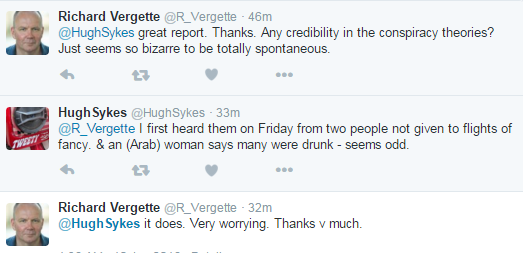
Again,  it "seems odd", says Hugh there, and the conspiracy theories were told to him by "two people not given to flights of fancy". 

And Richard Vergette, whose first tweet showed him to be already someone inclined towards accepting such a conspiracy theory then answered Hugh by agreeing it was "odd" and calling it "very worrying", as if his belief in the possible truth of that particular conspiracy theory had been strengthened. 

Hugh, unfortunately, didn't reply top tell him 'caveat emptor', thus allowing Richard to keep on thinking the conspiracy theories might be true after all - just as Hugh also appeared to do on Broadcasting House this morning.

Very odd. Very strange.

******


Update: DB is on the case.


And Hugh's response?:


Ah but, what if you also point out some reasons to believe that conspiracy theory as well? Doesn't that weaken the 'caveat emptor'?

Segue


One of Helen Pidd of the Guardian's heart-warming stories had concerned how her otherwise "open-minded" father had advised her to put locks on her bathroom and bedroom door before Yasser moved in as she's a single woman and he's a young man a long way from his wife. She'd never thought of that! But "of course" the lovely Yasser had no such "frisky" intentions towards our Helen. 

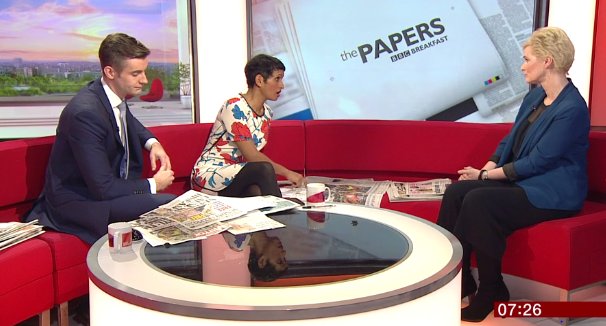
Following on pretty much straight after Helen and Yasser and their 'good news' migrant story came the BBC Breakfast paper review with Michelle Harrison of the market research company TNS. 

Michelle herself spotted that a "segue" between her first choice of story - a headline in The Observer - and what had just gone before had taken place. And, indeed, that "segue" was virtually seamless. 


Here's how it panned out:
Naga Munchetty: We've been talking about this a lot...Ben, can you give me a hand holding this up?...because obviously the attacks, the assaults on women, New Year's Eve in Cologne, and the backlash that has come from it. Quite interesting the drip feed of information as to who was behind this attack and the interpretation of it as well? 
Michelle Harrison: Yes, and obviously when I chose this headline I didn't realise we'd be having a segue straight after Helen and Yasser, and therein lies I think one of the really important parts of this story. So we have both a sense of the sort of demonising of migrants at the same time as we've issues that are sort of at the heart of the way that liberals think about society. So I think the broader context here - Merkel has been very brave over the last year in taking a stance on open borders, we've seen this week those headlines of children starving to death in Syria, and at the same time this is one of those stories that demonises, but we are talking about very. very important issues of people being able to live happily together in a multicultural environment. But very tricky. 
Naga: Angela Merkel...Angela Merkel has though been forced to toughen the actions when it comes to migrants. Anyone convicted...this is what she's looking for now, changing the law...any migrant to be convicted to be deported. 
Michelle:  And we've seen this story roll on, haven't we, from Germany having taken a real soft power stance on the way Europe should deal with this and slowly having to pull back to take on the views of many other European countries. So I think it's a very, very sad headline. 
Naga: Hmm.
Michelle: That's what it is.

Well done! Great story!


Helen Pidd of the Guardian was back on the BBC Breakfast sofa this morning. She wasn't reviewing the newspapers this time, but was actually 'the story'. 

Though a single woman, she's allowed a married male Muslim Syrian refugee, Yasser al Jassem, to live with her until the rest of his family (a wife and baby) arrives. 


There's been a few comic misunderstandings, but everything's turned out delightfully - except that Yasser hasn't found a job yet.

Helen does think though that the government [ie taxpayers] should give free intensive English lessons to all refugees, but still, otherwise it was heart-warming stuff, and the BBC presenters (especially Naga) seemed tickled pink by it:
Naga Munchetty: Yasser, we wish you all the best and, Helen, good luck! And well done! Thank you very much. 
Ben Thompson: We'll keep you updated on their story as we find out more about it, but until then...yeah, great story!
Who needs a full English breakfast to warm your innards when there's BBC Breakfast to do it for you?

When the film is made of this lovely story (by Richard Curtis?), who would play Yasser? Hugh Grant would have been good, but we aren't in the days of It Ain't 'Alf Hot Mum! so that wound't be allowed, so it would have to be an Middle Eastern Hugh Grant impersonator then. And as for who could play Helen Pidd, it would obviously have to be Eddie Redmayne. Sorted.

Beyond their ken


Here are two highly contrasting yet oddly complimentary takes on the Labour v BBC row for your delectation.

Both our big political parties are badly divided, but somehow or other David Cameron's splitting pains get much less attention than Jeremy Corbyn's. 
For instance, a BBC News programme last week arranged for some Blairite nobody to resign from his non-job, live on air. This event, plainly aimed at damaging Mr Corbyn, hardly fits in with the Corporation's duty to be impartial. 
The fact that most Labour MPs can't stand Mr Corbyn isn't news. Next they'll be revealing to us that Ted Heath couldn't abide Margaret Thatcher. We know. 
What seemed like a century of speculation on whether Dave Who had been sacked to make way for Fred Whatsit wasn't really justified. But of course the BBC isn't impartial and its idea of what is news is tinged with pink. It's crammed with shameless Leftists from cellar to chimney. So if the BBC is actively helping the Tories, which it does these days, then that must mean the Tories are now the main party of the Left.
What a shitty thing to do, eh? So shitty that after inflaming Jeremy supporters all over social media, Seumas Milne has decided to go to war with the BBC over the matter and lodged an official complaint. Apparently Laura Kuenssberg, in her capacity as chief political correspondent, should confine herself to reporting the news rather than striving to create it, and this in some way contravenes the BBC's much-cherished "impartiality". In my view, while it was a tawdry little episode that gave Stephen his five minutes before returning to the shadow of backbench obscurity and makes politics look a thoroughly unedifying business, I don't think Laura did anything wrong. She had the potential to make a scoop and, lo, did what any journalist would in her position. I am certain it would have happened in exactly the same way had a Tory junior minister muttered down her phone about resigning, and, because the BBC is formally separated from the state and has its editorial independence guaranteed by the Royal Charter, the Daily Politics is perfectly entitled to act like any other news organisation......... 
....As argued on this blog previously, the BBC is a biased institution: one that consistently tilts not toward the left or the right, but the establishment. Its common sense is the common sense of London-based financial, political, media, and cultural elites. Market capitalism is sacrosanct. Racism, homophobia, and sexism are passe. Long may the Queen reign over us. And politics, well, that just so much managerialism, isn't it? The BBC is the guardian of this supposedly natural order of things and will happily follow the political lead given from their friends and colleagues in Fleet Street. Jeremy and, for want of a better word, the revolution overturning the Labour Party's status quo is entirely outside the BBC's experience and runs against the received wisdom about "the left" imbibed from the New Labour days. And other politics outside that narrow range gets less-than-favourable coverage. Their reporting of the BNP and UKIP is/was broadly of the same character too. 
The odd thing about these is that they do share one point - even if it may not be too obvious at first glance: namely that they both think the BBC coheres around a metropolitan centre that finds it very hard to take on board the views of people outside its purview, whether those be Corbynistas or UKIP supporters.

There may be a fair amount of truth in that.

Saturday, 9 January 2016

How to Make a Brexit Sound Fiendishly Complicated


There have been two detailed critiques of Carolyn Quinn's 40-minute Radio 4 documentary How to Make a Brexit this week. 

The first comes from Dr Richard North at EU Referendum, but I'll pass over that and move straight onto David Keighley's more engaging take at The Conservative Woman

The first point to draw from David's piece is that in all his time (16 years) of monitoring the BBC's output he's never come across a dedicated programme on the subject of what leaving the EU would involve - which is a remarkable thing when you think about it, unless you think that the BBC has been consistently biased in favour of the EU for so long that it never crossed its mind to seriously consider airing the possibility. 

Having listened to the documentary before reading either critique, I can see the truth of David's argument here, which is that the programme appeared to be projecting a message here: that leaving the EU would be scarily difficult. 

I can see it because I remember myself thinking at the time that the whole thing (leaving the EU) sound very complicated. So it had even worked on me!  

Take a look at the transcription at News-watch. You can see for yourself, again and again, how the idea that leaving the EU would be a matter of unprecedented complexity is planted again and again - and not just from the pro-EU speakers.

I was, of course, listening out for the balance of speakers, which sounded OK to me; however, David's analysis of the programme shows that appearance of balance, speaker-wise, to have been a spurious one statistically-speaking: a word count shows that 1,200 words went to the pro-EU side and just 800 to the Eurosceptic side.

David's other argument is that the pro-EU speakers were given the space and edited so as to make them sound "coherent and persuasive" in arguing that leaving the EU is scary and difficult while the Eurosceptic side were "fragmented and edited" in such a way as to serve the programme's purpose. "If they provided Quinn with any clear argument in favour of exist, they were not obvious to the listener", he adds.

This is clearly going to a year when BBC bias watchers are going to have to keep their eyes wide open.

Framing the debate


There wasn't time to discuss the subject, apparently, on Any Answers, but still, this is how Anita Anand initially framed what might have been the discussion on events in Germany:
The widespread sexual assault of scores of women in Germany, that's sparking heated debate. Is this kind of spectacle inevitable when you let outsiders in? Are some hijacking the crimes of a few to shut the door on asylum seekers who truly need help? Is this a clash of ideology?  

"His desire to ban all Muslims from the United States"


I had the World Service on while off work on Thursday afternoon and, half-listening, thought I heard the BBC's Razia Iqbal say something untrue. 

I've found the programme again now, and the question I heard began at 36:34:
Mansoor Shams, you are a former US marine so you have been embedded in an establishment institution in the United States. I wonder what your perception then has been of the major shifts in the political campaigning. I'm thinking specifically, of course, of Donald Trump who is seeking the presidential nomination for the Republican Party and his desire to ban all Muslims from the United States.
"His desire to ban all Muslims from the United States?" Really? 

I suppose, listening back, that she'd probably just phrased her question badly there rather than actually attempting to suggest that Mr Trump wanted all Muslim already in the United States to be sent packing (as her form of words could easily be taken as meaning). Or, at least, I hope that's what she did.

In other words, she probably meant to say, "his desire to ban all Muslims from entering the United States" (...though if she did, she should also have added the second part of his statement saying "until our country's representatives can figure out what is going on").

It was a very sloppy - and potentially inflammatory - use of language though from Razia Iqbal there, wasn't it? (Unless it was deliberate or simply ignorant).

*****

It was typical of the BBC though that this question came during a discussion to mark the anniversary of the Charlie Hebdo attacks in Paris that focused exclusively on the feelings of Muslims; specifically the question of the extent to which the lives of ordinary Muslims have changed as a result of having the finger of suspicion pointed at them so regularly.

Razia talked to a graduate from Paris, a former US marine and business owner from Baltimore and a London psychologist, all Muslims. 

The latter, who wears a headscarf, now feels more "unsure" and "unsafe" because of the "rhetoric" she hears questioning Islam's compatibility with Western life. The French lady said the "daily discrimination" has "gone mad". The US gentleman said Muslim women he knows have have "very frightening experiences" since "this rhetoric" began. The British lady thinks about her safety walking home now. The French lady said she's "angry" at being made to feel as if she's always the immigrant, "not French enough". The US gentleman joked about Donald Trump but said "the talk is definitely effecting people". His mum worried about him getting through immigration control after his recent trip to Saudi Arabia. The French lady talked of "systemic racist policies" in her country. The US gentlemen said that Trump showed that "racism, bigotry and hatred" is part of the Republican debate now. He feels "stressed out" and worried for his family. The British lady, however, thinks plenty of people see Muslims as Britons first and foremost, as human beings, that there are people who will fight for you and with you, and she finds that "enormously heartening". 

Talking of Jenny Hill...


In it you'll hear from one of the victims of the attacks in Cologne, Michelle, who Jenny quotes saying, "It would be wrong to blame refugees. They need our help", which is followed by Jenny herself saying, "Many here fear a violent backlash against the 4,000 asylum-seekers living in Cologne."

You'll also hear from a young, male Iraqi refugee "with striking green eyes" who enthusiastically declares his gratitude to Mrs Merkel and his love for Germany but becomes sad when reminded of the attacks. "I'm so sorry this has happened," he says. "But Iraqi and Syrian men are good people". Jenny wistfully wonders if his hopes that his mother and brother will soon join him might not happen now.

And her closing section is just as wistful:
It feels like a long time since Angela Merkel told Germany it could cope with the vast number of migrants arriving. Back then, so many were impressed by her moral direction. Germany was, she argued, a rich stable country with much to offer. 
But I think of those fragile flowers left at the cathedral - delicate petals in a harsh winter wind.

Is BBC Radio 4 comedy getting less biased?


There's a characteristically considered and fair-minded piece by Sarah AB over at Harry's Place discussing "the BBC, the resignation - and comedy Corbyn" which I'd urge you to read when you have a moment. 

She thinks that Labour is "certainly making too much of a meal of this", but doesn't wholly agree with "those scoffing that there was absolutely nothing noteworthy - or irritation-worthy - (from Labour's point of view) about the way the news broke"...

...which is pretty much my position on the matter too.

She's certainly no Corbynista herself, but she also thinks that the BBC could have a bit of an issue with anti-Corbyn bias...

...as does parts of the BBC it seems, from Nick Robinson to the heads of the BBC's Comedy department who told Dame Edna Everage not to make a Corbyn joke unless she also made a Cameron joke. 

It gets even more interesting though...

The most striking part of her piece though concerns the perennial issue of .BBC comedy and BBC bias' (a Jeremy hardy perennial issue you might say): 
We’re rather more used to hearing of Radio 4 comedy’s supposed left wing bias; stalwarts such as Mark Steel and Jeremy Hardy are decidedly to the left, and there are regular grumbles about the cosy left liberal consensus on shows such as The Now Show and The News Quiz.  However a couple of recent programmes certainly demonstrate no pro-Corbyn bias. 
Dead Ringers presented an end of the year edition set in the year 2020.  One sketch presented a programme called ‘Who remembers the Labour Party’, presented by Caroline Aherne (from 13:40). To be fair, this sketch has several targets (we learn that George Osborne revealed his true lizard form in 2018) – and readers may like to go to 16:20 to find out who replaces Corbyn as Labour Party leader. 
A bit sharper, perhaps, was the latest edition of the News Quiz.  This opens with Francis Wheen (a signatory of the Euston Manifesto, incidentally) making fun of the Radio 4 injunction not to single out Corbyn for satire – ‘he’s not as other politicians – he’s the Messiah or something’. Susan Calman and Zoe Lyons are both very scathing about Emily Thornberry’s appointment as Defence Secretary (from 5:00).  Miles Jupp summed up mercilessly:
It really was a thrilling couple of days as a large number of people understudying jobs they’re never going to actually do waited anxiously to find out if they were going to be asked to understudy different jobs that they’re never going to actually do … Corbyn promised a politics that would be more familiar to the lives of everyday working people and he has delivered. The Shadow Cabinet now reflects the lives of everyday Britons incredibly closely, forcing them to work in jobs they never wanted for a boss they openly hate.
We've praised Dead Ringers as 'the exception that proves the rule' here several times before vis a vis 'BBC left-wing comedy' - especially for their hilarious mockery of Ed Miliband and George Galloway (alongside many a popshot at Nigel Farage and David Cameron) - but for The News Quiz to finally break free of its recent unbalanced left-wing ways and embrace a much more even-handed approach to its satirical targeting would be great news indeed. 

I've didn't listen to the last series of The News Quiz but I read a fair few comments at Biased BBC late last year saying that Miles Jupp had brought a marked improvement to the show (on the 'bias' front) after replacing Sandi Toksvig, so this opinion seems to extend across the political spectrum of the blogosphere. 

We'll have to see where this is leading of course.

Will this apparent commitment to increased balance by the makers of BBC Radio 4 Comedy be spread across the board? Will it lead to more varied commissioning (politically-speaking)? Will The Now Show be re-made? Will Marcus Brigstocke be required to bash Jeremy Corbyn and Caroline Lucas as well as Nigel Farage and David Cameron every time he appears on the BBC? And, more tellingly, will be be required to bash political figures from the centre-left (Brownites, Blairites, whatever)?

We live in interesting times -  as that politically correct mayor of Cologne might have said while dressed up as a 'Chinawoman' for carnival recently (much to the astonishment of the BBC's Samira Ahmed):

Attacks from two sides


The big 'BBC bias' story on the domestic front this week has been the extraordinary row between Jeremy Corbyn's Labour Party and the BBC over that deleted blog on the BBC's College of Journalism website by Andrew Alexander, an output editor for the Daily and Sunday Politics, entitled Resignation! Making the news on the Daily Politics:

Wednesday is always an important day for the Daily Politics because we carry Prime Minister's Questions live, which brings with it our biggest audience of the week and, we hope, a decent story. 
As I arrived at Millbank at 7am it was clear that Jeremy Corbyn's cabinet reshuffle, which had ended before 1am, was going to dominate at Westminster. 
When the programme editor phoned in we agreed that in addition to covering other major stories, including the junior doctors' strike, fallout from the reshuffle was likely to continue throughout the morning and this was a story where we could make an impact. 
When the producers arrived at 8am they began putting out texts and calls to Labour MPs we thought were likely to react strongly to the sacking of several shadow ministers for "disloyalty". 
Just before 9am we learned from Laura Kuenssberg, who comes on the programme every Wednesday ahead of PMQs, that she was speaking to one junior shadow minister who was considering resigning. I wonder, mused our presenter Andrew Neil, if they would consider doing it live on the show? 
The question was put to Laura, who thought it was a great idea. Considering it a long shot we carried on the usual work of building the show, and continued speaking to Labour MPs who were confirming reports of a string of shadow ministers considering their positions. 
Within the hour we heard that Laura had sealed the deal: the shadow foreign minister Stephen Doughty would resign live in the studio. 
Although he himself would probably acknowledge he isn't a household name, we knew his resignation just before PMQs would be a dramatic moment with big political impact. We took the presenters aside to brief them on the interview while our colleagues on the news desk arranged for a camera crew to film him and Laura arriving in the studio for the TV news packages. 
There's always a bit of nervous energy in the studio and the gallery just before we go on air at 11.30am, but I'd say it was a notch higher than usual this week. By this point we weren’t worried about someone else getting the story as we had Stephen Doughty safely in our green room. Our only fear was that he might pull his punches when the moment came. 
When it did, with about five minutes to go before PMQs, he was precise, measured and quietly devastating – telling Andrew that “I’ve just written to Jeremy Corbyn to resign from the front bench” and accusing Mr Corbyn’s team of “unpleasant operations” and telling “lies”. 
As Andrew Neil handed from the studio to the Commons chamber we took a moment to watch the story ripple out across news outlets and social media. Within minutes we heard David Cameron refer to the resignation during his exchanges with Jeremy Corbyn. 
During our regular debrief after coming off air at 1pm we agreed our job is always most enjoyable when a big story is breaking - but even more so when it’s breaking on the programme.
Corbynistas on Twitter and, now, the Labour Party itself have complained that the BBC has been 'making the news' rather than simply 'reporting it' (something the blog's title doesn't exactly disguise!), thus breaching the corporation's "role and statutory obligations". A Labour Party spokesman (namely Seumas Milne) said:
By the BBC's own account, BBC journalists and presenters proposed and secured the resignation of a shadow minister on air in the immediate run-up to Prime Minister's Questions, apparently to ensure maximum news and political impact. 
That was evidently done before any notice of resignation was sent to the Labour leader.
Such orchestration of political controversy is an unacceptable breach of the BBC's role and statutory obligations. 
Trust in the impartiality and independence of the BBC is essential. The BBC's role is to report the news impartially, rather than seek to influence events or promote a particular political narrative.
Well, it wouldn't be the first time the BBC had tried to "influence events or promote a particular political narrative", would it?


Anyhow, the BBC, in the form of editor of live political programmes Robbie Gibb, wholly rejected Seumas Milne's complaint:
I reject your suggestion that we orchestrated and stage-managed the resignation of Stephen Doughty. 
As he himself confirmed on Friday, Mr Doughty had decided to resign his front-bench position on Wednesday morning, before speaking to any journalists. He subsequently spoke to Laura Kuenssberg who asked if he would explain his reasons in an interview on the Daily Politics later that morning. Neither the programme production team, nor Laura, played any part in his decision to resign. 
It is true that we seek to make maximum impact with our journalism which is entirely consistent with the BBC's Editorial Guidelines and values. 
Your letter suggests that our decision to interview Mr Doughty in the run up to Prime Minister's Questions was designed to 'promote a particular political narrative'. This is simply not the case. 
The Daily Politics does not come on air until 11.30am on Wednesdays and the BBC's Political Editor always appears live on the programme in the build up to the start of PMQs. As the confirmation of Mr Doughty's resignation was Laura Kuenssberg's story, we felt it appropriate for her to introduce the item. Again I do not accept, in anyway, the programme has breached its duty of impartiality and independence.
Looking at Twitter, the reaction divides sharply (as usual). I've noticed that a lot of those who are backing the BBC are either journalists (such as Kay Burley) or, even more so, Blairite/Brownite Labour types (from Alastair Campbell, Dan Hodges, Kevin Maguire, etc, to all manner of local Labour types - and see also this article by a Labour councillor at the Huffington Post) Those supporting the Labour Party (of Mr Corbyn and Mr Milne) are mainly pro-Corbyn types. 

That, of course, leads to the question of why New Labour types are in full 'defend the BBC' mode while 'New Old Labour' types (so to speak) are in full 'attack the BBC' mode. The latter are likely to attacking the BBC because they think the BBC is biased against them and their leader; the former are likely to be defending the BBC because they either don't think the BBC is biased against Corbyn and his -istas or wouldn't mind if it is (given that they can't stand their new leaders)! 

Of course, that gives many of the BBC defenders the chance to say that the BBC is not biased at all because it's getting complaints from both sides. The interesting thing when you look at the profiles of the non-BBC people on Twitter doing that defending of the BBC is that a surprisingly large number of them describe themselves as being Labour supporters, occasionally distancing themselves from the Corbynistas. 

That, itself, is intriguing. Why are such people more likely to be pro-BBC than Corbynistas or right-wingers? Could it be because the BBC has a general centre-left bias which they're intensely relaxed about?

*****

A classic example of the BBC using the 'complaints from both sides' argument came from Newsnight senior broadcast journalist Jess Brammar, prompted by the row over the Daily Politics:


Now, as we've argued many times before, the 'complaints from both sides' argument isn't a good one (a) because one side may have a genuine case while the other doesn't and (b) because there may be more than two sides with the BBC being biased towards a third side.

In this case, maybe the BBC is biased against both the political right and the political far-left. 

Maybe, as its own internal polling famously showed, the BBC is an overwhelmingly left-liberal organisation. 

In party political terms, that might mean that it gravitates around a centre-left party - ranging from a few pro-EU left of the Conservative Party types (Newsnight's Chris Cook perhaps?) across the Lib Dems to the Blairite and Brownite wings of the Labour Party, with very few pro-Tory Right or pro-UKIP types and a small rump of pro-Corbyn Labour types (including some of their leading comedians, of course). 

If so, the BBC can still be strongly politically biased even if it's getting complaints from the Right and the Left, can't it?

*****

Going back though to the BBC's Robbie Gibb...

Another part of his response stands out for me - the bit where he said that he initially thought the BBC Academy blog had been for "internal purposes only"!:
When it became apparent that it had been published more widely, we decided to delete it as the piece was written in a tone that was only suitable for an internal audience. No other inference should be drawn from our decision to delete the blog.
Ha! Well, I for one am exercising my right as a BBC license fee payer to draw another, very different inference from the BBC's decision to delete the blog, Mr Gibb's stern command notwithstanding: They wanted to remove it from public view because it was proving embarrassing for them.

Tulips in the snow


The same edition of BBC One's News at Six as Jenny Hill's piece from Cologne featured another emotionally-charged report on the migrant crisis (obviously with no connections made between the two items). 

It contained many familiar features of BBC reporting on this theme.

The programme's opening headlines gave its angle: 
An increase in illness among migrants as they face freezing temperatures on the route to Europe.
Against a backdrop featuring heart-tuggings images of children, including a toddler in the snow as its central image....


...presenter Reeta Chakrabarti, donning a concerned expression, announced: 
Medics working at refugee camps in the Balkans say they're seeing a marked increase in the number of refugees falling ill because of the bitterly cold weather. Temperatures have fallen to as low as -11C degrees in the region. Our global health correspondent Tulip Mazumdar has followed migrants making the journey from the Macedonian border through Serbia to the Croatian border. 
Despite, pace Cologne, the overwhelming majority of migrants/refugees being young and male and not Syrian, the focus here was on (a) an older male Syrian refugee, (b) a baby girl, and (c) a family with four young children, including an ill two-year old boy, and a female relative who wept at "the kindness of strangers is overwhelming" - that family becoming Tulip Mazumdar's main focus.

Her report ended with the emotive words...
But more people follow in their footsteps - the desperate and the weak. Tulip Mazumdar, BBC News on the Serbia-Croatia border.
...set against the following image - the one which had been the central image of the backdrop to the introduction of the story:


Of course, it is terrible that children are caught up in such a situation but the families who put them in that situation always seem to be given a free pass by the BBC. 

Why did they take their children away from the warmth of Turkey at this time of year? No one at the BBC ever seems to want to ask them that. 

The implicit message always seems instead to be that 'the desperate and the weak' need the kindness of strangers - our kindness. 

After Cologne


Nothing shows the crazy world we're living in than the official response to the waves of sex attacks in German cities on New Year's Eve by 'Arab and North African' gangs. It was as if the German authorities were re-playing, on fast forward, everything that happened in slow motion in places like Rotherham, Rochdale, Oxford and other British towns and cities, and for exactly the same reasons.

As for the behaviour of the media: At first they told us nothing. Then, after social media sites and Breitbart began reporting what had happened, they began reporting it - four to five days after it had happened. (One German TV station at least had the decency to apologise for failing to report it earlier.)

They then appeared to play catch-up whilst still seeming to try to cling to the hope that the 'Arab and North African' men weren't recent asylum seekers/refugees.

BBC reports, for a day or two, all stressed (without questioning or further investigation) statements from German officials saying that there was no evidence of such a link, just as they used to do when the issue of race or religion (specifically the religion of Islam) arose in the wake of Rotherham, Rochdale, Oxford, etc. They also cited commenters calling for people not to jump to conclusions. Their  main online report on the story on 5th January did cite one policeman saying that eight detained suspects were asylum seekers but that was in paragraph 25/27 of the article (for some reason) and the following paragraph 26 then tried to counter it by repeating official cautioning comments.

The BBC's main online 'explainer' piece by Jasmine Coleman on 6th January waited 9 paragraphs before mentioning that the young men were 'of North African or Arab appearance', focusing initially instead on the area of Cologne's notoriety as a crime hotspot. Some 13 paragraphs later she returned to the question of the perpetrators saying that anti-immigration campaigners had "seized on" the incident and that some had criticised the media before quoting a German official cautioning against making the link to refugees and, in a very strong echo of the BBC's coverage of Rotherham, Rochdale et al, then cited one expert:
Meanwhile experts stress that sexual violence is an issue for people of all ethnic origins. 
Figures show the majority of people carrying out sex attacks in Germany do not come from an immigrant background. In two-thirds of cases, the perpetrator is known to the victim, Ms Kopetzky says.
As with the UK's problem with grooming gangs, such points miss the point. They ignore the specific nature of the crimes and they 'forget' about considering the statistics proportionally. Yes, most sex attacks in the UK and Germany are carried out by non-immigrant people and most perpetrators are known to the victims, but the UK is well over 80% non-immigrant yet the vast majority of those convicted of being part of paedophile grooming gang members were from an immigrant, Muslim background - i.e. a vastly disproportionate number - and they targeted non-immigrant (ie white) children, just as the mob in Germany targeted non-immigrant (ie white) women.

Then came the news that the bulk of those arrested so far have indeed been asylum seekers. and the news that four young, male Syrian refugees had gang-raped two girls aged 14 and 15 in a small southern German town. The BBC's main online article reporting this on 8th January was unusually forthcoming (though the ages of the girls wasn't given, only being mentioned in a later, separate article): 
Germany must contemplate deporting foreigners convicted of crimes following the Cologne sex attacks, Chancellor Angela Merkel says.
She said "clear signals" had to be sent to those not prepared to abide by German law.
Gangs of men described as of North African and Arab appearance were reported to be behind the attacks.
Police also received reports of sexual attacks in cities in Finland, Austria and Switzerland on New Year's Eve.
Meanwhile, four young Syrians are being held over the suspected gang rape of two teenage girls in the southern German town of Weil am Rhein on the same night, according to German media.
Last night's News at Six on BBC also had Jenny Hill saying as much, albeit tentatively:
The authorities now admit that some of the men who attacked [the women] may have been asylum seekers.
Her report marked something of a step backwards. She featured a Yazidi refugee from Iraq "who [she said] fears reprisals", adding that "anti-refugee violence is already on the increase". He denounced the perpetrators as newly-arrived and not representative of other refugees like him (which in his case, being a Yazidi, is likely to be true at least, most of the rest being Muslim). She then featured two young German woman as vox pops (both of whom looked, unless my eyes deceived me, as if they might also come from an immigrant background):


...both of whom downplayed the dangers, saying if you were careful, had "a trusting heart" and "saw these as single incidences" you should be OK - prompting the obvious question: Were they representative? Or were they simply the ones saying what the BBC reporter wanted to hear? 

Those are just some initial impressions on the BBC's reporting in recent days. Do they match yours, or not?

Friday, 8 January 2016

Another little list

With all the violence that’s being waged around the world, certain people must’ve thought the temporary hiatus in the BBC’s obsessive ferreting for negative news stories about Israel needed redressing. Never mind, Sarah Champion is on the case


I beg to move,
That this House has considered child prisoners and detainees in the Occupied Palestinian Territories.

Some might ask themselves, why would an MP from one of the most troubled constituencies in the UK be so concerned with the Palestinians? Stupid question. 
She is beholden to constituents from a default culture of Israel-hating / antisemitism. So initiating this debate would be a popular move for the Corbynite MP who belatedly noticed the massive abuse by ‘Asian’ men that was being perpetrated upon young girls in her constituency. 


July 2014


It seems that this debate was somewhat rushed. It appeared to be almost as time-poor as those vitally consequential interviews on the Today programme, which are always tantalisingly terminated  just as they seem to be getting to the interesting bit, often mid sentence, only to go to some annoying trailer or the weather forecast or sport or a particularly spurious impenetrable Thought for the Day.

During the debate people kept asking speakers to give way, but they kept refusing, crying “No! I will not give way!” being so overcome with passion, outrage and loathing.

The usual suspects were in out in force so the thrust of the rhetoric was heavily weighted against Israel. Well, as that was the whole point of the debate I guess it was never going to be anything other than a self-indulgent hate fest, no doubt to the delight of the councillors and voters of Rotherham.

Caroline Lucas, Andrew Slaughter, Richard Burden, Jim Cunningham, Bob Stewart, Lisa Cameron, David Jones, Naseem Shah, Simon Danczuk, Diana R Johnson, that awful windbag Philippa Whitford, and various others I was less familiar with spoke with great passion about the awful things the Israelis do to Palestinian children in detention in a celebration of virtue signalling gawn mad.
 “the ill-treatment of children who come in contact with the military detention system appears to be widespread, systematic and institutionalized throughout the process, from the moment of arrest until the child’s prosecution and eventual conviction and sentencing”.

Putting the case for the defence were: Louise Ellman, Andrew Percy, John Howell, Guto Bebb, Ian Austin and perhaps a couple of others who tried to draw attention to Palestinian incitement and the vile racism within the Palestinian education system, but no-one was listening because, why should they?

Naseem Shah for one  wasn’t going to hear anything she didn’t like. She insisted that no-one had ever been killed by stone throwing, even though one particularly sad case was cited:


Last February, four-year-old Adele Biton died after being critically injured by youths in a stone-throwing incident. I am just as worried as my hon. Friend is about the detention of children, but she should not minimise the crimes and violence that are taking place on the other side as well

I will finish by clearly making the point that the Israeli Government have not provided any evidence of any child causing a death, or contributing to a death, using a stone. There is no evidence of that.

I could make a sly comment about stone-throwing being an official method of ‘contributing to a death’ that is practiced  by followers of a certain religion, but I wouldn’t be so crass.

“The government must set up a “watchlist” of Israelis who have committed war crimes by detaining and interrogating Palestinian children, a Labour MP has claimed.Sarah Champion said the Israeli Defence Forces were guilty of "mass intimidation and collective punishment" of Palestinians in order to protect Israeli settlers in the West Bank.Leading a debate on the issue in Westminster Hall on Wednesday, the Rotherham MP called for a list of “all known war crime suspects” who attempt to enter Britain.”

Incidentally Sarah Champion is another MP who has been seduced by CAABU, is utterly beholden to her Muslim constituents and is a supporter of the Labour Leader, so what could anyone expect? (other than a small baying mob that wants the government to ‘get a little list’ of pestilential nuisances that never would be missed’.)

The BBC featured Ms Champion heavily in the unusual and interesting documentary about the House of Commons, and as we commented at the time, in that series she came across as likeable and enterprising. 

However, she has been heavily criticised for dodging responsibility for the Rotherham abuse scandal and blaming everyone else in a parodic ‘who, me?’ fashion, while at the same time claiming to be energetically ‘championing’ the cause of the unfortunate victims. 

Championing has taken on a whole new meaning.
Update:

I’ve just noticed that Andrew Percy MP has written about this here, (How not to help Palestinian children) and as a matter of interest, this ( Fatah praises and encourages “heroic” murderers of Israelis) just popped into my inbox, and so did this. (Palestinian Authority, Hamas, Responsible for Torture)


I rest my case.

Wednesday, 6 January 2016

Censoring the news


Yesterday the BBC finally got round to reporting the wave of sex attacks on women in Cologne and other German cities by large gangs of "Arab and North African men" which took place on New Year's Eve. They even gave it prominent coverage on their news website. (It was in the top two of their 'most read' articles for much of the rest of the day).

The most-watched news programme in the UK, the BBC's flagship News at Ten, however, made a clear editorial decision last night to downplay the story, pushing it well down its running order and then giving it a mere 19 seconds. 

The editorial team behind BBC News at Ten also decided to downplay the sexual element of the attack, playing the words 'robbed' and 'threatened' before 'sexually assaulted' in their description of the event and excising all mention of the fact that at least one of the women was raped.

They also chose to completely censor the clearly highly relevant fact that the gangs behind this extraordinary assaults on the women of Germany consisted hundreds of "Arab and North African men".

This is how BBC News at Ten reported the story last night, word for word:
In Germany tonight protesters gathered outside the cathedral in Cologne after around 80 women reported being robbed, threatened or sexually assaulted by groups of men on New Year's Eve. People suspect that as many as a thousand young males, many of them drunk, carried out the attacks. Chancellor Merkel has called for the perpetrators to be caught and punished.
How can anyone think that that's adequate reporting?

The editorial decision making behind that decision is deeply disturbing and BBC News at Ten should be ashamed of themselves.