Sunday, 5 November 2017

Remember, remember, the 5th of November


Andrew Marr is famously a painter. Who knew he was a poet too? Here's how he started his show today:
Remember, remember, the 5th of November,
Backbiting, leaking and plot; 
If this lot gets clear to November next year, it's all down to luck,
Quite a lot.
Eat your heart out Wendy Cope! 

*******

The newspaper front pages were all sleaze, sleaze, sleaze. The first one Andrew held up was the Observer, which is leading today with the shock news that Larry the Cat has been suspended from his Downing Street duties following allegations of sexual harassment after he rubbed his head up against several MPs' legs. 

Following last week's highly controversial edition 'The Problem with Men', Newsnight is said to be considering another special on Monday called 'The Problem with Cats' (N.B. - NOT 'The Problem with Katz' as some scurrilous types are suggesting). Following the same successful format as last week's edition, there'll be a panel consisting of 14 cats and three birds. The cats will be ordinary moggies dragged off the streets and the invited birds are rumoured to be Tweetie Pie from the 'Don't Call Me a Bird' Project, Pretty Polly the Talking Parrot from LBC, and Beth the Token Budgie from the Guardian

*******

And now back to reality...

The newspaper review itself (Kate Hoey, Anna Soubry and Sam Coates) was all sleaze, sleaze, sleaze too, with a little bit of Brexit tagged on at the end. Andrew was treading very, very carefully here.

*******

The Dawn Butler interview also concentrated on sleaze. Andrew pursued her doggedly. In response, Ms Butler 'did a Diane', and waffled,  and said 'Andrew' a lot, and to all intents and purposes placed her hands over her ears and began singing 'La-la-la' as loudly as possible.

*******

Introducing the weather, Mr Marr quoted Billy Connolly saying that there's no such thing as bad weather, only inappropriate clothing. Matt Taylor in the weather studio advised us to wear a warm jacket, and maybe a waterproof warm jacket, plus warm socks and gloves. The weather map exploded with fireworks. I only wish Matt had brought in some sparklers and waved them throughout (wearing safety goggles of course).

*******


Ha, Benjamin Netanyahu's first words to Andrew Marr today were a crack about BBC bias!: 
Andrew Marr: This Balfour Declaration is regarded as one of the founding documents of the State of Israel, and to celebrate its centenary, Israel's Prime Minister, Benjamin Netanyahu has come to London, where he's been in talks with Theresa May. To some, he is the arch defender of the Jewish people. To others, he is a bellicose hardliner dedicated to expanding the very settlements seen by Palestinian Arabs as the obstacle to peace. And he joins me now. Welcome Prime Minister.
Benjamin Netanyahu: The good part was shorter than the bad part.
It certainly was. And 'the bad part' kept on coming. No sane person could accuse the BBC of pro-Israel bias after this interview. That said, not everyone is sane:


Hm. Didn't this next question teeter perilously on the brink of Tim Willcox territory by seeming to blame Jews in Israel for the rise of antisemitism in the UK (albeit filtered through the safety blanket of his own "Jewish friends" and "a lot of Jewish community leaders")?:
Can I ask about the condition of Jews in this country? Because I have a lot of Jewish friends and there are a lot of Jewish community leaders who are very worried about your Government and they say that particularly the settlement issue has made it much, much harder to defend Israel in this country. We have always had antisemitism in Britain but it has been quite quiet for a long time, and it is back on the rise. 
And as for Andrew's question about Jeremy Corbyn, "Should you not pick up the telephone and talk to him directly?", I refer the honourable gentleman to this tweet:
Is #Marr for real?
Asking Netanyahu why he doesn't speak to Corbyn?
Who boycotted the Balfour Centenary dinner to address MEND Islamists?
*******


The Olivia Colman-Michelle Pfeiffer interview had a nice phrase from Andrew Marr about Kenneth Branagh's Poirot moustache, calling it "a vast grey marmoset". I think it looks more like a tamarin, specifically the emperor tamarin (named in honour of Franz Joseph I of Austria).


*******

Then it was back to sleaze again. Andrew began his interview with Amber Rudd by saying:
Can I make a parallel? I've been around for a long time. This feels a little bit like John Major's Government after the back to basics speech when day after day after day there was yet another story and another and another. And it was drip, drip, drip. And it shredded and exhausted that Government, and the same thing is happening to you. Can I put it to you this is not tittle-tattle, This is politically serious?
I think he has a point. It reminds me of that time too. And the BBC could barely focus on anything but sleaze and party splits at that time. And here we seem to be here again. Happy days!

Andrew pursed Ms Rudd doggedly too, but she's a more accomplished interviewee than Dawn Butler, a much better class of waffler.

Oh, and here's a bit more Rob Burley, for fans of the Marr editor's famous Twitter exchanges:


*******

And that's all I've got to say about that (you'll doubtless be glad to hear).

Saturday, 4 November 2017

An opinion poll the BBC wants you to believe (update)


Here's a curious postscript to a post from earlier today....

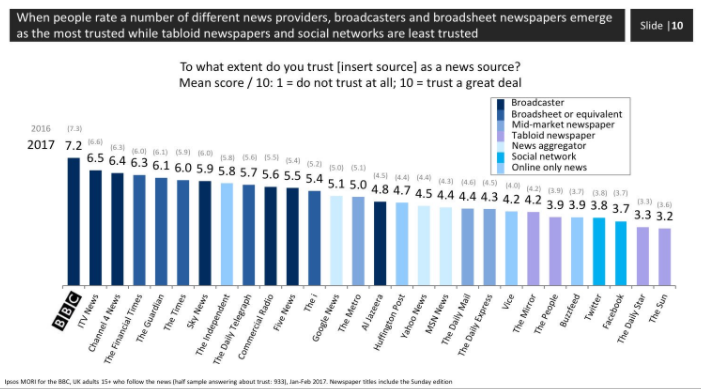
The BBC Press Office sent this tweet out a couple of days ago about a BBC-commissioned IPSOS Mori showing the BBC to be trusted much more than any of its competitors (well, on this particular take anyhow) : 


But it turns out that this IPSOS Mori poll isn't quite the 'new research' the BBC Press Office claims it is. 

A commenter on that earlier thread noted that the 57% figure also appeared in that new (and flawed) Cardiff University which 'found' the BBC to be right-wing biased

The presumption would naturally be that the BBC shared it with their academic impartiality-checking chums at Cardiff University. But when? 

Digging into this mystery, the Cardiff report's citation of this same figure - and it is the same figure - takes you to a link.

You pass through that very wormhole and land back in March 2017 at a BBC Trust transcript of a speech by the Trust's last head Rona Fairhead where she does precisely what the BBC Press Office was doing a couple of days ago - quotes from, and gloats over, that very polling data:


So what's going on? Well, if you look at the small print of this 'new' IPSOS Mori poll you'll see that all the polling for it was done in January and February of this year. 

In other words, this 'new' poll is some nine months out of date.

And as for it being 'new research', well if 'new' means getting on for a year old then 'new' it is. Unfortunately, 'new' usually means 'new'. (And I've re-checked my dictionary to make sure).

I don't know about you but I feel misled by the BBC Press Office here...

...ironically over a poll about BBC trustworthiness.

As Abraham Lincoln once said, you couldn't make it up!

We need to talk about Jon


In the immediate wake of the terrorist attack in New York I switched on Today as I was driving to work and heard Jon Sopel talking about President Trump's reaction to the attack. From the word go the BBC's North America editor began point-scoring off the US president. It felt like an editorial rather than a straight report. 

Now I know that lots of people, even on blogs like this, leap in far too soon with point-scoring after atrocities such as this, but a senior BBC reporter like Jon Sopel surely shouldn't be among them. 

Yes, some of his points were filtered through what Wikipedia would call 'weasel words' - such as "some critics pointed out" and "but again critics would argue" - but his main points had no such filters. They were straight-out points. 

And on Twitter he actually made the "some critics pointed out" point again and this time didn't use the 'weasel words'. On Twitter it became clear that it was his own point and that the 'weasel words' were precisely that, a smokescreen:


*******

And talking of Twitter, this tweet of his provoked a huge backlash:


It's a form of words ("#VehicleAttack") which most people beyond the BBC's circle find ludicrous at best. At worst they feel it is deliberately hiding the real thing which these attacks have in common - the inspiring power of Islamic belief. And yet BBC reporters will, almost without thinking (it seems), reach for such forms of words in the event of a terrorist attack. 

Now, I am going to stick up for him here because I think it's obvious what he meant. He obviously meant to say that all of those attacks featured a common method of attack, and that's something new. His shorthand language and unfortunate choice of hashtag obscured that.

A stronger criticism here is that Jon Sopel forgot the fabulous cities of Israel where this kind of attack began and where it isn't new. Surely Jerusalem should have been included in his list? To me, that suggests a partial-sightedness when it comes to terrorism on the BBC man's part. He forgot Israel altogether.

Of Francoists and illegal referendums


Q: Which side is this?

The BBC's Catalonia coverage has been quite controversial. 

I know that many of you, like lots of people I see on Twitter, think the BBC has been biased in favour of Spain against supporters of Catalan independence, but the BBC also came under attack last week from a couple of MPs - Labour's Chris Bryant and the Conservatives' Sir Greg Knight - who jointly accused it of 'pro-separatist bias'

Mr Bryant and Sir Greg, the Times reported,
...condemned the BBC for referring to Mariano Rajoy, Spain’s prime minister, as a Francoist, “as if to suggest that he supports a totalitarian state”. They said: “The impression left by BBC reports is that this is a battle between noble-spirited Catalans and iron-fisted Franco-supporting right-wingers. This too is entirely misleading. 
As soon as I read that I wondered, "Did the BBC really call Mr Rajoy 'a Francoist'?" Because if they did that would be quite something, especially if they meant by it that the Spanish PM is a Francoist now, here in 2017. I've hunted and hunted and I can't find any evidence that the BBC actually did call him that, but who am I to doubt such honourable gentlemen (as Mark Antony might have said)? 

Anyhow, this week's Newswatch with Samira Ahmed saw more complaints of pro-independence bias from three viewers, and Samira said that most of the complaints about the BBC's Catalonia coverage had come from that direction too. The BBC's Andrew Roy came into the studio to answer the charges and, in the way of BBC editors on Newswatch, stood by every jot and tittle of the BBC's coverage.

(Incidentally, the conspiratorially-minded among you will notice that if you add the letters 'a' and 'j' - the German for 'yes' backwards - to Andrew Roy's surname you get 'Rajoy'. Can that really be a coincidence?)

Here's the inevitable transcript:

Andrew Roy

SAMIRA AHMED: I'm joined by Andrew Roy, who's World Editor for BBC News. Thank you for coming on Newswatch. Most of the viewers who did complain said the BBC had been too favourable to the pro-independence side. How do you respond? 
ANDREW ROY: We haven't been. We've been physically in both locations, in Madrid and Barcelona, so we can put both points of view. Our correspondents have always been careful to get pro and anti clips from protesters and politicians into their pieces. We've been trying throughout to be absolutely rigorous in being impartial and objective and putting both sides of the argument. 
SAMIRA AHMED: I think the concern is that the headline coverage, which is how most viewers encounter the story, they feel has given the impression that this has been primarily a violent state crackdown on a popular independence movement and that's not fair. 
ANDREW ROY: I think that's incorrect as well. There was violence at the very beginning around the illegal referendum. We reported that the referendum was illegal. We showed what was happening in the polling stations. We also reported afterwards the disparity in figures about the numbers arrested and the people injured by both sides. Since then, there hasn't been much violence. There has only been a series of rallies in Madrid and Barcelona, both pro and anti independence, and we've been reporting that, reporting what the politicians have been saying, and giving both sides air time. 
SAMIRA AHMED: Do you think you did enough to explain why the referendum was illegal? 
ANDREW ROY: We've put online an awful lot of explainers. We've got pieces about the constitution of Spain. We have got pieces about the devolved powers of Catalonia. We have the history of the two sides in this dispute. If your audiences are saying they still don't understand it then maybe we need to do more, but we've certainly gone out of our way to try to explain what is a complex situation and anyone who wants more depth, that's all available online. 
SAMIRA AHMED: The trouble is, audiences, I think reasonably, can say we can't be expected to go hunting for every piece of background online. The bulletins are what a lot of people watch and that is what they are complaining about. And perhaps in reports that tend to be two or three minutes long, it becomes simplified as a tale of right and wrong. 
ANDREW ROY: We haven't been doing just two or three minutes on this story. We've been doing much, much more than that throughout the whole dispute, and like I say, we have also been pointing out here is a correspondent in Madrid, here is a correspondent in Barcelona, we're giving you both sides of the story. We've done historical explainers on air. We've also brought in the issues about the economics around this independence movement and whether it would or wouldn't work. So we've tried as hard as we can to get across to the audience the complexities of it in a reduced television bulletin, but this issue has had an awful lot of air time. 
SAMIRA AHMED: I think there's a particular challenge for television when you get passionate, colourful demonstrations wanting change, compared to what can seem a relatively grey argument, with a government that wants to keep things the same. Does that leave viewers inevitably with an unbalanced impression? 
ANDREW ROY: You saw from those clips, that the people who are in favour of unity are just as passionate and waving just as many flags, confusingly similarly coloured to the Catalan flags, but they are as passionate in putting their views across. We covered those rallies. We covered them when they are in Barcelona and when they are in Madrid. And we also go out into the crowd and get the voices supporting the rallies and also the voices down the sides of the rallies, who are possibly not supporting that point of view. So we do try to get the balance across, but also within the bulletins pieces we do. 
SAMIRA AHMED: Andrew Roy, thank you. 

And on it goes...


There's a disturbing report on the BBC News website which you might have missed. It's in the Somerset section. (I only spotted it because someone tweeted a link to it). 

A serious case review had found that the authorities once again failed to spot that a paedophile grooming gang was operating in the area. 

Worse, an underage girl - once of the two victims - was wrongly sent to court for racial abuse against her rapist. 

Ahmet Kurtyemez and Mehmet Citak have now been jailed for the offences.

It wasn't a story that BBC One covered on its news bulletins, nor did the BBC News Channel. ITV did report it though. 

There were 14 opportunities for the authorities to step in and stop the abuse. None were taken. 

John Humphrys - "I think we sometimes do lose touch with the population"


What interested me more about that Radio Times interview with all five present Today presenters was the section on Brexit - one part of the interview that didn't hit the headlines.

(There's no direct link to it as I can see, so the quotes here are taken directly from the dead tree version).

The Radio Times interviewer (Tom Loxley) posed them this question:
Jeremy Vine said recently that if you were listening to Radio 2, you wouldn't have been surprised by the Brexit referendum result. But if you were listening to Radio 4, you were shocked....that there's a metropolitan mindset on Today that means you got it wrong. You are out of touch with the country.
Now I have to say I didn't know that Jeremy Vine had made such a disobliging and frankly damning comment about his BBC colleagues over at Radio 4, but there you go. He did.

The reactions from the Today team to this question from the Radio Times weren't all the same.

Sarah Montague and Mishal Husain both straight leaped in, denying it and protesting their innocence, but John Humphrys immediately conceded that Jeremy Vine had a point:
Where Jeremy is right is that there's a disconnect between the people who run the BBC and a large chunk of the population. 
He put that down to the BBC's recruitment process which draws in too many people from a similar background. Thus:
...they tend to come with a set of liberal values that permeate their thinking, and therefore the thinking of the BBC - and for a while there's no doubt that the BBC had a strong liberal tinge. 
That, of course, implies (as he's said before) that this "strong liberal tinge" is now in the past, but he went on and said something which strongly suggests otherwise:
I noted on the morning of the referendum that in the BBC almost everybody who came in, above all, all the bosses, looked absolutely stunned. And I suspect if you walked into a cafe round the corner frequented by a rather wider mix of the population, there wouldn't have been that same sense of being utterly stunned. They'd have been maybe a bit surprised, but perhaps not even that. I think we sometimes do lose touch with the population. 
Well said John!

Nick Robinson wasn't having any of it though. Nor was Justin Webb. They were with Sarah and Mishal in taking the 'Not me, guv. We did just fine' line.

And then everyone (including John) agreed that they all park their personal politics "at the studio door", and that none of them knows how any of the others vote.

Ominous echo

I’m still taken aback by the vitriol in some btl comments that always turn up online when the topic in question concerns Israel.

Even in the non-left-leaning press, i.e., The Times and the Spectator, they’re ubiquitous, and plainly, short on facts. I see that as wilful ignorance, rooted in racism. They would see that as weaponising racism to shut down debate.  (Only, debate on that topic hasn’t been shut down, more’s the pity.) 

This Times (£) piece on Priti Patel’s controversial visit to Israel is a case on point. It does seem that, along with the sex pest business, the Conservatives are doing their best to put Jeremy Corbyn into Number Ten.

I do realise it was for charity, so I mustn’t be too unforgiving. I couldn’t resist watching the celebrity version of Gogglebox. Put it down to morbid curiosity of the irresistible kind.

I  sincerely hope it raised a lot of money for cancer research, but all I can say about the most high profile celebrity guest is that this carefully edited programme highlighted what we already knew. (That Corby is a charisma-free dullard.) Despite those embarrassing moments where he spectacularly misses the point, and various examples of his lack of interpersonal  skills and general incompetence having been thoroughly examined on Twitter, Corbynista commenters on Gogglebox’s own Twitpage still see him - with an almost religious fervour -  as their saviour. 


If I’ve said it before, I’ll say it again. There’s something in the air that’s ominously reminiscent of the 1930s.

Sneering


The Radio Times's feature-length interview with all of the present Today presenters hit the news because of what the presenters said about Thought For The Day.

John Humphrys said that he "usually" finds the feature "deeply, deeply boring" and wondered why Christians get the bulk of the invites (as they do).

Justin Webb said it annoys him because "they're all roughly the same" with the same nicey-nicey message, "If everyone was nicer to everyone else, it would be fine".

Nick Robinson agreed that there are not enough "profound" ones.

Only Mishal Husain defended the spot as "a bit of punctuation" in the "helter-skelter" of the programme .

And Sarah Montague expressed no view on the subject.

The Archbishop of Canterbury condemned John and Justin's "sneering". TFTD regular Giles Fraser also accused them of "sneering". Tim Stanley in the Telegraph also took it personally and complained that they are only "jealous".

I have to say that I agree with Justin Webb that the main problem with Thought For The Day is that it doesn't feature many 'red-in-tooth-and-claw' religious types and that the world view on offer is far too limited. They are (with rare exceptions) always the nicest, more liberal-minded representatives of their faiths.

I wouldn't wish to see it go though. It keeps parodists in business and provides a daily puzzle for the listener: 'How on earth is the speaker going to make the switch from talking about, say, Trump's tweets to talking about Jesus?'

Here are some of the latest tweets from TFTD Abridged, still performing the vital task of summarising individual TFTDs into 140 characters or less:

  • How to deal with ISIS?  Killing them all won't work, so we'll have to try something else. 
  • There's a new really fast car. People like things to be fast. Jesus did things slowly, so slow things are good.
  • Nice things are better than scary things. Happy Diwali! 
  • There's a lot of kids considering suicide. This is because of social media. Jewish mysticism has the answer: going home.
  • That couple who staged a sex act in Lindos remind me of the time I went to Greece and people wore shorts and I took photos.
  • Everything is just terrible in Las Vegas right now. Also, Jesus.
  • Sleep is important. The Bible says so. People regularly sleep through morning prayers. 
  • I had a heart attack.  Also, God. 
  • American football players kneeling during the National Anthem is totally like Jesus riding into Jerusalem on a donkey.
  • Donald Trump's speech reminded me of Manicheism because he said some people are good and some are bad. That's bad.
  • The high rate of traffic accidents in Kenya reminds me of Rosh Hashanah. 
  • The foster parents of the people accused of the Parsons Green attack are probably upset. This reminds me of the Prodigal Son.
  • A joke on the News Quiz has lead me to conclude...nothing much really. But the Bible's pretty good, isn't it?

The Return of the Trojan Horse


Peter Oborne can be, ahem, rather eccentric on certain issues. Here's one of them, where he backs the MEND view of the Trojan Horse affair...and look who's retweeting his contentious claim that the Trojan Horse plot "never happened in the first place"!


Mark Easton downplayed the significance of the affair at the time, dismissing the claims of Islamic extremism and equating the activities criticised in official reports with those practised in Christian faith schools. For him it showed 'diversity' not 'extremism'.

Sticking up for Hillary


A failure to follow up on stories after the facts change is an abiding sin of journalism and, as we know, the BBC is far from being innocent of it. 

Here's a small-scale but interesting example of that from the US online music and entertainment magazine Paste concerning a BBC Trending article from 2016

The BBC article aired complaints from Hillary supporters about Bernie supporters ('Bernie Bros') during the US primaries.

Here's the bit from Paste:


The failure to update the piece to reflect a change of fact and the intrusion of an angle from the BBC reporter (see that telltale word "even") is rather too typical of BBC reporting, especially of US matters, these days.

Incidentally, that same BBC reporter - Jessica Lussenhop, a senior staff writer for BBC North America - was responsible for such US election BBC pieces as the heartwarming article headlined The girl who 'dared' Hillary Clinton to compete. She also wrote feminist-inspired reports about how the media were guilty of sexism over their coverage of Mrs Clinton and one on the Clinton-Trump debates. All appear to come from one particular 'angle'.

An opinion poll the BBC wants you to believe


The BBC Press Office has been eager to promote a poll which it commissioned from Ipsos Mori - and one of its findings in particular:


Of course that slide is the most dramatic-looking. Others, however, are less dramatic:


It's no surprise that the spin-friendly BBC preferred the top one.

That said, both are excellent news for the BBC. Over 7 out of 10 here say that they trust the BBC as a news source and well over half say that go to the BBC first for trustworthy news.

Can you believe it? After all our hard work and people still trust the BBC!

Well anyhow, I'm off for a long lie-down with a very large bottle of gin. For some reason, the words of Honest Abe are springing to mind: You can fool all the people some of the time, and some of the people all the time, but you cannot fool all the people all the time. It's a nice positive thought to cling on to. How true it is I'm not sure.

Meanwhile, just for the sake of it, here's another reaction to the BBC Press Office from an eminently fair-minded-sounding individual on Twitter:

'Tory biased BBC'


I wonder what the collective noun is for a flock of Twitterers in fully cry? 'A prattle' maybe? Or 'a gabble'? Perhaps 'a burble'? ' A drivel' even? What about 'a yap'? Of course, it could just be 'a twitter of Twitterers', couldn't it? That would be a bit boring though so I think I'll go with 'a drivel of Twitterers'.

Cries of 'BBC Tory bias!' have (as ever) been busily 'drivelling' around Twitter in recent days, many variations on the same question (though the number of Tory MPs cited is often slightly different). An entirely typical one reads:
Why are you ignoring the 36 Tory MPs? Proof of indiscretions on paper but you concentrate on 3 Labour MPs! Tory biased BBC.
Oddly when I clicked on the BBC News website yesterday morning it was leading with Fallon denies 'lewd remarks' allegation and this morning it's leading with Tory MP Charlie Elphicke suspended. Both are Tories. 

A different point of view


Courtesy of the BBC's Autumnwatch, here's a white-tailed eagle soaring above cliffs in the Orkneys:

Missing word competition


This may be something or it may be nothing, but I spotted a missing word in a BBC News report about an Australian politician who got herself into a spot of bother after advising people not to open the door to anyone with an Irish accent, prompting accusations of racism against her. The missing word in question identified the political party she represents. Every other British news report I saw about her 'poor choice of words' mentioned the missing word in question ('Labor'), yet the BBC reporter who filed this piece merely called her 'an Australian lawmaker' and 'a minister in Victoria's state legislature'. Bias? Not bias?

Friday, 3 November 2017

The Mandy Rice-Davies approach.

I have friends - I once had friends - who are avid Guardian readers.. They see themselves as humanitarians, libertarians and socialists. They are undoubtedly middle class so I suppose it’s the Guardian that has made them into inverted snobs. They are staunchly a-religious and they take a dim view of Islamic fundamentalism and, obviously, terrorism. However, they have absorbed every melodramatic detail of the tragic Nakba / catastrophe. Why they chose to follow the Palestinian/Arab narrative exclusively, and so religiously, I have no clue. It’s as though they have abandoned reason. To me this is a complete, logic-defying mystery. However, their opinions are what they are and, by the atheist God almighty, they’re sticking to them. 
The reason behind this can only be latent antisemitism; but they don’t see it. They would be mortified at such an idea.

Under the general umbrella of “Stolen Land”, their view of the creation of Israel goes like so: Indigenous “Palestinians” were forced out of their homes at gunpoint by interloping European and American Jews who were mysteriously authorised to do so, illegally, by the British. 
They are the very types who claim they don’t hate Israel, only “What Israel is doing” . 

Recently, the Guardian featured a typically disingenuous article by Mahmoud Abbas, titled: “Britain must atone for the Balfour declaration – and 100 years of suffering” h
UK media Watch has given it a thorough Fisking. But of course, my ex-friends won’t see this, and even if they did they would be sure to take the Mandy Rice Davies approach.  

PMW has another deconstruction of Abbas’s account of ‘the greatest crime in the history of mankind”, which my ex-friends and their fellow Guardian readers are even more unlikely to see.

Oh well. That’s what this country is like these days. Here is Theresa May’s curate’s egg of a speech followed by a moving speech by Israel’s PM. at the Balfour Dinner, which I hope the shadow foreign secretary enjoyed.


Now, there's the Andrew Neil thing that everyone is talking about, and finally this strangely gleeful BBC report by James Landale about a scandalous breach of the ministerial code of conduct.
“I put a long list of questions to her department about this”.

He would, wouldn’t he.


Thursday, 2 November 2017

Nearly Another Flipping Week Over Open Thread


Just because this open thread is headlined 'Nearly Another Flipping Week Over Open Thread' doesn't mean that you have to confine yourself to comments about tomorrow's non-existent edition of Radio 4's Nearly Another Flipping Week Over. That would be silly. So please feel free to comment below on any BBC programme you like. Even Eat Well for Less? (if you really have to). Thank you.

Have you forgotten something, Cardiff Uni?


As regular readers will know, these researchers are from the same stable that the BBC relies on for its major impartiality reviews and they've previously produced reports 'finding' that the BBC, though broadly impartial, has a right-wing and anti-EU bias. (Hmm).

This latest one is a study of the BBC's use of think tanks and 'finds' that the BBC cites more right-wing than left-wing think tanks. QED.

The detail looks fascinating but within just one minute of looking in earnest at its data and hunting for its figures on the Resolution Foundation - the think tank I most associate with the BBC because I hear it mentioned a lot on the BBC (especially Todayand have written about the BBC's coverage of it before - guess what? I couldn't find any mention of the Resolution Foundation among the large list of think tanks they've monitored. 

Yes, it's not there. They've forgotten it!

So within a minute of digging deeper my initial impressions that their study looked impressive melted into air, into thin air.

How on earth could they forget the Resolution Foundation? As I say, it gets a lot of mentions on the BBC. (Check that link for yourselves if you fancy trying to doubt it). 

Though it has David Willetts as its executive chairman, the think tank is generally characterised as 'left-leaning', even by the BBC, as well as by the FT, Buzzfeed, The Times, etc, and if Justin and Stephen had remembered them then, using their own criterion, they would have to have included them in their 'Left or left-leaning' column, and that might have had a very significant impact on their results.

Professors Lewis and Cushion have surely made a fatal blunder in forgetting to include the Resolution Foundation. It's like conducting a study of bias based on the questions of Radio 4 current affairs presenters and forgetting, say, Mark Mardell. 

Please take a look at the report for yourselves, especially TABLE 2: Political classification of think tanks mentioned on BBC news, and see what you make of it.

Today. The Balfour declaration: part one

The resignation of Sir Michael Fallon and the ‘sex pest’ scandal in general has overshadowed almost everything else on the main news channels, but over at the BBC I’ve noticed increasingly frequent mentions of the Guido Fawkes website recently. This indicates that they must be keeping an eye on it and if so, they’ll have spotted this


if not this: or even this
As the BBC should know, several MPs pulled out of this event declaring that they’d just discovered that MEND was a bit dodgy. The MPs that did not (notably Stephen Kinnock and Wes Streeting) defended their decision to attend on the grounds that they were ‘engaging’. None of this seemed to strike the BBC as newsworthy. 
Interestingly, after a slurry of other incidents in and around Jeremy Corbyn’s Party, such as the reinstatement of Moshe Machover and this blatant piece of anti-Jew signalling:


We are being treated to the BBC’s special way of marking the centenary of the Balfour Declaration, including a ‘balanced set of interviews’ on this morning’s Today programme. One from the Israeli side and one from the Palestinian side. What could be more impartial than that? 

It would be fascinating to learn how these particular interviews were allocated. Nick Robinson got Tzipi Hotovely and Mishal Husain got that duplicitous rogue - pardon the value judgement - Palestinian spokesperson and chief negotiator Manuel Hassassian. 
This might have been simply because Nick Robinson has a history of struggling to pronounce the name of the latter, but as one commenter on Guido Fawkes’s website observed, 

“It’s only fair because they give Palestinian representatives a hard time with questions like:-
"What's it like living under the jack-boot of Israeli illegal occupation”.

This should give you a flavour of the way the interviews went. First of all it can’t have escaped any listener from any side of the divide, that Nick Robinson was downright rude. He interrupted, hectored and behaved in a decidedly unchivalrous manner. Bullying and, let’s face it, in today’s toxic atmosphere, his aggression could be perceived as gratuitous and, actually, misogynistic, though I doubt whether any hands  went on any knees in the course of that interview.


TH
We’re celebrating one hundred years since the Balfour Declaration that for Israel it represents the beginning of the international recognition of the Jewish peoples’ right to self-determination in our historic homeland; so this is where I would say the international community realised that the Jewish people really want to build a nation state in Israel, a place that Jews were connected thousand years, and the letter of Lord Balfour was really very precise it was speaking that this is a natural thing that the Jewish people should have their homeland, and we’re celebrating.

NR
It was precise in another way though, wasn’t it, the second half of what’s called the Balfour declaration said nothing shall be done which prejudices the rights of the people already living in that area. That is unfinished business is it not?

TH
No, I think that Israel is definitely having equal rights for both the Arab citizens and Israeli citizens and we have that established in the creation of independence, the very statement from this declaration is that all citizens, regardless of race, religion or gender have equal rights…

NR
 (interrupting) Those (rights) are people in Israel proper, but of course there are many people living under Israeli occupation on what the world refers to as the occupied West Bank, they do not have equal rights, do they?

TH
I deny the idea of occupation. This is Judea and Samaria, those are places that, as you can hear, ‘Judea’, it’s based on the connection of Jews to those places. Those are places where in the last twenty five years the Israeli government was trying to give the Palestinians all - I would say, all chances that they will have their own ruling, and this is where the Palestinian Authority was established in 1993. Unfortunately the Palestinians refused, every time, to.. either to have their own self determination or to … the idea that recognition of Israel as the Jewish homeland is something they are willing to accept. This is the main prob….

NR
 (interrupting) Let’s be clear, when you deny the notion of occupation, you are denying something recognised by every government round the world, you are denying something recognised by the United Nations, which all say that Israel is occupying land, after the 1967 war, and there should be the prospect at least of a Palestinian state there.

TH
Well, we all know how we got to this point. We all know that the Palestinians never accepted the idea of the partition plan….

NR
 (interrupting) No but we’re talking about your idea. You’re saying that it is ‘not occupied’ 

TH
I would like to…

NR
(interrupting) No, forgive me, let’s deal with what you said… in what sense is it ‘not’ occupied?

TH
Any nation can be occupier in a land that the people, the Jewish people belongs in thousand years, look, we’re speaking about Jerusalem, we’re speaking about Beit El, we’re speaking about places like Hebron - you know our founding fathers and mothers are buried in Hebron, so, no-one denies that, even Lord Balfour. The reason he recognised this connection because he was Christian, he knew the bible, he knew exactly the thousand years of connection of Jewish people with those places, so….


NR
 (interrupting) Well, let’s go back to Balfour; what he said”

TH
Saying the Jews don’t have connection to those places is denying the very basis of the Balfour Declaration.

NR
Nobody said that Jews don't have connection with them (Hebron, Judea and Samaria) they said that the land is occupied after a war, now Balfour, let’s go back to him he said that nothing should be done….

TH
Excuse me…

NR
(interrupting) forgive me let’s go back to Balfour. Balfour said nothing should be done which prejudices the rights of the Palestinian people  - now you’ve got children - imagine they were Palestinians living on what the world refers to as the occupied West Bank, are you really saying that they would have the same rights as your children have?

TH
Well, my children were raised with the idea that Jew and Arabs can live peacefully together…

NR
 (interrupting) That wasn’t the question.

TH
No, I’m answering to your question because I think that the people that are listening to us need to understand why we don’t have coexistence with the Palestinians, and the reason is very clear. When someone is willing to live with me, and is willing to have a very clear sense that this is the Jewish homeland, it’s very easy to live peacefully with us. They will have future just like my children. They will have the ability to enjoy from a democratic state - think about it, in the Palestinian Authority they never have elections, they deny the basic idea of democracy, they deny the basic idea of human rights. Think about the Gaza Strip. this is a place where there is no Israeli occupation whatsoever, no Israeli settlements, no Israeli forces and you still see a terror organisation that is taking control after the Palestinians choose this terror organisation, so you….


NR
Okay, let me go back to the Balfour one more time if I could, the British government said..

TH
 (interrupting) You need to ask yourself whether the fact that the Palestinian children are miserable is not because of their own leadership. I would say this is the reason…

NR
interrupting) Okay, so the British government’s position is that there is unfinished business in the Balfour Declaration, your Prime Minister is in the UK today and will be celebrating the Balfour Declaration, it is the British Government’s position that only half the Balfour has been delivered, let me just put the same question to you again; you have children; imagine they were Palestinians living in the occupied West Bank, would they have the same rights, was my question…. 
(interrupting as soon as she tries to answer) …..and the answer, you know, is ‘no you would not.’


TH
No. Not what I’m answering. In order to have the ability to have a democratic state with full rights you need to build your society that it will be based on those ideas, those are values that the Palestinian society at the moment, unfortunately is not respecting. When they are sending young children - my children are not raised that they need to kill Arabs - yes this is something I’m shocked from - they have schools and square sin the cities that are named after those people

NR
(interrupting) no you don’t - so there are many children so you don’t believe that many schools don’t teach it. Let’s talk about the future if we could, minister, because that’s what matters now.

TH
“Excuse me, you need to be worried about the next generation. You know something? I’m really concerned about the next generation in the Palestinian Authority. it doesn’t seem like you’re shocked from the idea that young children are being raised in this legacy of terrorism. This is horrible.

NR
“Has Israel now abandoned the goal set by many, of the so-called two state solution, in other words of Israel living alongside and in peace with the Palestinian State - from everything you say, you have.

ITH
It’s very clear that the Palestinians are not interested in a Palestinian state....

NR
(interrupting) What’s your policy?

TH
Our policy is coexistence. Our policy is fighting incitement. Our policy is to make sure that our borders will be safe and we won’t have another terrorist organisation on the east side of the border

NR
(interrupting) so there will be no Palestinian state?

TH
It doesn’t seem so. No, I don’t think there will be a Palestinian state because the Palestinians are not interested I…

NR
(interrupting) let me ask you what you think the future is, rather than your view of the Palestinians. Is your view of the future then, a larger Israel, incorporating what you call Judea and Samaria what other people call the occupied West Bank, with second-class Palestinian citizens live there, is that your vision?

TH
No, absolutely not. I think that Judea and Samaria are definitely going to be under Israeli control, I think that the Palestinians should decide whether they want to live peacefully with us. if they want to live peacefully with us the political solutions will be found very easily, but if they would like to declare a war on Israel, what was proven in the last seventy years is that Israel can win every single battle in every war that the neighbours are declaring on us.

NR
Let me ask you finally and personally, do you, do your family, do your children, have Palestinian friends?

TH
Of course because my brothers, they live in Judea and Samaria and part of the fact that they live in Judea and Samaria they buy in the same places that the Palestinians buy, and…

NR
(interrupting) They have friends?

TH
I don’t think the word if ‘friends’ because they don’t go to the same schools but I do think in the area…

NR
Going to a Palestinian shop is not the same as having friends.the reason I ask you the question is, peace needs hope. What the Balfour Declaration did was to give the Jewish people hope. What hope are you offering to the Palestinian people?

TH
I’m offering them democratic values. if they will accept the idea that everyone, Jews and Arabs, have the right to live here, I think they will have a great and glorious future just like we Israelis have. it’s up to their leadership to make sure that the next generation, the young children of the Palestinians will be raise in the idea that my children have the right to exist. Just like I’m raising my children to understand that their children have the right to exist.

***


Next instalment should be Mishal Husan’s interview with Manuel Hassassassassian, but let’s draw a temporary veil over that, or maybe I'll try having a stab at it later if time permits.

Oh look, maybe I don't need to. Let Melanie Phillips fill you in instead.

Update
I’m pretty sure I wasted my time transcribing this morning’s interview with Nick Robinson and Tzipi Hotovely. For one thing the tenor of Nick Robisnon’s irritability and aggression doesn’t come across very forcefully on the page, and in my haste to get it down I focused solely on the most obvious flaw in the interview, namely his unpleasantness.
However, that apart, I have serious doubts as to whether Nick Robinson knows the difference between Israeli Arabs and Palestinians ruled by the Palestinian Authority.
“Then Robinson started accusing Israel of denying those Balfour rights to the Arabs living under Israeli “occupation”. Hotovely should have replied that these Arabs were not Israel citizens and therefore not entitled to the rights afforded to Israel’s citizens, including Israeli Arabs. Instead she resorted to the knee-jerk and irrelevant political point about the Jews’ own claim to Judea and Samaria. Even when Robinson further compounded his own error by stating falsely that the Balfour declaration had said “nothing should be done to prejudice the rights of the Palestinian people”, she failed to say it had said nothing of the sort because there was no identifiable “Palestinian” Arab people at that time. Instead she spluttered, correctly but irrelevantly, about the Palestinians’ refusal to coexist with Israel.”

As Melanie Phillips so eloquently puts it, the majority of the BBC’s audience will be mistakenly assuming that Israel’s “behaviour is fundamentally unconscionable because the Jews displaced the indigenous inhabitants and rightful inheritors of the land.”

And of course, sadly most of our MPs are equally ill-informed. Melanie Phillips gives a more detailed description of Robinson’s imprecise interpretation of Balfour:

“Robinson stated first that this letter promised a homeland for the Jewish people alongside another homeland for the Arabs. It did no such thing. The relevant text of the letter was as follows: 
“His Majesty’s Government view with favour the establishment in Palestine of a national home for the Jewish people, and will use their best endeavours to facilitate the achievement of this object, it being clearly understood that nothing shall be done which may prejudice the civil and religious rights of existing non-Jewish communities in Palestine or the rights and political status enjoyed by Jews in any other country” (my emphasis). 
The crucial point is in the passage I have highlighted. For the British government did not offer, as Robinson falsely stated, a second homeland for the Arabs. Its undertook rather to protect the “civil and religious” rights of existing non-Jewish communities. 
That pledge has been fulfilled to the letter, since Israel’s Arab citizens and those from other non-Jewish communities have full civil and religious rights. The letter deliberately omitted any pledge to protect Arab political rights because it was only the Jews who had the right to a homeland in Palestine – and that was because it was only the Jews for whom this land had ever been their national kingdom. The Arabs were merely latter-day occupiers.”

I suppose we can’t expect our jack-of-all-trades presenters on the Today Programme to be experts on everything, but one might hope that they’d do some serious homework on this occasion; the

one occasion where, incidentally,  Mishal Husain comes up trumps - comparatively speaking. We are, after all, starting from very a low base.

Wednesday, 1 November 2017

Britain's Promise to the Holy Land

Given the climate of low expectations in which Israel-related programmes poise precariously in BBC world, Stephen Pollard’s positive review of Jane Corbin’s Balfour programme was par for the course. 

If that’s too convoluted, to put it another way, anything less than the default Israel-bashing to which we’ve become accustomed is a small mercy for which we should be truly grateful.

Still a bit obscure? 
(Last attempt) It makes a change to see a smidgeon of balance on an Israel-related programme on the BBC and, arguably, that absolves Stephen Pollard from some of the harsh criticism he’s getting for his Tweet. 
However, as some of his critics have pointed out, the programme was littered with omissions. But of course you can’t fit everything into a one-hour documentary that attempts to cover one hundred years of conflict about such a complex issue. 


What might illustrate the situation equally sharply is that the leftie press has seized upon one segment that implies that the intractable religious zealotry comes solely from the Israeli side:
“In the garden of his home in the Orthodox Jewish Israeli West Bank settlement of Tappuah, Lenny Goldberg rubbished the idea that it was us Brits who made modern Israel possible. “The only reason we have a country here,” he told Jane Corbin, “is not because of the Balfour Declaration. It’s because Jews sacrificed themselves with blood and fire and bullets.” 
Goldberg, a tough New York Jew turned tough West Bank settler, is among half a million Israelis living in 140 towns and villages that have sprung up on the ostensibly Arab West Bank in the past 30 years. When Corbin told him that these settlements were illegal according to international law, Goldberg replied that he didn’t care about mere secular laws. He was interested in the word of God as expressed in the Bible and that, according to that higher authority, there is no Palestine and so there can be no question of Arabs having a claim to live there. “This is where Abraham walked. Why should we give it up for a bunch of murderers?” he asked rhetorically.”
However, neither the Guardian nor the Indy reviews mention the part when Corbin speaks to Dr. Mahmoud al-Zahar, in which  the real and insoluble sticking point to a peaceful outcome is revealed in all its malevolence. 

"Quran tells us to drive Jews out of Palestine's entirety"

Since the programme was created to commemorate the Balfour declaration its focus was, quite rightly, on Britain’s part in the creation of the Jewish State, and Corbin didn’t shirk from recounting the cruelty of the British in imposing strict limits on Jewish immigration in what is recognised as the Jews’ darkest hour of need. This was a welcome contrast to the BBC's customary portrayal of the British military in Palestine as victims of Jewish terrorism, wherein the bombing of the King David Hotel is presented as an unprovoked atrocity against innocent civilianrs rather than a targeted attack on a British military headquarters. 


You can read about Orde Wingate here.  The Palestine Arab revolt occurred in the late 1930s, well before Israel's declaration of Independence, and  the Arabs’ hostility to the Jews is longstanding, religiously based, and demonstrably not a result of “What Israel is Doing” a commonly held belief encouraged by ill-informed broadcasting.