Monday, 27 June 2016

James Naughtie isn't taking the EU referendum result very well


There's a telling piece on the BBC News website at the moment by James Naughtie headlined Lessons from history for Europe's future. 

It probably sums up (in an over-elaborate way) how many other BBC reporters are feeling at the moment too.

I read it as one long, sad, bewildered sigh.

******

He doesn't exactly disguise his feelings. For him, the "world" has "turned upside down", thanks to the EU referendum result.

Presently in France, he's therefore seeking the consolations of history through reading a magisterial study of the Hundred Years War. 

After comparing the upcoming post-referendum EU summit to a "post-war" peace conference" (some sense of perspective please, Jim?), the former Today presenter goes on to write, "It seems natural to turn to chaotic times [i.e. the Hundred Years War] to feel at home".

(The world turning upside down? Chaos?  A post-war-like summit? Get a grip, Jim!)

He thinks about how if Henry V had just lived a little longer "fate" and "chance" would have seen England and France united, and England playing the role of "a moon" to Paris's "bigger planet". But "fate" and "chance" intervened, and Jim goes on to draw a contemporary parallel...:
Chance. The throw of the dice. The fate of countries that turns on the instant. 
Fearsome mortality, a battle. Or a vote.
Was this vote, when well over 17 million people voted to leave the EU, really a case of 'chance' or 'a throw of the dice'? Isn't that a very dismissive way of alluding to a clear democratic choice? 

"No one...knows where we're heading", he then intones, and despite thinking of Henry V, it doesn't "seem" to him "the moment for the St Crispin's Day speech" (a famous piece of English patriotism). 

And, worse, Marine le Pen is smiling "a lot", so Jim, in Paris, changes the subject with his Parisian friends to football instead.

Fate. Chance. The Somme, And...

...yes, one final, very telling sigh:
But, in Picardy, I might have time to read some more history. 
Funnily enough, there is something about the 15th century that is rather appealing just now.
That's the longest, saddest, most bewildered sigh of all. 

He's not one bit happy about the result of the EU referendum, is he? 

Whoops apocalypse!


The post above was written whilst half-watching the England-Iceland match. (I'm so, so glad I only half-watched it).

Still, just as the BBC keeps asking people if they can see "a silver lining" in the EU referendum result, my silver lining here is that at least it shows that being outside the EU - as Iceland is - doesn't inevitably and irrevocably lead to complete and utter ruination (despite everything I'm now regularly hearing from embittered Remainers and the BBC).

Here's something Icelandic by Iceland's greatest classical composer (and one of my favourites) - reputedly the loudest piece of classical music ever written. It depicts the ferocious Icelandic volcano Hekla - the "gateway to Hell".

(Don't tell James Naughtie though or he might use that as a metaphor).

Fiction, paranoia and all

My late mother looked out at me from the bathroom mirror this morning. When I was young I thought the old girl was stupid, but fast forward a decade or three and now it seems I AM her. I can hear myself saying things she used to say (and sounding quite like her as I do so.)

The constant whinge we’re hearing, which is that the old who voted to leave the EU have ruined the lives of the young who voted to stay, is unpleasant and inaccurate; but even if it weren’t, let’s not forget how cringeworthy most of our own youthful attitudes look, in retrospect. The old may not all be wise, but neither may the young. Especially the ones who are complaining now but didn’t even vote.

Since 24th June, when the country delivered that surprise slap in the BBC’s face, the BBC’s political fraternity have been consistently talking the country down. The financial and business gurus have hugely exaggerated the effect on the pound and the ftse. Britain’s glass is half empty, across the board. Sally Bundock and Ben Thompson were at it earlier today, and Thompson even described what would happen “If we leave the EU” - in fact if I remember correctly he even said “If we vote to Leave the EU”. Eh, what?
funny business

The BBC has a choice. An editorial choice. It can report what it chooses to report and ignore what it chooses to ignore. The most glaring evidence of that is, of course, the MSM’s exclusively negative reporting on Israel. The BBC chooses to ignore multitudes of positive stories about Israel yet ignores mountains of easily accessible examples of the Palestinians’ malevolence. 

You know how small children inadvertently reveal what they’re thinking in fantasy and play?
It’s a peculiar characteristic of the Arab world, which followers of the BBC won’t know much about because the BBC doesn’t report it. 

The conspiracy theories and infantile accusations the Israel haters of the Arab world invent could be used as typical psychological case studies of projection.  Like children, they egg each other on, their tales getting wilder and wilder and ever more revealing of their own thought processes and “unconscious impulses”.  This would be almost comical if only the rest of the world saw it for what it is instead of resolutely taking it at face value. The rest of the world lacks a sense of humor. 

Just one recent example of the EU’s gullibility on this score is the speech Mahmoud Abbas gave to a packed auditorium on 24th of this month.
After he had delivered it, fiction, paranoia and all, he received a standing ovation. Thank goodness we voted “Leave’. Any fleeting twinge of buyer’s remorse - dissipated in one fell swoop.

Thanks to Daphne Anson (comment below) I enjoyed reading this piece by Charles Moore,  (Telegraph) particularly:
“.....it is the Labour moderates, with their gloopy admiration for the EU and their uncritical endorsement throughout the Blair/Brown era of the excesses of global capitalism, who are the most out of touch with their natural supporters. “
and the final few paragraphs:
It's as if the BBC wishes the world was falling apart
Funny how Project Fear has been even more strongly pushed by the BBC (and Channel 4 News) after Remain has lost. The poor public are encouraged to believe fantasies, such as that all Poles must now go home or that we shall need visas to visit France. Such tales cannot be authoritatively refuted because poor Messrs Cameron and Osborne dare not admit that most of what they told us the week before is rubbish, and the Leave campaign is not the government of the country. 
Into this vacuum rush the doom-sayers. Yesterday the BBC put at the top of some bulletins the exclusive ("the BBC has learnt") that HSBC will move 1,000 workers to Paris if Britain leaves the single market. The following things were not properly explained – that HSBC was contemplating this, not actually doing it; that we might not leave the single market anyway and certainly won’t for more than two years; that 1,000 workers is only just over two per cent of HSBC’s British workforce; and that most of those sent to Paris would probably be French people currently in London. 
Is there any country in the world – apart from Britain – where the British Broadcasting Corporation would greet the return of parliamentary democracy with terror and dismay? 
  Despite the above, there is one person who should be deported at once. During the campaign, Ken Livingstone said that if Britain were to vote to leave the EU, he would leave Britain. When I last looked, he was still around. He should be put on a plane with a one-way ticket to Venezuela or Iran. 

Hysterical lefties really need to grow upAs the culturati weep into their lattes while demonising the poor, old and insecure, the carry-on has been beyond parody. 
It has been a particularly grim couple of days for a soft-left newsaholic like me with a tenderness for the arts world. To quote one performing artist’s tweet — “Ashamed. Terrified. Shocked. Horrified”. Indeed: but it was not the actual vote that shocked, life having taught me that democracy has rough patches. It was the online squawk of reaction by my timeline, my tribe: cultural icons, colleagues, friends. If they feel “let down, betrayed, distressed” by the result, so did I by the mass response of the liberal media and arts sector to this vote against a 43-year-old administrative arrangement. 
 (That’s the accessible bit) Behind the paywall:
These are directors, actors, critics, cultural titans, intelligent lefties. Yet the carry-on was beyond parody: anguished bunker-mentality tinged with patronising. generalising hauteur about those who voted Leave. There had been nonsense from that general direction in the days before, alarm calls like panicked parakeets about how Brexit meant turning your back on Beethoven, Picasso and foreign cooking.”
Do read it all if you’re a subscriber to the Times online, or buy a copy. I disagree with some of the things she says, but after all, she was a Remain voter, and the obligatory comments about Nigel Farage and ‘that poster’ are par for the course.

My dear departed mother and her generation, (both parents staunch Labour supporters and readers of the pre-historic Manchester Guardian) would be turning in their graves if they could see us now. 


Tom Corbyn. "Palestine campaigner"

Sunday, 26 June 2016

Andy's Final Thought


Sticking with the Marr programme, I was heartened that the news bulletin noted the anniversary of the Islamist slaughter of 38 tourists - including 30 British tourists - in the Tunisian resort of Sousse but, disturbingly, the bulletin avoided any mention of Islamism.

It merely described the terrorist atrocity as being an event where "a lone gunman went on a rampage".

Is the BBC retreating on reporting that story honestly too?

******

Andrew Marr then teamed up with Andrew Neil to deliver a striking joint 'op-ed' on the EU referendum (prior to the paper review).

Neither said anything that hasn't been said elsewhere a thousand times already, but both - especially Andrew Marr - delivered it with feeling, as if it was 'something worth listening to'.

So let's listen to what Andrew Marr said...

His main point was that Britain is "deeply divided" and "not one country". There's a "yawning gap", he said, between "the posher, better-educated, richer" parts of the UK and "the huge swathes of post-industrial, ex-mining and struggling fishing and agricultural Britain".

So much, so gloomy.

Today's campaigners aren't to blame, he continued. We've been declining for the last 50 years. "Under our last 5 prime ministers we became a shopping nation" (thus, by counting back, locating the problem as starting under Mrs Thatcher). London prospered but the political and media class ignored "industrial Wales, the Black Country and struggling coastal towns", which became "ever poorer, ever more desolate".

******


(Thank God he didn't mention Morecambe by name when talking of "struggling coastal towns"! 

We're, of course, not struggling in the slightest here in Morecambe, and not remotely desparate. We're on the rise again. 

Please, please, PLEASE come and visit us. I beg you, on bended knees, PLEASE!

We've got lots of excellent new restaurants, a lovely upgraded promenade and stone jetty, the relaunched Art Deco Midland Hotel (as featured in ITV's Poirot), some provocative rusty modernist architecture, a splash park to delight the kids (near to where Blobby Land used to be), new play areas to delight the older kids, several tattoo parlours, the Eric Morecambe statue (on a par with the Angel of the North and Nelson's Column), lots and lots of car parks, a Brexit-supporting Wetherspoons named in honour of Eric Morecambe, and spectacular views - from many angles - of Morecambe Bay, the Lakeland hills and the Pennines. What's not to love?

Mr Marr should holiday here in Morecambe. 

And so should Polly Toynbee, if she can even bear to tear herself away from her beloved Tuscany. I'd happily let her call me a bigot. I'd even buy her an £8.50 ham-and-pineapple pizza at Frankie and Benny's to make her feel as if she was back at home in her former Italian villa).

******

Mr Marr then talked of the "waves of migration and globalised culture" that "washed among us, eroding our sense of self". The change of "colour and language" left "older people bemused and cut off", he said.

The influx of "eager, white, hard-working" East Europeans "alarmed" the poor parts of the country. The "self-confidently multi-ethnic, liberal, urban class" was "having such a good time they barely noticed".

He went on: "London spoke a lot but didn't listen. Well, it's heard now. This has been the rebellion of the diminished against the cocky, the ignored against the shapers of modern times, and the struggling against the strutting."


His concluding passage, delivered with a rhetoric flourish, said: "We are still today a lucky country, able to fashion our own future and with a wonderful history. But we are also divided, full of bad feelings and in choppy seas, still searching around for a rudder."

******

I might have been brainwashed by BBC bias here, but I can't find much to disagree with there...

...though the language suggests a typical 'liberal' struggling to be 'honest' in the face of a massive 'shock'. 

And the polls have long suggested that concerns about mass immigration extend well beyond "older people". 

Plus, naturally, I thought he was describing his own circle - including much of the BBC - in his description of the "cocky", "liberal" urban class, and wished he'd admitted as much.

But you probably can't have everything, can you? (Can you?)

On Laura K


Laura K was there all night for BBC One's referendum coverage. 

Like David, who 'live blogged' the results on a comments thread below, I felt as if she looked - especially as the night went on - as if she'd been crying prior to her every single contribution. Either that or she was extremely tired. 

Knowing what I know about the unrelenting hatred for her from the Corbynistas, I gulped when her BBC One news bulletin reports in the immediate wake of the BBC's official calling of the referendum for Leave included some somewhat sarcastic-sounding criticisms of Jeremy Corbyn's underwhelming role in the campaign. I knew exactly what that would result in (and, checking Twitter, it did result in that very thing). 

(From my experience, 'somewhat sarcastic-sounding' is her default tone of voice when presenting reports for BBC bulletins). 

And the poor thing was a paper reviewer on this morning's Andrew Marr show. 

I gulped again when she, of all people, was invited to talk about the attempted coup against Jeremy Corbyn and was struck by how - in relating the story of the sacking of Hilary Benn - she kept on calling the Blairite Mr Benn "Hilary" whilst slipping into calling Mr Corbyn "Corbyn", and how she kept on stoking the story in a way the Corbynistas emphatically wouldn't have liked.

I didn't think that would help her either.


Trying to stand back and blog impartially about this, was Laura wrong to make criticism of Mr Corbyn one of the angles in her initial BBC One reports? And was she wrong to call Mr Benn "Hilary" so often whilst slipping into calling Mr Corbyn "Corbyn" (as if she was some kind of Blairite insider)?

On the first one I will give her the benefit of the doubt. The Labour leader's role in the referendum was equivocal, to put it mildly. The subsequent post-referendum spate of resignations from the shadow cabinet have shown that Laura K was onto something (though Corbynista diehards are free to air conspiracy theories that Laura K was 'in on' the conspiracy and helped give it a fair wind via the BBC).

On her repeated use of "Hilary" for Hilary Benn and her parallel slip in calling Jeremy Corbyn "Corbyn", well, I think that calls for an 'Hmmmm!' at the very least.

I certainly think it's beyond dispute that she's not biased in favour of the Bearded One.


P.S. And the plot thickens. The aforementioned Laura K has been at the forefront of this afternoon's major breaking news story concerning claims from Labour "sources" and documents leaked to the BBC, that JC's office "deliberately sabotaged" the EU Remain campaign.

That isn't going to help her either with the Corbynistas! (though I can't imagine the Blairites and Brownites disapproving, of course!)...

...though it might earn Jeremy Corbyn some grudging admiration from some Leave supporters, if true!!

Time for a joke...


Football news...

Here's the wonderful but resolutely non-BBC Radio 4 comedian Andrew Lawrence on the latest Euro 2016 result:

Petitioning


In giving Evan Davis a little credit at the end of that last post for behaving himself more on last night's Newsnight special (after he behaved so badly on Friday night's Newsnight), I forgot the bit where he (seriously) plugged that petition calling for a second referendum (at 26:55):

Evan Davis, plugging that petition

As soon as I heard about that seriously undemocratic petition (long before Evan mentioned it on Newsnight) I thought it had better reach around the 18 million mark - and then have to be checked very thoroughly for massive fraud - before anyone in their right mind would even begin to start to take it seriously.  

And yet here was Evan plugging it, with a serious face.

I've been trying so hard to catch up today that I've fallen a long way behind, so I'm relying (if you don't mind!) on you for help....

Has the BBC kept on plugging this petulant, childish petition without raising all the obvious caveats about fraud (and charges of fraud are being widely made about this petition now) or raising the even more obvious points about how undemocratic such a petition is? 

(If it has, good on it. If it hasn't, shame on it).

P.S. I see Alan at Biased BBC is saying that "the BBC seems to be trying to incite a civil war and the overturning of democracy", which would be quite something.

And on we go (starring Evan Davis)....


Would Monet have been for Frexit?

Impressions, Sunrise (or Sunset)...

The first Newsnight since the referendum result was declared (Friday night's edition) was punctuated by a series of reports, all of which (even Mark Urban's) featured melancholy background music and wistful images. Such music couldn't help but convey a mood of regret.

(Were you thinking what they were thinking? - to paraphrase an old UK election poster).

The programme's newest edition - its new business editor Helen Thomas (once of the FT) - looked weary and depressed while reporting on "the plunge" of the pound:

Helen Thomas, looking happy

Of course, she could just have been tired (having - like me - stayed up all night the previous night, perhaps?).

Then there was Evan Davis, who didn't seem tired at all.

In the three-way discussion between Remainers Ken Clarke and Tristram Hunt and Leaver Suzanne Evans, it was Suzanne Evans who got the tougher challenges from Evan. 

And Evan and Ken Clarke chatted like sad old friends reminiscing, poor things.

And when Dan Hannan duly appeared, Evan outperformed Emily Maitlis. 

He went for Dan over immigration, suggesting that Dan and the Leave campaign had misled the public over dramatically cutting the numbers of migrants once we leave the EU. 

Evan kept putting his head in his hands to demonstrate his disbelief at the sheer dishonesty of the Leave campaign (despite Dan not having said anything different that night to what he's ever said before - and I've been 'following' Mr Hannan for some time, so I know that). 

Of course, I can see the point Evan Davis was trying to make. I know (from talking to them) that quite a lot of the people up here in Morecambe and Lancaster who voted Out did so in the expectation that the number of migrants coming into the UK would be cut substantially after we left the EU. 

That Dan Hannan has never argued that - despite Evan's heavy and repeated implying that he has - is something known to me (and, probably, you) but perhaps not to most Leave voters. 

Dan has always been openly pro-immigration and has always been clear that, for him, it's about us being able to control our own immigration and choose who we want to come in, even if that amounts to huge amounts of people. 

That could prove to be a problem with voters up here - and elsewhere. Most of them don't want that at all.

That, however, is beside the point of this post. Its point is that Evan Davis gave the impression of being petulant and spiteful towards Dan Hannan...

Evan, in full flow on Friday

...and, after all his theatrics and heavy hints about Mr Hannan's dishonesty, he concluded the interview by saying "Wow!" to Dan's final answer, and then saying: 
Dan Hannan, thank you very much. Christine Ockrent, thank you. I had meant to come back to you Christine. We're out of time. But I hit a nerve there with Dan Hannan. Thank you.
He then moved on. 

If there's any BBC presenter I expect pro-EU bias from it's Evan Davis. His performance that night didn't snap me out of that expectation. 

His performance on last night's 'Life after Brexit' Newsnight special was much better. Maybe he'd calmed down a bit.

Well, those are my impressions anyhow.

"Something like 2 per cent of our laws in this country are from the EU"


From Maxine to Martine (whose names often get mixed up by people on blogs!)...

BBC presenter Martine Croxall's opinions on the BBC News Channel's The Papers have caused concern here before - and suggested a pro-EU bias on her part. (Our archive on her can be found here). Finally, it appears she's gone too far - even for the BBC. 

I first spotted that from a mysteriously brief entry on the BBC's Corrections and Clarifications page (whose link took you to another identically brief entry):


It then appeared in an article at Heat Street headlined BBC Presenter Caught Peddling EU myth. That presenter was Martine Croxall: 
While hosting a newspaper review last night at 11.30 on the BBC News channel, Croxall challenged pro-Brexit supporter and former Tory MP Esther McVey over the number of laws imposed on the UK from Brussels. 
McVey was trying to make the point that the EU has become dominant when it comes to legislation in the UK.
She said: “…Fifty per cent of the laws are now coming from Europe…” 
But Croxall interrupted her, and lectured: “That’s not true, though, is it? That’s not true. Something like 2 per cent of our laws in this country are from the EU.” 
Not only was Croxall standing uncomfortably near the impartiality line which BBC broadcasters must never cross, but she was also wrong.
Of course, the BBC only conceded the 'Inaccuracy' point. They didn't concede any 'Bias' point. 

But I would urge you all to watch that edition of The Papers in its entirety. (It's not long). Martine Croxall's challenges towards Esther McVey went well beyond that one intervention. They were relentless and overly passionate. She comprised something of a tag-team with John Stapleton against the former Tory MP. 

Yes, Miss McVey probably talked too much and some balancing points needed making for the sake of BBC balance, but I think Martine went seriously OTT here.

Purely incidentally, it looks as if Martine is going to have to amend her LinkedIn page. One of her 'current' roles looks if it might be ending very soon!:

"And the financial markets collapse"


For those, like me (and David Keighley at News-watch), who have shown (at the very least) that some flagship BBC programmes and some BBC reporters/presenters did show a pronounced anti-Brexit bias during the EU referendum campaign, it was startling and sobering to keep hearing from so many people who we like and admire and who usually agree with us about BBC bias (including prominent pro-Leave types) that they thought that the BBC had in fact behaved in an unexpectedly fair way and covered itself in impartial glory. 

One of those people was Peter Hitchens. He wrote again a couple of days ago about "the creditable efforts of the BBC to be impartial, which I absolutely did not expect", having previously written, "I underestimated the BBC, which has, perhaps thanks to years of justified and correct criticism from people such as me, taken its duty of impartiality seriously". Interestingly, he now thinks that the BBC has reverted to type - since the referendum result came through:
Parliament is pro-EU. The Civil Service is pro-EU, the judiciary is pro-EU, the BBC is pro-EU and is now returning to its old bad habits after an admittedly creditable attempt at balance. Its 6am radio news bulletin on Friday said, falsely and dangerously, that the pound had ‘collapsed’ following the result and there will be a lot more of this foolish panic-mongering in days to come.

Saturday's excellent Dateline London gave proof for his closing point. Presenter Maxine Mawhinney began by saying, in doom-mongering fashion: 
Britain leaves the European Union. The Prime Minister stands down. And the financial markets collapse. Plenty to talk about.
Alex Deane, who was on superb form throughout, didn't let that pass without comment: 
No, hang on a minute. Let me answer the question who asked everyone else. The market didn't crash. The FTSE finished higher on Friday than it was last Friday. And it's extraordinary to hear someone from Bloomberg reinforce your false premise that there was a big crash or the pound slumped. The pound is where it was in February.  
The 'someone from Bloomberg' he was talking about was Stephanie Baker. Along with French regular Agnes Poirier, she took the anti-Brexit line. 

The final guest, German regular Thomas Kielinger, took up a position closer to Alex's. He may be a Europhile but he's always been a passionate Anglophile and thinks we'll prosper outside the EU. I found his contribution rather moving. 

All credit to the makers of Dateline London for assembling such an interesting and varied panel. Less credit to Maxine for framing the debate in such a loaded, doom-mongering fashion.

******

Alex Deane's appearances on Dateline and a highly sparky Sky News paper review last night have - inevitably - drawn some very ugly comments at places like Digital Spy and on Twitter. Thankfully, Twitter has also deluged him in praise too - quite a few from Labour supporters saying how suprised and pleased they are to agree with him. Alex's response to the ugly comments on Twitter is usually to re-tweet them and add a good-natured joke.

Here's another of Alex's jokes today. It made me smile:


A warning


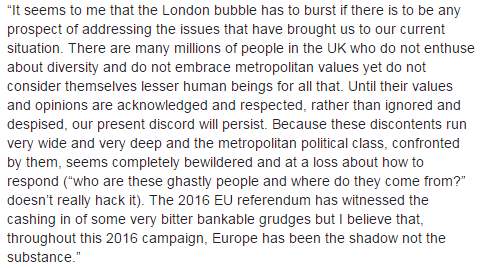
For those of you who still haven't yet seen this, here's a leaked internal BBC memo from David Cowling - former editor of the BBC Political Research Unit (now no longer with the corporation). It sends a warning to his (then) BBC colleagues:


Though his claim that "Europe has been the shadow not the substance" is in keeping with his former line of thinking, Mr Cowling (now of KCL) makes some prescient points there, doesn't he? 

Will the BBC take them on board now? From what I've seen of quite a lot of the BBC's coverage since the result of the referendum, I rather doubt it. 

Feedback and 'Feedback'


We are very much into 'complaints from both sides' territory here, but...

On this week's 'historic' Feedback 'EU referendum coverage special' all of the featured callers criticised the BBC's coverage from an anti-Brexit position.

Most of their complaints were so silly and demonstrably untrue that I ended up agreeing with the robust knock-downs delivered by the BBC's Ric Bailey - the usual 'we got it about right'-spouting senior BBC editor put up to appear on this edition Feedback.

For example, one caller complained that the BBC had failed to challenge Brexit campaigners over that '£350m a week to the EU' claim. 

His complaint is absolutely absurd. That's something I've heard BBC reporters and interviewers doing endlessly, literally since Day One of the campaign. Evan Davis alone must have furiously challenged Leave supporters dozens of times on Newsnight. Today also kept on challenging Brexiteers over it. (It was still doing it last week). Mark Mardell kept on snapping at pro-Brexit interviewees over it too. When the BBC editors gathered for a mass debunking of stats on Today and a similar one on BBC One, that £350 figure was first up for debunking. More or Less kept on debunking it (on various re-incarnations of the same programme). The BBC website's Reality Check started with it. 

And yet this Radio 4 listener failed to hear or read or see any of that, by the sounds of it.

******

Why did Feedback only invite anti-Brexit listeners to complain about the BBC, given that doing so might in itself bring down obvious charges of anti-Brexit bias against Feedback?

An obvious possible line of defence for Feedback here (not that I can imagine either the folk at Feedback or the average Feedback listener ever quite putting it like this!) might run as follows: "Well, that's only evidence that Feedback is faithfully reflected the views of its audience: the Radio 4 audience. That's a well-heeled, largely metropolitan audience even more removed from the general popular mood than most politicians at Westminster!".

That line of defence (dreamed up my me) may have some truth in it (if I say so myself), but how does it explain this bizarre section from presenter Roger Bolton (beginning at 7.47)?
I should, by the way, point out at this time also we have had some people - Stephen Luscombe and Elaine Langham, for example - saying just that they thought the BBC coverage was (now adopting a slightly incredulous tone of voice) biased towards the Remain campaign. I suppose that's an example of Feedback trying to be balanced.
That 'attempt at balance' took all of 13 seconds. Why didn't we hear what Stephen and Elaine actually said? Were the pro-Remain listeners who did appear really representative of the feedback received by Feedback?

Was "I suppose that's an example of Feedback trying to be balanced" simply a two-fingered salute from Roger Bolton to 'people like us'?

Referendum night memories


I feel the hand of history on my shoulder so I suppose I should begin with some insightful comments about the historic events of the past week: Fancy Iceland getting through to the knockout stages of Euro 2016! Who saw that coming?

On the other big Euro-related story of the week, I will continue to stick to my usual, narrow furrow. Never mind what it means, how we've got to where we are, and where we should go from here, I'm going to talk about the BBC. As David Mitchell's Shakespeare in Upstart Crow would say, "It's what I do!"

As I stayed up all night to watch the result of the EU referendum on the BBC I did think about live-blogging it, but decided not to. So thanks to David Preiser for stepping into the breach and giving us such a strong flavour of the night.

All I will say about it is that I found the BBC's election night coverage largely fair up until the moment when the BBC called it for Leave at around 4.40 am. (And I didn't even mind Jeremy Vine's "confusing" graphics.)

One of the two stand-out exceptions, bias-wise, up till that point, was the BBC's economics editor Kamal Ahmed, whose regular pronouncements on the plunging pound and use of that scary-looking graph were delivered in such a tone that he might as well just have gone ahead and announced , "The post-Brexit Apocalypse has begun. Told you so! Why didn't you listen to me?" 


And his reports on the following day's main BBC One news bulletins stuck doggedly to that same plunging pound story - even after, by the time of the BBC One News at Ten on Friday, the pound had already substantially recovered. It was left to newsreader Huw Edwards to point that out, in a few words, just before Kamal's latest overwhelmingly gloomy report.

The other stand-out exception was the way Nigel Farage was repeatedly condemned and sneered at, on and off, throughout. Most of that may have come from their guests but the BBC reporters/presenters kept laughing along with the sneers and never once sought to challenge the criticism of the UKIP leader. UKIP ought to look into those moments very carefully. I'm quite sure my memory isn't playing tricks on me there.

The change in tone after the BBC called it for Leave was so startling that I laughed out loud. It was like something from one of those Chris Morris/Armando Iannucci media-mocking programmes from the 1990s. All traces of remaining jollity vanished. Grim faces and nothing but grim faces arrived from BBC reporter after BBC reporter....

....and so it stayed throughout the following day: 


And for minutes after that announcement the caption across the bottom of the BBC's screen largely stuck to reading, "Pound drops to lowest level since 1985". 

That mood has stuck on the BBC face, like after a changed wind in the old saying, ever since.

Saturday, 25 June 2016

Opting out of the hard shit


We’ve had a couple of days to think. This piece by Fraser Nelson interested me, both for the article itself and also for some of the below-the-line responses. 
Apparently, before resigning, David Cameron had asked his aides: “Why should I have to do the hard shit for someone else, just to hand it to them on a plate?”
Fraser’s answer, and I suspect he speaks for many people, went something like: ”you are the prime minister, and many people are counting on you to do so.” 

Looking back over events, it seems that Cameron handled the whole affair quite badly, showing little evidence of foresight. He could have done with one of those flow-charts that help people make decisions. You know, diagrams that offer yes/no routes to an eventual crock of gold. 
It now looks as if he hadn’t even properly considered the possible outcomes of the referendum - quite simple; yes or no. Not just yes.
Theory of change

It looks also as though he hadn’t properly considered the outcome of his promise to support Brexit if he failed to secure significant reforms for the UK, and then refusing to admit the inadequacy of the crumbs he was fobbed off with, then pretending that the referendum was about leaving or remaining in a ‘reformed EU’.  
Not forgetting a few other things he hadn’t properly thought through, such as prematurely announcing that he didn’t intend to stand as PM next time round. 
Then, there’s Turkey.
Oh yes, and announcing that as well as not ‘seeing why he should do the hard shit’, he announced that he wouldn’t do anything at all till October, thus provoking threats from various shunned EU officials about the bad shit in store if we didn’t bloody well get a move on with article 50.

The one thing that underpins this dire situation is this business about immigration. It seems to me that the BBC has played a huge part in toxifying this topic. There are two parts to the public’s worries about immigration, one mentionable, the other unmentionable. 

Mentionable - barely - is the numbers argument. We’re a small island with limits. We can’t fit everyone in. We can’t accommodate them all. We’re bursting at the seams. 
Also in this category is the question of economic inequality, a conundrum that works two ways. The expats whose pensions stretch further in, say, Spain, and the Brits who abandon all principles and amass fortunes working in Arab states. 

But the very real effect on the UK by migrant workers whose willingness to work harder for less, causing job losses for locals and driving down wages, has at last made this particular aspect of immigration, and the attendant fears thereof, mentionable.

Then there is the unmentionable. Something that only people like Paul Weston or Tommy Robinson dare to articulate. Outwardly it’s called ‘cultural’. It’s the way that some neighbourhoods have become alienating and frightening to the original residents and to outsiders. 

Most of all the fear is of Islam and the Islamification that’s spreading through Europe. It is already causing deep division here. But we cannot mention it without being ostracized by the fools and the blind, who think tolerance, as well as wealth, should be redistributed - to the deserving and the undeserving, indiscriminately. 

I have to generalise about the BBC. I know there are some exceptions, but broadly speaking the BBC has always taken Palestinian propaganda at face value and swallowed it whole. Lock, stock and barrel. People running the BBC have little or no knowledge of history, and no doubt most of them still believe, along with Ken Livingstone, the fictitious propaganda that more than 700,000 innocent Palestinians were driven out of their homes at gunpoint by Jewish terrorists in 1948 to create Israel.  Let’s face it, if you believed that, you might see things the way they do, coupled with the inexplicably romanticised version of Islam that the BBC continually portrays.

That is the only explanation for, e.g.,  the BBC Trust’s inability to understand why Tim Willcox’s ‘clumsy’ / ‘badly worded’ remark to an Israeli-born witness after the Paris terrorist attack was inappropriate and offensive. They seemed to think he had made a valid point, and, after all, had apologised for unwisely blurting out ‘Jews’ when he meant ‘Israelis’. 
Their faith in the righteousness of the Palestinian cause prevented them from understanding that the Paris attacks were part of something much more fundamental than ‘revenge’ for what they erroneously believe to be a ‘Jewish-only’ Israel, a country illegally and unjustifiably obtruded on stolen ‘Muslim land’. The fundamental reality that believers of such ahistorical fiction could never grasp is of course that the Paris attacks were fuelled by the same old same old. Antisemitism. 

The BBC could easily show the public just a fraction of the hatred that is openly promulgated throughout the Arab world. Not difficult. It’s on the internet, on Arabic TV, in Arabic education. But they never, ever do. 
That is why there’s still a taboo over criticising Islam. It’s branded racist. It makes you a bad person, a hater. The world turned upside down.

I don’t know if this is wishful thinking, but I’m beginning to think that underlying those fears about immigration is a deeper fear of creeping Islamisation. There is reason to worry. Evidence is gradually seeping through. But as of now, we have to euphemise it or be branded bigots. 

Earlier today Jeremy Corbyn eventually came out to make a speech, but it was so boring that both the BBC and Sky cut to Nicola Sturgeon and then to some EU bigwigs pronouncing on how they were going to punish us for rejecting them.


Corbyn has announced an enquiry into immigration, and why so many Labour voters opted to Leave. That’s in addition to the enquiry about antisemitism, which has expanded to embrace Islamophobia, racism and bigotry. He ignored the more interesting topic, that of those dastardly mutinous plans to depose him.

It’s like, break open the popcorn, and be entertained by everyone opting out of the hard shit.

Friday, 24 June 2016

Can't believe you wanna leave


Referendum - impetuous observations.

For once I’m going to go against my own better judgement and make some impetuous observations.
I didn’t stay up all night, but I did peep a couple of times. Or three.

I think the pollsters have a lot to answer for, as well as the media. Will we never learn to ignore them? The certainty that Remain would prevail undoubtedly encouraged some extra Leave votes from the uncertains or the undecideds, whose Leave votes were in fact intended as protest votes.

All the guests in Victoria Derbyshire’s Manchester studio this morning looked crestfallen, even the Leave voters. I think everyone was taken by surprise, and I think the disappointment was pretty predictable - a mixture of anti-climax and apprehension. I didn’t watch it all, but from the parts I did see I thought guests spoke generously and perceptively, although I do think Victoria herself was unable to conceal her disappointment at (and disapproval of) the outcome.

Victoria's guests - generous and perceptive

I wish David Cameron had waited a while before resigning. I really think he should have waited. Some of ‘the people’ who have ‘spoken’ quite rightly feel abandoned.
As soon as I saw Samantha coming along beside him (why the long face?) I knew he was going to do it.

The main thing his resignation says to me at this moment (I may change my mind later) is that MPs are unreliable. I understood the PM had tried to reassure us that he would stay and fight, either way. 

 All those people (I think) including Michael Fallon and Chris Grayling who are now telling us he could do no other than resign should have spoken up before. 
They should have explicitly said "if Remain loses, David Cameron has to resign"  rather than writing letters begging him to stay on if we vote for Brexit.

Now he has both resigned and postponed the implementation of negotiations for Brexit in accord with article 50, leaving a vacuum in which various panic measures - such as last-minute surges of would-be immigrants -  not to mention unnecessarily prolonging uncertainty, which will probably bring more economic / financial turbulence / volatility and sour things still further. 

David Cameron showed us how inflexible the EU is by the paucity of the reforms he was able to obtain for us despite his best efforts. I did notice that the word ‘reformed” was not included in his resignation speech. 
The first half of his speech was generous and  reassuring, but I’m sorry to say that his resignation almost seemed like petulance disguised as self-sacrifice.


Ask me tomorrow, and I might have changed my mind.

Slow news day


From Twitter:

Wednesday, 22 June 2016

The Great Debate

What did you think of the Great Debate? What did you think of the BBC’s contribution?

First you sit through the debate itself. Then you are fed various reactions (not only by the BBC by the way, but by the press, Sky, and so on) and you start to wonder if you had actually watched the same programme.

One small thing summed up the impact of the Great Debate. Afterwards, Reeta Chakrabarti interviewed four of the people who had been chosen to put questions to the panel, two from each ‘side’. 
Not one of the four had changed their minds in any way whatsoever. Of course asking their question in such a public arena must have been nerve-racking, so perhaps they were too distracted to listen to the answers. 

Or it could be that nothing much short of cataclysm will change the human mind when it’s firmly set on matters it cannot fully grasp. Mine included. Well, if that is true, then the great debate could only affect the undecideds.

“.....unite against the hate that killed her” says Harriet Harman on TV as I type. See? That sort of thing.  Are ‘Remain’ actually claiming Jo Cox as their martyr?  No - how distasteful of me.


Many pundits are declaring that Ruth Davidson emerged as the clear winner. But why? Probably because they weren’t quite as sick of the sight of her as they were of the others. I couldn’t help noticing that they passed on Frances O’Grady. Very wise.

As far as I could make out, Ruth Davidson had two tactics. One was to insist on extracting undeliverable, speculative promises about immigration from the Leave side, and the other was to intermittently accuse them of lying. I can’t see how anyone thought her performance was a triumph.

I must be the only person in the world (apart from my family) who found the Leave side’s mission to insert the phrase “take back control” as many times as possible deeply insulting to our intelligence. But  on the other hand, if the general public are genuinely as dumb as they are portrayed by the media, only repetition of basic slogans could penetrate our rhinoceros-hide-like stupidity.

Another thing the media has decided for us, thank you very much, is that the Remain side wins on the economy and the Leave side wins on immigration. Somehow that seems to have been established as fact. 
The great debate, however indicated that this could actually be another media myth. 
I found the Leave arguments on the economy just as robust as the Remain’s, and I did think the Remain side raised a few doubts about post-Brexit’s ability to reduce the number of immigrants. 

Sovereignty is the most interesting aspect of this conundrum. I am persuaded by the argument that (oh no! I have to say it) we could ‘take back control’, but doubts creep in, even to that prospect, when I think of the calibre of the ‘we’ that would actually be in control. The warring Conservatives? The retrogressive Corbyn Party?
I know we can kick them out if we don’t like the direction they’re taking us in, but the juggernaut takes so damned long to change course that it all seems so cumbersome, and by the time we realise we’re heading for the rocks the damage has been done. And it’s irreversible. If you’ll excuse the nautical analogy. (Since the image of being driven over cliffs in a speeding car has been appropriated by both sides)
While we’re on the topic, I rather like the image of being shackled to a corpse. It’s very evocative. 

As for the other speakers - I thought Sadiq Khan was pretty terrible. For one thing his enunciation is poor. He gabbles. But that soundbite that the media is so fond of : “Project hate” is beyond unseemly. I just found it inappropriate and divisive.

I think we’ve seen a bit too much of Boris in buffoon mode recently. He spoke on Sky this morning in a much more considered tone, and I wish we’d seen more of that and less of the other. Gisela and Andrea were warm and personable, but we’d seen too much of the same from them already. Maybe they should have given Daniel Hannan a go.


Out of interest, here’s an excerpt from something from Gatestone that popped into my inbox.
“Even after hundreds were murdered in terrorist attacks over the past months in Paris, Brussels, California and Florida, the leadership of the U.S. and Europe persist in their politically correct denial of the threats from radical Islam. 
Worse, led by the European Union, Facebook, Twitter, YouTube and Microsoft have been trying to impose a muzzling "code of conduct" to censor and remove from the internet any comments they consider "illegal hate speech." This, in the words of Soeren Kern, "could include virtually anything deemed politically incorrect by European authorities, including criticism of mass migration, Islam or even the European Union itself." 
We have recently felt the effects of it; we were censored by Facebook twice in one month, once just for pointing this policy out. If you have not yet been the victim of an assault on your freedom of speech, prepare to be one soon. Facebook suspended the account of Ingrid Carlqvist after she posted our video about Sweden having the second-highest rate of rape in the world. The video has been watched by more than 200,000 people. Then, Facebook blocked our article by Douglas Murray for objecting to Facebook's censorship.”
I haven’t got a Facebook account, but I have access to one, and my family agree that all their Facebook timelines have been littered with semi-aggressive posts promoting Jeremy Corbyn and Bernie Sanders,  and denigrating the ‘right’. Very intimidating if you happen to take a different view.

People have been making snide remarks about Israel and the Eurovision Song Contest. I must say I don’t know what the necessary qualifications are. Also I don’t care. But if anyone’s interested in Israel’s relationship with Europe, do have a look at this.  Click please.
It’s both a prospective model for Brexit and a little ad for Israel that I think Jo Cox’s followers  ought to be made aware of.

Israel is in Europe too. 

The United Kingdom has recently been totally absorbed with the Jun 23rd referendum on whether the UK should Remain or Exit the European Union.  The arguments in favor of the Remain camp appear to hinge on its claim that the UK’s economy would collapse if it terminated its EU membership.  UK citizens should not panic, however, but instead take a closer look at the “Israeli model”. 
The modern State of Israel has been an “adopted” member of many European entities for some time - mainly due to the unwillingness of surrounding Arab countries in Asia and Africa to accept the Jewish State into “their” continents.  Israel is not a member of the EU, but the current relationship has many mutual benefits.  Using news articles since the beginning of this year, here are some examples of how the relationship benefits both Israel and Europe.’ 

Israel – it’s practically holding Europe together!