Tuesday, 9 January 2018

Activists


'BBC Kim Ghattas' has a very large bee in her bonnet (h/t Monkey Brains).  

You may (or may not) recall that 'viral' video of the feisty Palestinian girl who repeatedly slapped and kicked a couple of Israeli soldiers late last year. The Israeli soldiers responded with admirable professionalism, taking it all on the chin and moving away to diffuse the situation. The girl was arrested later.

In such a conflict, people take sides. For some, the video showed the bravery of the Palestinian girl. For others it showed the admirable professionalism of the Israeli army. 

It's possible to see the girl, Ahed Tamimi, as both an aggressor and as a victim. She was certainly aggressive towards the Israeli soldiers and obviously considers herself to be a victim of the Israeli forces who her family accuse of invading their property. Others say that she's actually a victim of her father because her father has been exploiting her from before she was even a teenager, filming her provoking Israeli soldiers from around the age of 11 - pushing her fist in their faces, slapping them, kicking them, all on camera. (The poor lass has become something of a celebrity as a result.)

If you stand back a bit, I think the 'Others' have a point. What normal father would repeatedly put his daughter in such situations (over a six-year period), again and again? (Not that she ever came to any harm at the hand of the Israeli army.) 

His intention was obvious: either make a heroine or a martyr of his poor daughter. (Does Ramallah have social services?)

Her father, as you might have guessed, is an activist and his extended family includes convicted terrorists. 

That said, I've been following this story closely and one of the peculiar features of it is there's a hot dispute about Ahed's age. Google it for yourself and you'll see that 'prestigious' media outlets are divided over whether she's 16 or 17. 

Some pro-Israel sites contend that she's actually 18, though I think they're misreading earlier reports and that she really is actually either 16 or 17 - and most probably 16. (I've dug into the matter!). 

Only the wildest anti-Israel propagandist sites (and even next to none of them), however, claim that she's only 15....

....oh, and the BBC's Kim Ghattas, who calls her a "15 yr old Palestinian activist". 

Have you fact-checked that, 'impartial' Kim of the BBC?

As you can see from her first tweet (below), 'BBC Kim' is wholly trusting of Ahed's father and his "poignant" letter. 

The man is an activist. Mightn't she consider that he's engaging in propaganda (as he surely is)?. Why just trust his word, unless she wants to trust it? 

This wasn't an impartial tweet from 'BBC Kim Ghattas', and nor are the others. (Is she an activist too?)

Anyone who watched that video and saw the Israeli soldiers being stoical and professional towards Ahed as she slapped and kicked them again and again will think BBC Kim's depiction of what happened - "Ahed Tamimi, unarmed, slapped a gun toting Israeli soldier who was in her back yard" - somewhat lacking in terms of the full and unvarnished truth. Take "gun toting" as a choice of words. Not exactly an impartial one, is it? And Haaretz, who Kim cites, have also published pieces headlined Ahed Tamimi and Her Family Aren't the Palestinian Saints You Want Them to Be (a piece Kim Ghattis didn't link to).

And then, in the final tweet, 'BBC Kim Ghattas' goes on to express a extremely non-neutral opinion. 

Now, yes, it's all Twitter, but - as we know from Helen Boaden, Mary Hockaday and now Fran Unworth - Twitter counts. BBC reporters aren't allowed to unimpartial on Twitter and, if they are unimpartial on Twitter, according to BBC supremo Fran Unsworth, they mustn't report on that subject for the BBC.

If I hear Kim Ghattas reporting on anything to do with the Israeli-Palestinian question ever again I will write to Fran Unsworth and ask her to bring Ms Ghattas to book. 


Monday, 8 January 2018

Laura, Laura and a 'glitch'


A bright, new dawn?


A string of tweets this afternoon from Matthew Moore of the Times broke the news of the goings-on today at the BBC:
  • NEW: BBC staff told that anyone who has indicated support for Carrie Gracie, or tweeted an opinion about BBC pay, can no longer present any segments on BBC pay.
  • The directive, from new director of news Fran Unsworth, applies to off-air producers as well as on-air presenters.
  • Given that dozens (hundreds?) of BBC women and men have publicly backed Carrie Gracie, this threatens to turn into farce...
  • UPDATE: BBC says that staff have been reminded of existing guidelines that reporters who have expressed public views should not conduct interviews on that subject.
How fascinating! As the Guardian puts it, "the BBC has banned journalists who tweeted support for Carrie Gracie from presenting on-air segments about the gender pay row at the broadcaster...as  editors at the BBC moved to enforce its editorial guidelines by stopping journalists reporting on the issue if they have supported Gracie or have been campaigning for pay equality":
A BBC spokesperson confirmed that editorial guidelines were being applied, saying: “Where a presenter or reporter has publicly expressed a view on a particular issue they would no longer be perceived as an impartial voice, therefore it is right they do not conduct interviews on that issue. This is in keeping with editorial guidelines.” 
The BBC’s guidelines include a segment about reporting on controversial subjects concerning the broadcast. They say the reporting “must remain duly impartial, as well as accurate and fair”. The guidelines add: “We need to ensure the BBC’s impartiality is not brought into question and presenters or reporters are not exposed to potential conflicts of interest.”
What an excellent decision! Let's hope this policy is now enforced across the BBC on other issues too (from Brexit to Trump, from transgenderism to abortion, etc).

If it is enforced, then here are going to be lots of BBC presenters suddenly disappearing from programmes and then returning ten minutes later and lots of BBC reporters no longer able to properly report on their own subjects!

Censorship


I read the Times's take, Lonely hearts jihadist couple guilty of bomb terror plot, before reading the BBC's, Derby terror plot: The online Casanova and his lover. The Times begins:


After reading that it and then moving onto the BBC News website, it surely must strike you that Dominic Casciani's BBC piece is deliberately avoiding using the word 'Muslim'. The word is conspicuous by its absence. 

The Times mentions the name of the dating site where the terrorists met - SingleMuslim.com - not only once but twice. Dominic Casciani for the BBC, in contrast, despite writing a much longer piece, only refers to it as "a dating website", never naming it. 

Incidentally, the news of their conviction is now nowhere to be seen among the 13 top news stories on the BBC's home page. ITV and Sky still have it among their main news stories. 

The Carrie-on Saga

The  Carrie Gracie saga gets more farcical by the minute.

Firstly; how can the BBC achieve “equality” without,  a) levelling up women employees’  pay or b) bringing male employees’ pay down? (allegedly forbidden under employment law)

Secondly; not quitting the BBC looks like having cake and eating.

Thirdly; why agree to co-present the Today Programme  with stratospheric-salaried John Humphrys?

Fourthly; what if the entire sisterhood decides to sue the Beeb?

Fifthly, does ‘equal pay for equal work’ apply to a unique post like, say, China Editor?

Sixthly; some below the line commenters are comparing Carrie Gracie unfavourably to Jeremy Bowen in terms of ‘danger money’. They say Bowen could be shot at any moment.


Sunday, 7 January 2018

Breaking news...


Cripes! The best BBC foreign reporter by far is quitting her role at the BBC...


Ironically, the gender pay gap row may largely be a myth but there are, apparently, still a very small number of major employers out there paying women less than men for doing the same job. And the right-on BBC is one of them.

Best wishes Carrie! If you want to write for Is the BBC biased and misogynistic? you know where we are! (We're lacking a China editor).

Update: This post has been edited. Carrie hasn't quitted the BBC, as I originally wrote. She's merely quitted her job as China editor. She's staying with the BBC and says she'll return to the BBC newsroom if they give her the same inflated salary as her male colleagues. (The 'inflated' bit is my addition). 

Further Update: Carrie has written about the "crisis of trust" at the BBC tonight at The Spectator. (Yes, not the New Statesman). It's a long and compelling whinge. ("Mine is just one story of inequality among many", she writes.) 

I don't like popcorn but I'm stuffing it in tonight regardless.

Oh, and BBC watchdog Samira is 'standing' with Carrie...


Well, it may not actually be happening to you, but it does seem to be happening to BBC women. 

Yes, it's tempting to quote one of the BBC's greatest sitcom characters, namely Battery Sergeant Major Williams, but we should surely all stand with Carrie. 'Inflated salaries for all at the BBC!' 'Je suis Carrie!' (P.S. In Chinese, according to the infallible Google Translate, that's 我是嘉莉。). A judge-led public inquiry is surely needed.

Oh, and here comes Kirsty...


And now to bed, feeling positively pregnant with popcorn...

Is this a biased BBC report I see before me?


Macpicard

This lunchtime's The World This Weekend was lacking the glamorous, globe-trotting Mark Mardell. 

Instead of Mark reporting (Lord Brett Sinclair-like and at the BBC licence-fee payer's expense) from some sun-soaked, glamorous continental European location like Barcelona or Lisbon or Lake Como  - or for that matter the even-more-glamorous British seaside - poor old grey, depressing Radio 4 SJW Matthew Price (no offence! lovely chap!) got packed off instead to the knife-crime-infested swamps of London. (Hope he wins his award!). 

A The World This Weekend special on knife crime was the result. 

By chance, I was wanting to hear about that very subject after reading a fascinating piece (a couple of days ago) at Spiked by Luke Gittos entitled There is no epidemic of knife crime. 

Luke argued, with lots of statistical support, that the evidence just isn't there to support the contention that there's an unprecedented epidemic of knife crime. Knife Crime has been with us for decades, fluctuating up and down, spiking here and spiking there. 

He also argued though that there's a nihilistic culture among young black men which is the underlying problem, especially in London, and that this is the problem that dare not speak its name, and that the "tiptoeing" around it does more harm than good.

Well, today's The World This Weekend, strongly going with the 'epidemic' contention, most certainly did tiptoe around the 'nihilistic culture among young black men' issue. We heard lots of talk about 'the community' and 'communities' but nothing about which community or communities.

Also, as noted on the Open Thread, Matthew Price avoided many other issues, such as "lone parenting and poor parenting, incentives to lone parenting, poor school discipline...and message sent by repeat offending let-offs" as well as the influence of BBC-acceptable-and-promoted musical genres like violence-friendly grime.

(Honestly, why doesn't the BBC get as worried about grime as it does about 'insensitive' tweets?) 

Matthew did ask one question (to the lady who thought that a 'holistic' approach was needed to tackle the issue) about some listeners possibly thinking that a 'lock 'em up' approach was needed to deal with knife crime, but that was the single concession to the idea of balance in this overwhelmingly left-liberal take on the issue. 

Please listen for yourselves and see what you think (if you've a spare 25 minutes or so).

Is the BBC Nostradamus?


I was reminded today about a high-profile BBC programme from 2005 called How Euro Are You?. 

With the aid of pollsters the BBC 'found' that 57% of the British public wanted to "integrate fully" with the EU and that a mere 10% of the British public wanted to leave the EU. That, of course, was no more representative of the actual public mood back then than it is now.

That in turn reminded me of that notorious Newsnight panel, also aided by pollsters, which produced shows of hands that went overwhelmingly against sovereignty mattering when it came to what mattered in the EU referendum and which contained as many people who said they felt 'European' first as felt 'British' first (a point of view that has always been a tiny minority view).

And then there was the Walsall North panel on Newsnight  during the 2017 general election, chosen (of course) with the help of pollsters, which left viewers with the strong feeling that the sitting Labour MP was about to be re-elected in an absolute landslide. Not one of the chosen members of the public said they would be voting Conservative. In a huge stroke of irony for Newsnight that Labour MP was actually one of the very few Labour MPs to lose his seat in 2017 to the Conservatives (with a 6.1% swing).

And I've just remembered this today...Back in February 2016 I moaned about a Mark Easton report for the main BBC One news bulletins and the BBC News Channel in a piece I called Mark Easton wins it for the EU?. Mark's  voter panel from Lichfield, selected by pollsters, produced a majority for Remain. The actual result from Lichfield, on June 23rd (on a massive 80% turnout), was 59% for Leave, 42% for Remain. 

Why does the BBC keep producing 'voter panel/public opinion' results that are completely at variance with reality - and, even worse, invariably completely at variance with reality in very particular directions?

Does anyone know of any counter-examples? 

Gender truth gap?


You may have noticed this story yesterday as it was a lead story on the BBC News website for much of the day: 


The Comments thread below it is chock-a-block with people slamming the BBC's reporting. The highest-rated comment, for example, says, "This has been debunked time and time again. When variables such as the actual job done, the hours worked, experience, qualifications and age are taken into account the mythical gender pay gap suddenly disappears. Stop peddling this nonsense, BBC." The reporter's Twitter feed has also been filling up with similar complaints. 

All I'd add is that, checking NewsSniffer, it took 12 hours after the piece was first published for the following 'balancing' paragraph to be added: 
There was some criticism of the way the data was presented, some made the point that men are paid more than women in certain companies because they are in higher-paid positions.
I suspect she'd been looking at some of the feedback she'd been getting and thought she'd better add it.

Lesser spotted right-wing comedian sighted on BBC


Rod Liddle has a piece in The Spectator registering his surprise and pleasure at the appearance of a right-wing comedian - yes, a right-wing comedian! - on Radio Four’s The News Quiz. 

And is if that wasn't unprecedented enough, the aforesaid comedian (Simon Evans) went on to defend Donald Trump and criticise the NHS.
The audience wasn’t sure what it should do, and Evans was of course ribbed for his opinions by the other three panellists and indeed the compere. Which is when I thought: hang on, why should I be grateful to the BBC for allowing one single representative of majority opinion on air? And yet it was such a breath of fresh air. Not because I’m a conservative, but just for the sake of diversity of opinion. 
This is the thing. You think the BBC news programmes are bad? It is away from the news programmes that the BBC really shows its bias. And so we end up being grateful when someone who speaks for the majority – or at least a very large minority – actually gets airtime.
Having listened to it myself, I can confirm that it was a breath of fresh air - and funny too. 

A fellow comedian made a telling point, however, in reply to Simon (on Twitter): "I thought you were brilliant. It's notable how jarring it is to hear those opinions on Radio 4." Very true.


Anyhow, I've got a potential cutting for the show. It comes from The Guardian (well it made me laugh): 

Saturday, 6 January 2018

"European legend"


Angela Merkel, Empress of Europe

BBC World Affairs Editor John Simpson's piece on the plight of Mrs Merkel on this morning's Today sounded a wistful and admiring note. It ended:
It feels like the last chapter of an important, possibly an irreplaceable, European legend. 
It was The European Legend's decision to open doors of Germany (during what the BBC man called "the refugee crisis", though others - more accurately - call it "the migrant crisis") that's cost her dear, he said, as the last election showed:
Angela Merkel went, Theresa-May-like, into an election in September and got a real pasting. Her Conservative group scored worse than at any time since the West German state was founded. The Socialists did quite badly too, but the right-wing - too far right-wing - Alternative für Deutschland won its first seats in the Bundestag.
You'll note the opinion hiding in full view there: the too far right-wing AfD.

Update: Please see Ozfan's comment below. JS was talking BS.

"He claimed"


Just good friends?

If there's one thing we do know about the Iranian regime it's that it has been brutalising women and murdering gay people for nearly 40 years. 

According to the BBC, however, this isn't something we 'know' at all. It's only something people 'claim'.

Here, for example, is the BBC News website today:
Mr Tugendhat said it was "hardly a knee jerk reaction" to condemn the regime, which he claimed had been brutalising women and murdering gay people for 40 years.
And here's BBC political correspondent Leila Nathoo on Today (at 7:02 this morning):
The Conservative MP Tom Tugendhat, who chairs the cross-party Commons Foreign Affairs Committee, said it was "hardly a knee-jerk reaction" to condemn a regime which he claimed had been brutalising women and murdering gay people for 40 years.
(The emphasis on 'he' in that last quote was Leila's own). 


True story


He's a "Proud Scot living in England. Happily married with 3 lovely daughters. Nothing to do with US politics or running the White House etc" whose 'pinned tweet' reads "This isn't the Steve Bannon you're looking for". 

Apparently he's been receiving messages from angry Trump supporters accusing him of treason. 

Though he's taking it all with good humour, I do feel for him. One of my friends at work is called Ayatollah Ali Khamenei and he's always getting tweets from people who think he's a different Ayatollah Ali Khamenei (namely the Supreme Leader of Iran).

Aya (as we call him) doesn't mind the confusion as a lot of the tweets he gets are really very nice, especially the regular very friendly messages he receives from a chap called Jeremy who claims to work in the House of Commons.

True story. And Nick Robinson can back me up on it. 

The elephant in the ward


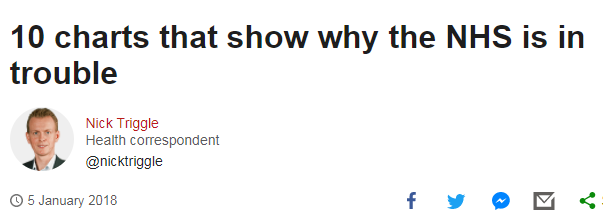
The BBC News website has a new 'explainer':


Now, there's no prize for guessing what doesn't get a mention in the entire article. Yes, immigration. (h/t Not a Sheep). 

According to Migration Watch, immigration has had a major impact on NHS demand. As an indication of the scale of the possible impact, they write: "In 2015/2016 there were almost 745,000 new migrant GP registrations in England, Wales and Northern Ireland – that is more than one every minute and the highest number on record."  

It's a familiar complaint on blogs hereabouts that the BBC invariably sweeps this particular elephant under the carpet whenever it discusses 'why the NHS is in trouble', but familiarity doesn't make the complaint any less true. 

Full tilt


From this morning's Today:
Nick Robinson: Without the pain would there have been the music?
Eric Clapton: Probably not. No. I think the only part that is regrettable, the most regrettable part is, I got drunk. And that part - it's like 20 years of drinking - where I did really offensive things. I was a nasty person, which I say in the movie...
Nick Robinson: You focus on an incident you are often reminded about in which you say you were 'semi-racist'. I mean you were racist on stage. You were fully...
Eric Clapton: Full tilt, yeah.
Nick Robinson: Words we don't normally use on the radio. Words like 'wog'. Words like 'coon'.
Eric Clapton: Yes.
Nick Robinson: To describe the people you wanted to get out of the country.
Eric Clapton: Yes, so I mean as a simple-minded working-class villager like me, which is what Brexit is all about, there was a sort of air of this around the early 70s. And I'm not excusing myself. It was an awful thing to do.
Nick Robinson: In a way that view had then...you praised Enoch Powell at the time...you think the roots of that are in Brexit?
Eric Clapton: I think so. Yeah. I think it was a gut-feeling referendum. I had ceased to be xenophobic and I was very concerned about all the people that had come here who might be asked to leave, so I voted to remain.
At which point Nick Robinson asked him if he was being offensive again now by smearing 17.4 million people as 'xenophobic'? No. He just moved on. 

He's a mentalist!


Donald J. speaks his mind:


And so (drily) does the BBC's John Simpson:

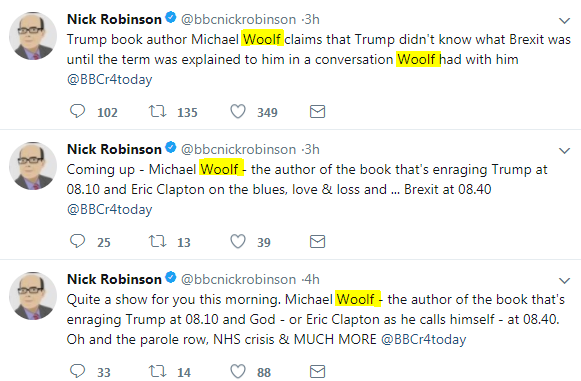
Who's Afraid Of Michael Wolff?


Just a little Twitter fun for the weekend...

Four days ago:


Today:

The man's name is Michael Wolff. 😎

Friday, 5 January 2018

Impartiality


Antonia Blair

Is perception 'all'?

Regular readers of this blog will know that the BBC isn't willing to accept criticisms of BBC bias (with rare and telling exceptions) unless they've been monitored over time - especially over long stretches of time.

'Due impartiality' demands a long view, apparently. 

Yet when the BBC is monitored over time - especially long stretches of time and in very great detail - the BBC still won't accept the criticism. 

And that, at the beginning of 2018, is where we stand.

Nowhere.

As ever.

*******

Shall we run yet another experiment then? Or Heisenberg-style, might the mere act of observation skew the result (especially if the BBC observes us doing it)? 

Well, if you're one of the few people who still watch Newsnight...

(...and, yes, I'm one of you [albeit largely for the purposes of writing a blog about BBC bias]...)

...you might have noticed that - so far this year on Newsnight's 'Viewsnight' feature (one week's worth of views) - there's been:


- followed by


Of course, to those of use who think that the BBC has an Establishment, soggy-left, pro-EU bias this might not be perceived as exactly surprising.

And wouldn't you think that any seconded Newsnight editor might give that much more than a moment's thought and then, having done so, take strenuous efforts to ward off such criticisms - especially if they were really living and breathing 'BBC impartiality'?

*******

By the Grace of The Guardian...

But these are only two 'Viewsnights' in a row (albeit the first two chosen for 2018).

Is perception 'all'? Does 'perception' tell us the truth about BBC bias? Or does it mislead us?

"Time will tell", it might be said. But will it?

And even if it does will it it make the slightest bit of difference? 

*******

Well, to round off this week's Newsnights, the final 'Viewsnight' this week (which I've just viewed) comes from the Guardian / BBC Radio 4 writer-presenter Grace Dent. And she's promoting veganism. 

*******

So that's feminism, anti-Brexitism and veganism in just one week from the BBC's Newsnight! 


*******

We might just as well retire now!

So I say again: Happy New Year! God bless us, every one!

More on 'Sir Starmer'...


The Shard (and Sir Keir Starmer)

Following on from the previous post, here are transcripts of how the BBC's and ITV's news bulletins respectively covered Sir Keir Starmer's role/non-role in the Warboys controversy this evening.

First, here's BBC One's News at Six:
Mark Easton (BBC): The Director of Public Prosecutions at the time, Keir Starmer, now a Labour shadow minister, today urged victims to take the allegations to the police: 
Keir Starmer: I think these decisions were nine years ago. It's very important that you go to the Crown Prosecution Service and get an accurate readout of the decisions that were made, particularly if further allegations are likely to be made now. Thank you very much indeed.
Now, here's ITV's Evening News tonight:
Ria Chatterjee (ITV): Today ITV News challenged Keir Starmer, who was director of public prosecutions at the time Worboys was sentenced: 
Keir Starmer: I think these decisions were nine years ago. It's very important to get an accurate readout of the decisions were made, particularly if other allegations are likely to be made now. Thank you very much indeed.  
As you can see, ITV took the same route as Sky, beginning with ITV's 'challenge' to Sir Keir, thus raising the suggestion that the shadow Brexit secretary has questions to answer. Mark Easton, in complete contrast, chose not to rouse any suspicions in the viewer's mind that there is controversy about Sir Keir's role/non-role here. 

Hmm.

If this and the previous post show anything, it's that the BBC's most widely-accessed outlets are taking the 'nothing to see here' approach to the Keir Starmer angle while ITV and Sky are taking the 'there could be something to see here' approach to the Keir Starmer angle.

Now, I'm not being partisan here. I don't really care. It's just such a blatant difference between the BBC and its TV rivals here, that something must account for it.

At least one media outlet is betraying bias, surely?

What about Channel 4? Well, checking Channel 4 News tonight, they don't say much about Sir Keir either but even they say (thus suggesting that Sir Keir was involved and has questions to answer):
A word search by the Met police revealed dozens more women had made allegations to them about Worboys, but the then Director of Public Prosecutions Sir Kier Starmer, now Shadow Brexit Secretary, decided it was not in the public interest to bring any more charges.
So the BBC is a clear outlier here.

And they are a clear outlier both on their News website and their main TV evening news bulletin.

Something must account for the BBC's different (more helpful) approach to Labour's shadow Brexit secretary, mustn't it? But what?

'Sir Starmer' - A case to answer or no case to answer?


BBC News report (screengrab)

Reading this evening's reports about the release of John Worboys, the London black cab rapist, there's an interesting difference between the main online reports from BBC News and Sky News concerning the role (or non-role) of Labour's shadow Brexit secretary Sir Keir Starmer eight or so years ago.

Labour's Keir Starmer, director of public prosecutions in 2009 and the current shadow Brexit secretary, refused to answer questions about the case when approached by Sky News.
Asked whether he thought the right decision was made by prosecutors not to pursue further allegations against Worboys, Sir Keir said: "These decisions were nine years ago.
"It's very important you go to the Crown Prosecution Service and get an accurate read out of the decisions that were made, particularly if further allegations have been made now."
The CPS said Sir Keir Starmer did not have "any involvement" in Worboys' case.
Sir Starmer [sic] had faced questions over the release as he was director of public prosecutions at the time of Worboys' trial.
Speaking outside his home on Friday, Sir Keir Starmer said that if anybody felt allegations they had made had not been sufficiently investigated they should "go to the police".
When asked whether he thought the right decision was made by prosecutors, the shadow Brexit secretary said only the Crown Prosecution Service could provide "an accurate readout of the decisions that were made".
As you'll spot Sky goes straight in with an anti-Starmer point about him refusing to answer questions from Sky, whereas the BBC goes straight in with a pro-Starmer point about the CPS saying it was nothing to do with him.

Take your pick!

Wednesday, 3 January 2018

And repeat...


So Guido Fawkes has caught the BBC out for failing to mention that a staff nurse they "allowed...to repeatedly attack the government over the so-called 'NHS crisis' this morning" is "a top Corbynista, star of a Labour Party Political Broadcast and hardline left-wing activist":
5Live introduced Danielle Tiplady by saying “Let’s bring in Danielle who is a staff nurse”, before she went on to reel off Labour attack lines on the NHS. 
The BBC has admitted they got it wrong with a semi-apology on Twitter:


The interesting thing here is that this is the second time Fawkes has caught the BBC out over this lady. And, Googling around, guess what the BBC's answer was last time, according to the Mail? 


Almost identical words. Talk about sticking to a formula!

A challenge to the BBC from John Mann MP


This in intriguing:


As I can't find any new reports about this I'm guessing it's one of Mr Mann's constituents.

Monday, 1 January 2018

Giles Fraser 'Forgets' to be Historically Accurate


This morning's Thought For The Day on Today was delivered by the Guardian-writing cleric Giles Fraser, as always seems to happen at New Year. 

Now, that's not just me imagining him to be ubiquitous on Thought For The Day at New Year. Giles himself tweeted yesterday that "I seem to do it every New Year."

Incidentally, he also tweeted that it's "highly possible that if I finish this bottle of red I will sleep through my alarm and there won’t be a Thought for the Day in the morning." Well, the red wine didn't make him sleep through his alarm and there was a Thought for the Day in the morning.


Now, I have to say that I thought it was one of the best Thought For The Days I've listened to (which may not be saying much of course). I learned something new - about New Year's Day being the Feast Day of the Circumcision of Christ in the Christian calendar (and why) - and I think Giles's overall point was both interesting and correct, and his 'thought' well-written and worthwhile. 

The problem comes with Giles's moment of linguistic historical inaccuracy - the bit where he calls Jesus "a Palestinian Jew".

Giles is one of those Anglican clerics who clearly sides more with the Palestinians than with the Israelis and can stray into 'activist thinking' when the issue comes up. Whether he was doing so here or merely being ahistorical in using the term 'Palestinian' I can't say, but Jesus wasn't 'a Palestinian' and he wasn't correct in describing him in those anachronistic terms. Jesus was a Hebrew-and-Aramaic-speaking (perhaps with some Greek and/or Latin) Judean from Galilee in the Roman province of Judea. It was a century or so later than Emperor Hadrian changed the province's name from Judea to Syria-Palestina (after the brutal suppression of the Jews by earlier emperors - especially Titus - after a disastrous revolt).

The issue here, bias-wise, is that due to Thought For The Day's highly circumscribed pool of opinion (comfortable, tightly-bound religion, BBC-style) TFTD speakers whenever they allude to such matters tend to tread much the same path as Giles Fraser. (And, yes, that includes you Lucy Winkett).

Anyhow, here's Giles's Radio 4 sermon in full:

Good morning. 
I've just been reading this fascinating book called Forgetfulness by Francis O'Gorman. His thesis is that modern life is obsessed with the idea of the future to the detriment of the past. As if every day's a New Year's Day, we exist in a permanent state of looking ahead of ourselves towards what's next, towards continual innovation and progress. The modern workplace is full of management gassing on about 'going forward'. Out with the old, in with the new. 
Though a Christian himself O'Gorman believes that Christianity was originally responsible for this slide towards cultural amnesia - all that stuff about repentance and starting afresh, about being renewed through baptism and born again in the spirit. Here, O'Gorman, insists is the source of the desire to live permanently in the future, as if in a rolling process of ever-repeating New Year's resolutions.  
But here's the thing: In the Church's official calendar today's not celebrated as New Year's Day. That's a more secular festival. Today comes eight days after the birth of Jesus which, according to Jewish law, is the day on which male Jewish babies have their brit milah - their circumcision. So, in Church terms, today is the Feast Day of the Circumcision of Christ. 
And this often-neglected festival is connected with O'Gorman's important theme because one of the most historically-common forms of Christian forgetfulness has been around the whole subject of its relationship with Judaism; indeed Christianity commonly presents itself as a 'new testament' to Judaism's 'old testament', as if the Christian bit replaces the Jewish bit as a sort of an update. That's why the language of the Old and the New Testaments can be both patronising and misleading. Because, as Jesus's circumcision makes it perfectly clear, this so-called replacement theology has a massive problem: Jesus wasn't actually a Christian. He was a temple-worshipping, kosher-keeping, circumcised, First Century Palestinian Jew who loved the Book of Isaiah and called God 'Abba'. St Paul may have come to see circumcision as unnecessary for Gentile converts but he certainly didn't mean to distance new Christians from God's promises as laid out in the Hebrew Scriptures.  
The Feast Day of the Circumcision of Christ is, therefore, a day for recognising the rootedness of the Christian faith in its history in Judaism. It redirects our attention to where we've come from and reminds us fundamentally that Jews and Christians are cousins. 
So, in terms of the Christian calendar, the First of January is not all about putting the past behind us with airy and unconvincing promises about the new person we would like to become. 
I agree with O'Gorman. We should be far more suspicious of all this shiny rhetoric of 'the new'. Today's about looking back and acknowledging the things that have made us who we are, and therein lies the possibility of much more meaningful change.

Scenes from this morning's 'Today' programme


Katya Adler

Here is a transcript of BBC Europe Editor Katya Adler's contribution to this morning's look-ahead on Radio 4's (far-right) Today programme. What do you make of what she said?

Matthew Price: And Katya Adler, Lyse Doucet there mentions Islamic State's, so-called Islamic State, fighters lying low in Europe, and that is one of the motivations behind the populism trend that you've witnessed in Europe, even though there were those big election victories for non-populists, so-called. 
Katya Adler: I think 2016 was seen as the year of the populist or the year of the anti-establishment figure in Europe. 2017 saw President Macron being elected in France, it saw Geert Wilders not becoming Prime Minister in the Netherlands; Austria at the end 2016 voted a former Green party leader as its president. But I think if you look at it actually, 2017 was very much the year of the populist anti-establishment, because I think that their discourse has bled very much into mainstream politics. And we've just had, now at the end of 2017, the formation of the new Austrian government. for example, where the centre-right is now married with the far-right, but also Germany - of all countries - the fact that the AfD performed so well in the elections in 2017, and we will probably in 2018 see the formation of another GroKo, as they call it: a grand coalition between the centre-left and centre-right, which is anathema to many, many Germans. And I think in the end this will only go to fuel the far-right AfD, and also the Liberal Democrats. who refused to make a coalition with Germany (sic). Their young leader wants to form his party along the lines of Kurz in Austria as well - centre-right populist, you know, flirting with anti-immigration sentiment but not going too far. And I think we'll see more centre-right movements in Europe going towards that, you know, saying, yes, we are European but we're anti-immigration, we're anti-political Islam, you know, those kind of phrases coming. And I think, you know, this goes against the predictions after Brexit: this idea that the EU would be strengthened. I don't think so. Actually I think you'll see that the strengthening of the Hungarys and the Swedens, the Eurosceptic Danes. These are not countries that want to leave the European Union but they are very distrustful of the European Commission. They want less power from Brussels, so more sovereignty for the member states. 
Matthew Price: What has happened in the last 12 months to Britain's standing diplomatically in the regions in which you work?  
Katya Adler: I think it's been astonishing. When the UK voted to leave the European Union the EU countries went through a whole range of emotions in rapid succession. And it could be tempting to see Brexit as dry politics, but it's not just in the UK this has been linked with emotion. So in Brussels, in Berlin and in Paris there was horror, there was upset, there was a feeling of betrayal - almost like a lover betraying you. It was amazing. This has now gone actually to quite cold pragmatism I have to say. But what's changed very much is the UK standing, because we were seen as 'too cool for school' . We were in the EU but we really didn't want to be in the EU. I know that in a lot of the press in the UK there's this thing, 'They never liked us, they never wanted us and now they want to punish us. But living in the EU, which I've done for so much of my adult life, in different countries, we were seen as so respected for our diplomacy, our international diplomacy, envied for our sense of competition, our kind of roll-up-the-sleeves, can-do attitude (whereas the other Europeans might sit around and have endless cups of coffee), and our political system revered by the more modern democracies in the European Union. We have fallen off the pedestal. That is not to say that we are seen as something to be belittled - not at all! -  but we're seen as 'another European country' but not 'Great Britain' as was so admired before. And this has been through the Brexit process, and the perception in the European Union of the fact that the UK voted to leave, trigger the formal process to leave, Article 50, and then had a massive discussion with itself on a political and social level about why, how, when, what. And it has. It's reduced the standing I think.

Further reading


If you're in need of a little more BBC bias-related reading this afternoon then I'd recommend a couple of pieces from adjacent blogs:


David and Hadar are getting the year off to a flying start. 

"Pretty relevant I think"


Certainly the common assumption after the end of the Cold War that liberal democracy would sweep all before it and spread all over the world has been shattered. On the eve of a New Year at the end of the politically tumultuous one that was 2017, we're asking if we are at a critical tipping point all over the world. For there's also the rise of the hard-right in Europe, Brexit and the election of Donald Trump. That's forced some to question basic assumptions about the wisdom of the rule of the majority. Of course, Winston Churchill once said this: many forms of government have been tried and will be tried in this world of sin and woe. No one pretends that democracy is perfect or all-wise; indeed it has been said that democracy is the worst form of government except all those other forms that have been tried from time to time." But he also said this: "The best argument against democracy is a five-minute conversation with the average voter". (Mark Mardell, The World This Weekend, 31/12/2017)

Just nipping back a year to yesterday again and Mark Mardell's The World This Weekend, which devoted the bulk of its programme to asking if, worldwide, democracy has seen its brightest days already. Given "the rise of the hard-right in Europe, Brexit and the election of Donald Trump", "some" have been "forced" to "question basic assumptions about the wisdom of the rule of the majority", said Mark (without telling us who this "some" are). His programme then duly "forced" itself  to do the same.

It was interesting, and had a varied guest list of experts (the excellent Niall Ferguson, the excellent Helen Thompson and, er, Yascha Mounk) and plenty of necessary disagreement (especially between Niall and Yascha). 

That said, Mark Mardell can't help revealing his own opinions. After citing a quote from Honest Abe...:
I want to throw in a quote from former American president Abraham Lincoln; "Elections belong to the people. It's their decision. If they decide to turn their back on the fire and burn their behinds then they will just have to sit on their blisters". 
...he added:
Pretty relevant I think.
Now, what did he mean by that? In what way is Lincoln's talk of voters burning their behinds and getting blisters 'relevant' now? 

Well, Mark went on immediately to mention "the election of Donald Trump and the triumph of Brexit", so that's obviously what he was alluding too. 

I very much doubt that anyone who wasn't negative towards Brexit and Trump would have ever thought of applying Abraham Lincoln's quote in that way. 

A post about grey wagtails


A new year, and a new bird in my garden today (one I've never seen before)...


A grey wagtail no less. 

It bobbed about for at least an hour.

It certainly lived up to the latter part of its name by very busily wagging its tail as it went about its business. (It would put Miley Cyrus to shame). Pied-wagtails now seem lazy in comparison. The 'grey' bit of its name undersold it though. It had vivid splashes of yellow. 

Lovely. 

(Just thought I'd share).

Back to you Michaela and Chris...

As a New Year dawns...


(h/t StewGreen)

This is a good start to the New Year. Paddy O'Connell is promising to correct his mistake about Lord Adonis on next week's Broadcasting House. If he also credits John Longworth for being correct in that apology, it would be admirable behaviour indeed. 

I remember 2017 like it was yesterday...


Radio 4's Sunday programme offers perhaps the most undiluted liberal bias to be found anywhere on the BBC - Damian Thompson, Daily Telegraph (2010)

Though yesterday is already 'so last year', I must just dip back into it to mention Radio 4's Sunday, as the programme more than lived up to its reputation for 'undiluted liberal bias'. 

The first topic was President Trump's first year on office and his impact on religion in the USA. Instead of a balanced discussion we were merely given an interview with a liberal American journalist, Sarah Posner. Her comments dripped with disdain and disapproval for the President. Here's a flavour:
Oh my! Well! What relationship with Islam! I mean, for example, President Obama had a good relationship. Trump has stomped all over that with his Muslim ban, with his anti-Muslim rhetoric, with his unwillingness to even recognise that he engages in anti-Muslim rhetoric. So there's probably never been a president, at least in recent memory, who's had such a terrible relationship with American Muslims and probably with Muslims around the world, and I think the Jerusalem declaration was just another nail in that coffin, in that relationship.
Next came a report on following two calendars at New Year as that nice Trevor Barnes spent a Sabbath evening with liberal rabbi Laura Janner-Klausner and her Muslim friend, the Guardian-writing journalist Remona Aly. (Both are very much 'BBC' religious types. Laura often does Thought For The Day on Radio 4 and Remona often does Pause for Thought on Radio 2). Interfaith harmony reigned. 

Then came a segment on populism, social media, fake news and trust with philosopher Baroness Onora O'Neill. The interview went down a predictable route. (Social media bad; traditional media good.) The Baroness wants social media to be 'structured' to make it clear where there's evidence and where there's not - i.e. for social media to be made more 'transparent'.

After a BBC piece about the BBC - namely a feature about Radio 4 LW's The Daily Service  - there was a look-ahead-to-2018 discussion with journalist Harry Farley and Sughra Ahmed from Stanford University. Sughra previewed the royal wedding and said how Meghan Markle, for her, is "real, especially for multicultural Britain". Harry then talked about the "huge significance" of having a woman as Bishop of London, and blessings for same-sex marriages. Sughra moved onto the "ongoing mainstreaming of Muslim female attire", which Harry said was especially interesting in the light of more "hardline" responses, such as the burqa ban in France. The Pope in Ireland was also discussed before Sughra discussed the "deep concern" of "so many of us" about anti-abortion laws in the US. 

Finally came an interview with Archbishop John Sentamu, wherein (among other things) the Archbishop told us that Donald Trump's intervention over Jerusalem "wasn't helpful" and chuckled that four couples from the US were at his Christmas Day service wearing badges saying, "He is not my president". 

Now, of course, there was much of interest in what Baroness O'Neill and the Archbishop of York had to say, and the feature on The Daily Service was quite interesting. (Lord Reith had specified that it should be "Christian, undogmatic and manly"). The programme was, however, highly restricted in the range of views it offered. 

My New Year's resolution is simply to remember to write 2018 instead of 2017. Hopefully, Sunday's will be to work much harder at dispelling the impression it gives of offering  'undiluted liberal bias' week in and week out. 

Anyhow, Happy New Year to them too!