Friday, 25 December 2015

Merry Christmas!


Merry Christmas to all our readers!
(Normal business will resume shortly after the new year)

And from the ITBB Christmas cracker:

Lately, every time Father Christmas found himself in a confined space such as a narrow chimney or inside a broom cupboard, he would break out into a cold sweat and have panic attacks, so he decided to see a doctor about it. It turns out that he suffers with claus-trophobia.

Where does Father Christmas like to enjoy a mixture of badminton, horse-riding and subtropical swimming? Santa Parcs.

Last Christmas, I gave you my heart. But the very next day, £5 on eBay.

You know you’re getting old when Santa starts looking younger.

Thursday, 24 December 2015

Double Standards all round

The other day I expressed disappointment at the fact that MPs debating foreign affairs seemed woefully ignorant about the topic under discussion.   Few of them appear to know much (or anything at all) about the Palestinian Authority’s routine practice of glorifying indiscriminate acts of  terror against Israeli civilians.

 The Palestinian leadership officially honours terrorism. Palestinian Media Watch documents examples of the PA inciting  individuals to take up kitchen knives to stab Jews or mow Israeli  pedestrians down with vehicles. This, and various street-naming activities in honour of terrorists ‘martyred’ while perpetrating violence against unarmed civilians, goes on with the official approval of Fatah/ Mahmoud Abbas, Israel’s ‘peace partner’.

Then I read this: "PMW findings used to confront PA officials"
“A delegation of Australian and British politicians visiting Israel and the Palestinian Authority used Palestinian Media Watch's findings to challenge and question PA officials”
A quick search shows that the UK delegation included: Rt. Hon. Sir Eric Pickles MP, Rt. Hon. Lord Trimble of Lisnagarvey, Guto Bebb MP, Andrew Percy MP, Jack Lopresti MP., British ambassador to Israel David Quarrey, Joan Ryan, chairwoman of the British Labor Friends of Israel and John Spellar.

I have to say that I hadn’t heard of some of these characters, and judging by their Twitter timelines, they didn’t seem to have been particularly affected by what they saw and heard. They barely mention the visit as far as I can tell.  

PRIOR TO the dinner on Sunday, following a presentation by Itamar Marcus from Palestinian Media Watch, Dialogue participants went to Ramallah to meet with Palestinian Authority Prime Minister Rami Hamdallah and the PA education minister, who were asked about the naming of a girls high school after a terrorist, Dalal Mughrabi; sporting events named after terrorists; branding anyone who supported peace initiatives through sport as traitors; and the preaching of hatred through the education system.” 

Palestinian Authority Prime Minister Rami Hamdallah and the PA education minister Dr Sabri Saidam didn’t take too kindly to being questioned. 

“The Palestinian Education Minister Dr Sabri Saidam told SBS News he had expected the discussions to focus on education, but was surprised by the group's "explosive, blunt and rude" questions about Palestine's education system.He said both Australian and British MPs asked the offensive questions."There was a lot of incitement I would say on behalf of the delegation meaning or implying that the Palestinians are the ones terrorising Israel when we have been subjected to the longest occupation, as I said, of modern times," he said.

That is a little bit hilarious. The men who were accused of incitement threw the exact same accusation back at the accusers! How unimaginative and how typical.
You’d think that unpleasantness would have made some impression on the delegation, but if it did, I found no indication of it on Twitter. 
Oh well. Next time there’s a debate on the Middle East maybe one of these gallivanting MPs will speak up on Israel’s behalf. This might be awkward if any of them needs the “Asian” vote to stay in office.
With the exception of Eric Pickles, who does occasionally come out with some positive pro-Israel remarks, I doubt if they will risk airing such unfashionable views in front of the children constituents.


Meanwhile the BBC is going overboard with stories like this , and the Telegraph chooses a rather alarming headline for this story, which the Times of Israel  also tackles using the somewhat sensational headline: "Head of Extremist Jewish Group calls Christians "Blood-sucking Vampires"  
but puts into context with the following strap line: 
Religious rights group calls on police and attorney general to investigate Lehava leader Bentzi Gopstein for incitement to violence in recent op-ed”

and further explanation:
“In response to Gopstein’s remarks, the Israel Religious Action Center called on Israeli legal authorities to launch a criminal investigation into what it deemed to be the Lehava leader’s incitement to violence against another religious group. 
“Bentzi Gopstein is capable of doing anything in order to incite against anyone not like him — Arab Muslims, Christians and others, while using blunt language and calling to violence,” Orly Erez-Likhovski said in a statement posted on the group’s Facebook page. 
“Unfortunately, against this blatant incitement, accompanied by unruly violence, there’s deafening silence by law enforcement,” she said, calling on Attorney General Yehuda Weinstein to put Lehava leaders and others who incite to violence in the dock”

The media, in other words, are keen to amplify atypical (Israeli extremist) views in order to cast Israelis as villains, but are suddenly overcome with crippling shyness over blatant incitement, glorification and celebrations of acts of violence when it emanates from mainstream Palestinians, officials, ministers of education and religious leaders. 
If delegations of MPs can go there and see for themselves what’s happening but maintain a deathly silence when they get home, it’s more than pathetic.


Sunday, 20 December 2015

Spain: Update (3)


And at 23.01, here's the BBC's latest update. The percentages have gone. We're into seats now:


You need 176 seats to win a majority. The centre-right and centre, if these figures are correct, have 162 seats; the centre-left/far-left have 160 seats - though I believe there's another far-left party in Spain that might tip the balance a little bit (I saw that somewhere else on social media). No two parties can form a majority on their own. Hung parliaments R them.

At which point, I'll bid you buenas noches.

Spain: Update (2)


OK, 22.02...

The BBC News website has updated the results and it looks as if Twitter had it right after all and that the BBC has been firmly behind the curve. Look at the Podemos percentage and compare it with the previous screenshots:


It's starting to look like social media 1: BBC 0 here.

P.S. Damn it! I was hoping the BBC had it right here! Bloody BBC!!! 

P.P.S. (22.29) Oddly, Fraser Nelson at the Spectator had been trumpeting a Podemos-provoked earthquake two hours ago, going off an exit poll. 

That poll suggested 27% for the Popular Party, Podemos on 22%, the Socialist PSOE on 20.5% and Ciudadanos on 16%.

Hmm, I think I'm still preferring social media reporting here. That said, that Speccie piece is looking better than the BBC's reporting (at the moment).

Spain: Update


I suppose I'm 'live blogging' the Spanish election results here...though not for much longer as I'll be off to bed soon...

The BBC News website now says:

Add caption

One of the Twitter feeds I follow, which has been very busy tonight, is presently saying something rather different, especially vis a vis Podemos:


My confusion deepens. Is the BBC seriously behind the curve? Or is Twitter (God forbid!) massively wrong?


Update 21:46: An answer to my question (about vote share v seats for Podemos and Ciudadanos) on the previous post now appears in the BBC's main article:
The early results gave Prime Minister Mariano Rajoy's PP 124 seats in the lower house of parliament - well below the 176 seats it would need for a majority. It had 186 seats in the outgoing parliament. 
The Socialists (PSOE) were predicted to win 94 seats. Although Podemos won fewer votes than Ciudadanos (Citizens) it was predicted to win more seats - 41 to 36 respectively - because of the Spanish electoral system.
Ah, the old 'nearly 4 million votes, just 1 seat' thing! (says someone who voted against changing the voting system in the PR referendum of 2011 - something I now strongly regret).

12.3% v 12.9%


The results of the Spanish election are coming in and, reading the main article on the BBC website, I'm officially confused. 

This is what it presently says (a screenshot):


However things eventually turn out (and Twitter is presently suggesting that far-left Podemos is in third place, well ahead of the centrist Ciudadanos), what's puzzling me here is that this BBC article [one of the lead articles on the BBC News website at the moment] presently says that "anti-austerity Podemos" is on 12.3%, well behind the main centre-right and centre-left parties, and that the "liberal Ciudadanos party" is "in fourth place" with...er...12.9% of the vote. 

Isn't 12.9% more than 12.3% though? (If Rachel Reeves from Countdown is available, I would love to discuss the matter with her to make sure). Wouldn't that put Ciudadanos in third place and Podemos in fourth place?

I have a strong feeling this BBC report will prove wide of the mark - though even if it doesn't it's still perplexing.

Of course, Spain's electoral system might well be non-proportional. That might account for the BBC's early rankings.

Still, it doesn't look as if pony-tailed Podemos will come out clearly on top after all, as the BBC spent so much time anticipating might happen in 2014 and early 2015.

Time will (shortly) tell though.

Ed Stourton offends the Twitterati


This morning's Sunday on Radio 4, possibly the most liberal programme on Radio 4, found itself in the eye on a Twitter storm today, being roundly denounced by its fellow religious liberals.

It was all very odd (as most things have been today).

The programme, characteristically, had picked up on a call by a liberal Anglican, the Dean of Christ Church, Oxford, for the C of E to apologise for its treatment of homosexuals. Sunday chose to make this a main story.

The Dean, the Very Revd Prof Martyn Percy, duly appeared - as, 'showing BBC impartiality', did Canon Dr Chris Sugden from the traditionalist/orthodox Anglican Mainstream.

The Twitter storm erupted because the socially conservative Dr Sugden described homosexuality as a "lifestyle choice" and went on to say that those African churches who supporting legislation against homosexual behaviour were doing so in the interests of children - i.e. to prevent grooming. 

Many took this (understandably) to have linked homosexuality with paedophilia. 

An onslaught hit Sunday as a result, with Thought for the Day's Vicky Beeching quickly becoming a rallying point for those furious at the BBC. 

Some of them were appalled that Dr Sugden had been invited on in the first place. 

(My favourite example of this kind of criticism is the following gem of inconsistent logic: 

)

Most, however, were appalled and, frankly, stunned that Edward Stourton failed to challenge Chris Sugden on the 'grooming' point. (I was surprised about that too, though, perhaps, for different reason).

Oddly, Ed had challenged Dr Sugden at that very moment, but on an unrelated point. It wasn't that Ed was being unduly nice to Chris Sudgen. 

But, yes, he hadn't picked up on Dr Sugden's homosexuality/paedophilia linkage and didn't challenge him on that.

Still, it is fascinating that Sunday, of all programmes, can now, at last, also claim to have had claims of bias 'from both sides'.

A mixed blessing for them I suspect here though.

Chrismukkah


Other than The Andrew Marr Show my encounters with the BBC today have been confined to three Radio 4 programmes. Two were on my regular Sunday 'beat' - Sunday and Broadcasting House - and the other was prompted by reading a comment at Biased BBC slagging it off. 

That last one was Chrismukkah and Other Cultural Mash-ups. The commenter at Biased BBC described it in the following way:
More multi culti pro mixing from the BBC, with an attack on Christmas, which again should be ‘holidays’ or some other non ‘offensive’ word! 
They seem so ignorant of what Christianity is about, that they honestly believe Father Xmas, Xmas trees, & Easter Eggs are somehow mentioned in the Bible and part of the religion!
I have to say that I didn't think it was an attack on Christmas (or that most of her other criticisms applied either), but the claim that it was "multi culti pro mixing" is undeniable. It was very obviously and openly that

The presenter, Sharmini Selvarajah, who has previously worked for the BBC and the Sutton Trust and now works for the House of Commons, has the following Twitter profile:


She was never anything less than open about her enthusiasm for multiculturalism and cultural mixing here.

What to make of her programme? 

Well, I found it fascinating from start to finish. And I found myself strongly warming to pretty much everyone who appeared in it. And I learned a fair few things too.

Sharmini, of Hindu heritage, used her own part-Jewish family as a test case for Chrismukkah - an American-born fusion of Christmas and Hanukkah that has been embraced by some Jewish families but strongly resisted by others. Sharmini's own (Jewish) husband and her mother-in-law have reservations; Sharmini has none. Their discussions about it were absorbing and thought-provoking.

Their local rabbi, Jonathan Romain, was struck by the star atop the family Christmas tree - a star of David in the blue and white colours of the Israeli flag. 

For a rabbi of the Reform Judaism persuasion, Jonathan sounded suitably 'tolerant' if slightly uneasy. 

The presence of Rabbi Jonathan Romain - the most regular rabbi to appear on Radio 4's liberal religious current affairs staple Sunday - points to where this programme was coming from though. Everyone was 'progressive', religiously-speaking. 'Orthodox', 'traditional', 'conservative' and 'fundamentalist' believers were conspicuously absent from this delightfully upbeat programme. 

Even the hijab-wearing Muslim sisters of a Christian family who neglected neither Eid nor Christmas were presented as being 'tolerant'... 

Everyone was nice.

This was then, in brief, a lovely BBC Radio 4 programme celebrating multiculturalism - and however charming it may have been (and was), that fact is undeniable. 

That the BBC commissioned it shows their unquenchable pro-multicultural bias. 

That it was, despite that, still enjoyable and engaging shows the presentation skills of Sharmini and the likeability of her friends and family...and the BBC's nous. 

Jeremy on Jeremy


Courtesy of the FT, former Newsnight presenter Jeremy Paxman has just taken his fellow former BBC colleague Jeremy Clarkson out to lunch.

Here's a couple of paragraphs from the resulting piece, presenting Jeremy P's general take on Jeremy C - and giving us an interesting glimpse into the thinking of "a couple of senior BBC producers":
I had happened to mention to a couple of senior BBC producers beforehand that I was lunching with Clarkson, and two individuals whom I had previously thought of as intelligent, friendly and quite sophisticated suddenly became a pair of spitting cobras. To them, Clarkson was pure pantomime enema. Is this a political thing or — they both happened to be women — a gender matter? 
Because I simply cannot understand what there is to feel so bitter about. You don’t like him? Don’t listen to him. You don’t care about cars? I’m not interested in cars, either. But I do like to laugh. And Clarkson is funny. Very funny.

Tentacles


Here's a completely random thought I had whilst watching this morning's Marr show on BBC One...


During the paper review, the SNPs's John Nicolson referred to an article in The Independent by "my old BBC colleague from On the Record, John Rentoul". 

My random thought at that point was: "Small world!"

And that, being a blogger about BBC bias, was inevitably followed by another thought: "...and a small world inextricably linked to the BBC!!"

And that's only for starters...

On the paper review with  the SNP's John (who worked for the BBC for over ten years) were Labour peer Baroness Bakewell ('The Baroness Formerly Known as Joan') and UKIP's Suzanne Evans.

Joan Bakewell is, of course, a BBC veteran - a BBC presenter since the Swinging Sixties, when she was famously described by Frank Bow-Tie as 'the thinking BBC viewer's Bakewell tart'.

Before becoming 'Labour' Joan was 100% 'BBC'. 

And Suzanne Evans...yes, even UKIP's Suzanne...worked for the BBC from 1987 to 1999. (She even worked on my hobby horse, Radio 4's Sunday).

And, as you'll know, former Independent editor Andrew Marr has now been with the BBC since 2000, first as its political editor, then as one of its star presenters.

*****

So, using my trusty calculator (in the modern way), I make that four people...yes, four out of four!... involved in this morning's Marr show paper review who have long and close links to the BBC.

As Harry Hill might say: What are the chances of that happening?

Never mind Common Purpose, the Bullingdon Club or the Freemasons, it's the flipping BBC we need to keep an eye on, isn't it?? 

The funniest thing was that although they initially all seemed to strongly disagree with each other, that soon changed and they started agreeing with each other and getting on splendidly. ("We all agree on that", said Joan, firmly, at one point - and they did!).

As Harry Hill might repeat (it being a catchphrase of his): What are the chances of that happening?


Then things took an even odder turn. They began talking about Morecambe's very own Tyson Fury and BBC Sports Personality of the Year. 

I will try to faithfully reflect the turns of the following discussion here, but beware: there are a quite a few non sequitors in what follows - and that's entirely down to the programme's guests, not me!...

Andrew Marr began by outlining the controversy and noting in apparent mitigation, that Tyson is "from the traveller community" (very 'BBC' that!). 

John from the SNP dismissed that as irrelevant and launched into a tirade against Tyson for all manner of thought crimes (with UKIP's Suzanne nodding along) before railing against the BBC for allowing Mr Fury onto the list in the first place. He claimed that the BBC was being hypocritical. 

The BBC seemed OK with 'misogyny' and 'homophobia', the SNP man continued, but if Tyson had made insulting remarks about Muslims he'd have ("quite rightly") never been allowed anywhere near the SPOTY list by the BBC! 

'Islamophobia', the SNP man further continued (repeating himself), was something the BBC obviously took more seriously than anti-women and anti-gay prejudice.

Well, fancy an SNP politician pointing that out! (Joan Bakewell, tellingly, looked on with what appeared to be an incredulous smile.)

And it got odder...

Suzanne Evans of UKIP then stuck up for the BBC. She said the BBC was probably unaware of his offensive tweets and that they shouldn't be criticised for putting him on that list. But, she added, no one should vote for Tyson Fury tonight, to send a message. 

John from the SNP took issue with her - despite going on to immediately repeat pretty much everything she'd just said! - saying, no, Tyson Fury shouldn't be banned as free speech matters and he should be allowed to say what he wants, however silly it is...but it sends out the wrong message to the "kids".

Andrew Marr commented, "He comes from a very fundamentalist Christian background and that's were some of these ideas come from" before, with a firm wave of one of his arms, he moved the subject on. 

(Would he have said that about someone from "a very fundamentalist Muslim background"? I rather doubt it.)

All I can say to all of this is that working for the BBC may be bad for your thought processes!

Good things


Has Anita Anand taken notice of all the flak that's recently been coming her way for her "hectoring and disapproving and opinionated" behaviour on Any Answers? 

I think she might have done given because her behaviour on this week's programme could hardly have been more different (for the most part). It really sounded to me as if she was deliberately on her best behaviour, taking a much more hands-off approach to her callers, allowing them to speak at length, asking them non-loaded questions (sparingly), not huffing and puffing at them if they said something she didn't approve of and not sounding as if she was pushing her own opinion either. Only near the very end, when an elderly lady who pronounced Kenya as 'Keenyer' and began arguing that Cecil Rhodes wasn't a racist appeared, did a bit of Anita's old disapproving tone begin to resurface, but even here she held herself back from actually hectoring the lady. 

The result was refreshing and interesting, and long may it continue that way. 


And while I'm giving credit where credit's due, this week's Dateline London was also refreshing and interesting with a decent range of views and some of my favourite Dateline guests - Thomas Kielinger, Agnes Poirier, Alex Deane and John Fisher Burns. 

They talked about the UK and the EU, the Middle East and Libya, and...of course...Donald Trump.

The mere mention of Donald Trump brought derisive laughter and some of the familiar kind of criticisms of The Donald that we've been hearing across the BBC for what feels like forever and a day now. However, John Fisher Burns of The New York Times did make the point that the second part of Donald Trump's statement about not letting Muslims into the U.S. - the bit about "until we can figure out what the hell's going on" (to paraphrase the point) - will strike a chord with a lot of people everywhere, and Alex Deane got to put a counter point to Thomas Kielinger, Agnes Poirier and Gavin Esler:
Well, I have bad news for you. That is, we - that is both 'we' the people sitting around this table and 'we' the people who might watch Dateline London are not Donald Trump's perfect audience. We are not the people he's seeking to communicate with and in the efforts he's making to win the nomination from his party he's doing very well. And when in fact you say you want to 'ameliorate some of his outrageous statements' it's those that mean he does best in that environment. 
And unless I've been misunderstood, and I don't think this was going on at this table at all, it has been very obvious that many people don't want him to succeed and I would suggest to those people that sneering at him is the worst tactic of all because when people sneer and say 'You know, this statement's been outrageous or that view is unacceptable' people who are deeply afraid about their children and their lives say, 'Actually, he speaks...I thought he had a point but now you say what he says is unsayable. He speaks for me. He's the only one that's saying it'.  

And while I'm praising stuff, I was going to write my own words of appreciation for David Aaronovitch's excellent Radio 4 discussion, What is IS? - one of the most interesting programmes from the BBC this year; however, as commenters at Biased BBC have put it so well already, I shall simply copy-and-paste their comments below and add 'Amen' to them:

Stuart Beaker
David Aaronovitch What is IS? R4 22.15, repeated from earlier in the week.
I have said before that we should be prepared to recognise and praise good programmes that the BBC produces, and journalists who present them. This was such a one, I think. I thought this kind of discussion had died a long time ago for the BBC. It was informative, it failed to patronise the listener, and above all it did not appear to be biased.
I am unsure whether Mr Aaronovitch has been pilloried here before, but this was indisputably a good programme, going into fascinating detail about the eschatological basis for Islamic jihad and (mainly) Isis, but also other apocalyptic Islamist groups. I found out much that I had not heard before, and the cross-referencing to non-Muslim cults through history seemed sound to me (I am much more familiar with Christian heresies and cults), which gave me confidence to trust what was being said about Islam in its radical formats.
Others might pick holes in its approach, contents, or conclusions, but that is not the point – it set out an ‘honest stall’, whose content invited comment and perhaps argument, but not the justifiable blanket condemnation that so much of the Corporation’s programming achieves now. I say well done!
chrisH
Agree entirely Mr Beaker.
I praised it earlier in the week, alongside Jonathan Freedlands programme on the Shoah film.
Neither were prefect-but Aaronovitch asked good questions,and genuinely seemed to want to know the answers. He was honest in his own limitations ,and inability to understand the eschatological implications of IS and what fuelled them.
Which I found refreshing and informative from a BBC who always seem to think they KNOW what answers their agenda requires-and will try to mould the quotes and soundbites for the editing suite to “analyse”.
Praise where praise is due-if only the BBC would not insult our intelligence with forever trying to cover Muhammads arse…the facts speak for themselves, and all involved in this programme gave us enough truth to draw our own conclusions,,,felt the Jonestown parallel failed, but at least they didn`t gloss over Islams ultimate aim…sad to say, it`s so unusual to get such a show these days though.


The Jonathan Freedland programme that chrisH praised there, Shoah in Jerusalem, was also exceptional and informative, containing several lump-in-the-throat moments. I'd urge you to give it a listen - and to read Jonathan Freedland's accompanying Guardian article, The day Israel saw Shoah, as your 'weekend long read'.

Saturday, 19 December 2015

An instrument of Israel’s enemies


Further to my previous piece about the depressingly ill-informed attitudes of some of our MPs, including Justine Greening, Col Richard Kemp has written a piece on the subject in the Jewish Chronicle. If you’ve read the HLMG report, you might like this, as Amazon would say.


1.) UNHRC and human rights groups who have been commissioned to evaluate the  Israel Palestine conflict lack credible military expertise. 

2.) Bodies who have taken it upon themselves to pass judgment on “Gaza wars” need to understand that human rights law is not applicable to armed conflict. (War) 

Human rights law is fine if you are dealing with a police arrest on the streets of London, but not when you're looking at large-scale violent armed exchanges between warring factions - that is what the Geneva conventions are intended to regulate.”

3.) Israel’s enemies have managed to manipulate the media into promoting an ignorant, distorted, malign and misjudged overview of the situation and those who are taken in by that are effectively an instrument of Israel’s enemies.

“There was not a single Jew in the HLMG. Not one had any allegiance to Israel, except the recognition that Israel is an ally and an outpost of the West.” 


and the need to point out the above says quite a lot more than meets the eye. 

BBC Trending


There was quite a strong Twitter reaction to one particular scene in this Thursday's Eastenders. During a Carter family meal, tensions erupted over Nancy's relationship with quiet, geeky Muslim Tamwar:
Nancy: I'm not reading the Koran because I'm thinking of converting or getting married. I just want to understand why Tam sees the world a bit better. Like, he's a good man and he's got good morals...
Babe:  What? And we 'aven't?
Linda: Mum!
Nancy: All right, look, Islam brings Tam simplicity and peace and answers, and looking into the way the person I'm with sees the world feels like the right thing to do. And if - the massive if - I ever did think about converting - or, an even bigger if, getting married - that I would tell you because you're my family and I wouldn't keep something like that from you.
As the BBC's own 'BBC Trending' didn't cover this one, Is the BBC biased? will have to do it for them. Unlike a lot of 'BBC Trending' posts, what follows will be a wholly fair and impartial representation of what was tweeted about the scene!:


Conspiracy theorists


I see the Guardian is giving several dozen nudges and a whole batch of hints that nasty old Rupert Murdoch and his Tory puppet George Osborne jointly cooked up the deal that did for the poor old BBC earlier this year:


'There's no smoke without fire' seems to be the message behind this less-than-entirely-convincing piece of Guardian journalism which lists various dates and various contacts with various media types, including Ol' Rupert, and allows its readers to join the dots

Now, any science or statistics fans will know that correlation does not imply causation. So the fact that George met Rupert twice before the BBC deal was brought about doesn't necessarily mean that Rupert put George up to it. 

Similarly, the passage deep inside the Guardian piece which says David Cameron "has also met [Guardian editor Katharine] Viner and the Guardian’s Jonathan Freedland and Patrick Wintour, as well as [the BBC's Lord Tony] Hall in September" doesn't necessarily mean - because of the proximity of the names in that sentence and the proximity of the dates of their meetings with the PM -that Lord Hall of the BBC and the Guardian are in cahoots either!

That, of course, won't stop some BBC types from joining the Graun in their nudge-nudge-wink-winking over this. 


Self-censorship?


Commenters at Biased BBC have observed that yesterday's news of the conviction of 11 members of yet another paedophile gang in West Yorkshire for the prolonged sexual abuse and rape of a 13 year old white girl hasn't received prominent coverage from the BBC. 

The names of those found guilty are: Sufyan Ziarab, Bilal Ziarab, Yasser Kabir, Hussain Sardar, Nasir Khan, Saqib Younis, Israr Ali, Faisal Khan, Zain Ali, Tanqueer Hussain and Mohammed Akram. A twelfth man, Khalid Raja Mahmood, had already pleaded guilty to five charges of rape. A second under-aged girl was also abused by the gang.

Though the story broke yesterday evening, BBC One's flagship News at Ten gave the story no coverage whatsoever - which, given its seriousness, is surprising. 

The story was, however, reported on the BBC News website, in the Leeds and West Yorkshire section - though it takes some finding:


And the local BBC news programme BBC Look North did give it some coverage last night as well. 

The nature of that coverage, however, quite took my breath away.

It provides one of the most striking examples yet of the sheer lengths the BBC will apparently go to to play down the overwhelmingly 'Muslim' nature of these sick grooming gangs, doubtless in the interests of maintaining 'social cohesion'. 

In the BBC Look North coverage no clue was given as to the backgrounds of the gang members - not even their names. The girl's ethnicity also went unreported.

Those can only have been deliberate editorial decisions by the BBC.

Here is a transcription of the report in full:
Newsreader: Now in other news...Twelve men will be sentenced in February for the systematic rapes of two young teenage girls in Keighley over a three year period. Eleven were found guilty by a jury at Bradford Crown Court today but three were cleared. Another man had pleaded guilty to five rapes before the five-week trial began. Our crime correspondent John Cundy has more. 
BBC reporter: The rapes happened at several sites around Keighley between 2009 and 2012. The main victim, aged 13 to 14 at the time, was described as "vulnerable" and "from an unhappy family background". The organiser of her ordeal used the girl as his drug courier and sexually exploited her. He's never been arrested and is believed to have fled abroad. The jury took three days to reach their verdicts. There was uproar in the dock and the public gallery of Court 3 here at Bradford Crown Court as the verdicts were read out. Fifteen security officers and four police officers had to restore calm. The judge, Roger Thomas QC, said the behaviour of some of the defendants during the five-week trial had been the worst he'd experienced in 40 years, "insolent, arrogant and disrespectful".  
DCI Chris Walker: These young girls were preyed upon and either raped or sexually assaulted. One was even passed around these men for no other reason than their own gratification. 
BBC reporter: A serious case review by Bradford Council is under way. The twelve men will be sentenced in February. John Cundy, BBC Look North, Keighley. 

Why is the BBC receiving funding for R&D from the EU?


The Daily Telegraph had an overnight 'exclusive' about the BBC: 


Now, I have to say that I find these kinds of story very hard to fathom at times. Pinning down exactly what's what when it comes to EU funding for the BBC keeps proving a little bit tricky, especially as the BBC is never exactly forthcoming about it. Plus it would also help the reader's understanding if the Telegraph were to link to the source of its latest 'scoop' - namely the relevant pages of the EU's transparency register.

Anyhow, from what I can make of it, "The BBC has admitted taking more than £2 million in European Union funding over the past three years" and that this is above and beyond the £9.3 million its Media Action unit received between 2011 and 2014 and which went in part towards projects associated with the EU's European Neighbourhood Policy.


Just as a reminder about that previously disclosed funding...as Media Neighbourhood's own website puts it:
We are a journalism training project funded by the European Union and run by a BBC Media Action led consortium. We cover 17 countries in the European Neighbourhood.
The programme's "two key objectives", according to the same website, are:

  • To strengthen the professional capacity of journalists across the ENPI region, particularly in the areas of media independence and online media. 
  • To enable the public in the ENPI countries to have a more informed and objective understanding of EU social, economic and political issues and cooperation with the ENPI beneficiary countries. 
The countries in question are: Algeria, Armenia, Azerbaijan, Belarus, Egypt, Georgia, Israel, Jordan, Lebanon, Libya, Moldova, Morocco, Palestine, The Russian Federation, Syria, Tunisia and Ukraine.

Quite what "enabling the public...to have a more informed and objective understanding" of EU-related matters means and quite why the BBC's Media Action Unit is engaged in helping to deliver this project for the EU I really cannot say but I don't like the sound of it one bit, impartiality-wise. 


Anyhow, that's just a reminder of where we previously stood over the already-disclosed £9.3 million EU funding for the BBC's Media Action Unit. The money the Telegraph is reporting about EU funding that seems to be above and beyond that:
The broadcaster said it had taken the cash under the European Union framework programme, to fund its research and development arm, which is working on projects such as 3D broadcasting, and ultra-high definition filming. 
The BBC is not allowed to spend the money on programme-making or newsgathering, and corporation sources insisted that the grants helped the entire broadcasting sector develop new technology, and had no impact on editorial decisions. 
In the financial year 2013/14 the BBC took £878,000, while in 2014/15 it received £778,000. The broadcaster has received £476,000 in the current financial year, but that figure is expected to rise. The EU transparency register, where the payments are listed, states: “Grants are non-programme related projects undertaken by BBC R&D.”
Searching the EU's transparency register, I think this might have been one of the pages the Telegraph has been looking at, though I can't be sure. It's the BBC's own 'registrant' page on the register:


So what is going on here? 

Why is BBC Media Action receiving EU funding to help the EU "enable" the publics in countries like Ukraine, Moldova and Russia to "have a more informed and objective understanding" of the EU and its relationship with those countries? 

And why is the BBC receiving funding for R&D from the EU, especially in the run-up to the UK's in-out referendum on EU membership?

*******

The more you read the Media Neighbourhood website, the odder it all becomes. As it's banner says, "This project is funded by the European Union. This project is being delivered by a consortium led by BBC Media Action". 

Reading its 'European Union' page, however, the project's lack of impartiality could hardly be clearer. It begins...
The European Union (EU) is unique. It is not a federal state like the United States of America because its member countries remain independent sovereign nations. Nor is it a purely intergovernmental organisation like the United Nations because the member countries pool some of their sovereignty — and thus gain greater collective strength and influence than they could have acting individually. 
 ...and continues (at length):
The European Union (EU) is a family of democratic European countries working together to improve life for their citizens and to build a better world. 
Family squabbles and occasional crises are what make the news headlines, but away from the cameras the EU is actually a remarkable success story. In just over half a century it has delivered peace and prosperity in Europe, a single European currency (the euro) and a frontier-free ‘single market’ where goods, people, services and capital move around freely. It has become a major trading power, and a world leader in fields such as environmental protection and development aid. No wonder it has grown from six to 28 members and more countries want to join.
This is the pro-EU message this EU-funded project is projecting to those 17 other 'neighbourhood' countries and, to repeat, "this project is being delivered by a consortium led by BBC Media Action". 

What is the BBC doing being involved in this? 

Am I missing something? I'm beginning to think I must be because this seems too bad, too damning, too easy a 'gotcha!' to be true, doesn't it?

Friday, 18 December 2015

A 'liberal interpretation of the facts'?


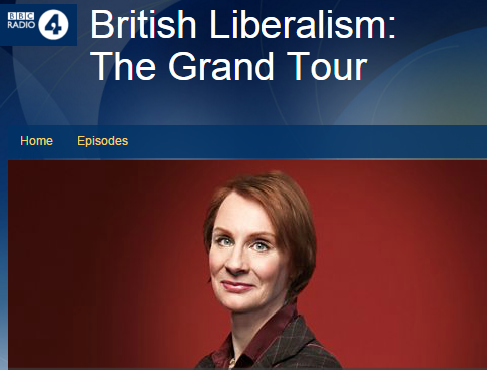
I was intrigued by a comment over at Biased BBC about Anne McElvoy's just-completed series about British liberalism on Radio 4, British Liberalism: The Grand Tour:

Thoughtful
The Limits of Liberalism
Radio 4
Some appalling lies being told about the Rushdie book burning by Fascist Muslims. It is difficult to hear the denial of reality & rewriting of history by those lefties such as Anne McElvoy.
It did not come as a surprise though to hear that some of the Fascist (Il)liberals actually wanted Rushdies book banned !

The relevant passage from the programme (which was very interesting overall) runs as follows:
Anne McElvoy: In 1988 Salman Rushdie published his novel The Satanic Verses. For many British Muslims the novel was deeply offensive. Frustrated by the failure of protests to have the book banned a group of Muslims gathered in a square in the centre of Bradford. They registered their outrage by burning a copy of Rushdie's novel. 
All this takes us back 300 years to 1683. We began this series with the burning of books condemned for containing 'damnable doctrines' under the rule of Charles II. It's easy today for a liberal to pick a side in that struggle but in the book burning of 1988 liberals found themselves facing a trickier dilemma. These book burners were not powerful representatives of an authoritarian state; they were members of a relatively powerless minority who believed that they had no other way to get their voice heard. One way or another though they still found themselves using the symbolism of Locke's tyrannical opponents.  
Professor David Feldman: In terms of liberalism the controversy over Rushdie's book raises two issues: one is the issue of freedom of speech and the other issue is about toleration - or more precisely the degree of consideration which ought to be given to others' sincerely held beliefs.  
Anne McElvoy: The Bradford book burners were a tiny minority within a minority, but for liberals it brought to a head some of the contradictions they'd long been struggling with.  
Professor David Feldman: The Rushdie Affair is extremely painful for people who identify as liberals, I think, because liberals had been more likely than anyone to oppose immigration restriction in the 1960s and early 1970s, they had promoted the Race Relations Act, they had opposed Powell and Powellism, and they had affiliated their opposition to racism with their support for a whole other set of liberal freedoms: abortion law reform, reform of the law on obscenity for example. The Rushdie Affair showed that matters were not so simple and was extremely divisive for liberals. Some secular liberals did indeed support those within the Muslim community who wanted to ban the book. Others did not. 
Anne McElvoy: Liberalism is interested in minorities just as much - or more than those who hold power but giving priority to group rights can end up intruding on the private sphere. And though it may encourage us to behave better it's a funny way for a declared liberal to go about it if it ends up coercing us to think or speak within certain parameters. 
Now, I certainly agree with Anne McElvoy's point that "it's a funny way for a declared liberal to go about it if it ends up coercing us to think or speak within certain parameters" and I think that makes it clear where she stands on the burning of Rushdie's book, but was Thoughtful correct nonetheless about the "appalling lies" being told here?

Well, whether they are really lies or merely inaccuracies, Anne's outlining of the Rushdie Affair doesn't seem especially accurate to me either.

For starters the first burnings of the book in the UK didn't take place in Bradford in frustration at previous protests' failure to have an impact; they took place in Bolton at the very first UK protest against The Satanic Verses.

And as for the book burners being "relatively powerless", a recent book - The Rushdie Fatwa and After: A Lesson to the Circumspect by Professor Brian Winston of Lincoln University - makes it plain that the people behind the protests were far from powerless. Leading, well-connected Muslim businessmen led the highly organised charge:


Anne McElvoy's 'liberal interpretation of the facts' does seem open to question here, doesn't it?

Another BBC factual error?


The closure today of the UK's last deep coal mine has received considerable coverage from the BBC today. 

I noted down part of BBC reporter Dan Johnson's report for BBC Breakfast that reflected a concern I've written about before here:
Dan Johnson: Kellingley was one of the news 1960s pits offering a bright future:
Contemporary news report: The coal from Kellingley will flow like a black river for the rest of this century and beyond. 
Dan Johnson: But job cuts and closures led to the year-long Miners' Strike. After that came a slow, painful decline.  
That's the kind of thing that risks being taken out of context - and that the BBC often takes out of context, repeatedly implying that the blame for the decline of the coal mining industry lay with the Thatcher government of the 1980s and that its death began with the Miners' Strike on 1984-5, whereas the reality is that the death of coal mining in the UK was already beginning as Kellingley was being born:


Some of the graphics I've seen in other BBC reports today have suggested this, to be fair to them - without exactly spelling it out; however, I can't say I was impressed by the main BBC online report on this story this morning which ended with the following:


The problem with that is that it's simply untrue that "privatisation in the 1980s" led to the Miners' Strike. 


That's an error that seems to have gone unnoticed all day (so far). 

Or am I missing something?