Saturday, 25 June 2022

'Newswatch', 24 June 2022 - Transcript of interview with Dominic Casciani


Samira Ahmed: Hello and welcome to Newswatch with me, Samira Ahmed. How should BBC journalists describe people crossing the English Channel in small boats? Asylum seekers, refugees, illegal migrants?

Samira Ahmed: When news of Thursday's two by-election results came in, Boris Johnson was in Rwanda, and hanging over his trip, there was the government's controversial plan to send asylum seekers to that country. That term 'asylum seekers', along with 'refugees', is the most common one being used around this issue on the BBC, as you can hear in these two recent reports.
BBC reporter: It's a hotel in Kigali like many others. Inside, one of the rooms made up and ready to receive their unwilling guests - refugees forcibly removed from the UK.
BBC reporter: The government's policy to remove asylum seekers to east Africa is on hold, but the Home Secretary this lunchtime insisted it will happen.
Samira Ahmed: But some Newswatch viewers aren't happy with the use of those terms. Sue Crooks wrote:
Sue Crooks: I am annoyed by your manipulation by language in news programmes. 'Refugees' are those fleeing for their lives. 'Asylum seekers' are those identified as at risk because of their views. 'Economic migrants' are those who seek to improve their lives by migration. 'Illegal immigration' is, as it states, illegal. Please don't insult the viewers by using the wrong label to influence sympathy.
Samira Ahmed: Meanwhile, Astrid Jillings had a different point to make:
Astrid Jillings: Before me knew better we referred to people with a disability as 'handicapped'. We now know better and use inclusive language. I was reminded of this in the past few days. 'Asylum seekers' and 'migrants' are temporary terms and do not reflect the whole identity of people that have left their homes behind to start a new life in a different country. It concerns me that some people don't view these people as individuals. My request to the BBC is to set an example by referring to these people as 'people' as by using more inclusive terms like 'people seeking asylum' or 'people that have migrated', etc.
Samira Ahmed: Well, someone who's been thinking about the use of language in this context is Dominic Casciani, who's the BBC's home and legal correspondent. Thank you for coming on Newswatch. How should we describe these people crossing the Channel?
Dominic Casciani: Well, Samira, this is really complicated because the law is about to change, which is going to, to be frank, completely muddy the waters here about the language. Now, the basic fact is claiming asylum when you're saying you're a refugee in need of protection is not a crime. That's slightly complicated by what's happening at the Channel at the moment where you can have a situation where somebody is crossing because they're an economic migrant - they're effectively seeking to better themselves, you know, they basically want to improve their life in some shape or form - they haven't necessarily got a claim on asylum. Now, in that context, if they haven't already got a visa or permission to enter the UK, technically speaking, you could say they're an illegal migrant because they're arriving without authorisation. To complicate matters further, you can then have an asylum seeker, someone who sourced asylum elsewhere in Europe on their way to the UK. I've spoken to people in the past who've claimed asylum in Germany, in Sweden, in places like this, and then decided to come to the UK. So they have some kind of refugee claim - or say they do - but then they've decided to come to the UK to claim asylum here. Now, in that context, are they an asylum seeker or someone who's basically, effectively, 'asylum shopping', to use language which is deployed by some, looking for a better life? That's quite a complicated mix to start getting your head around, so I can understand how the audience can be a little bit confused by some of this.
Samira Ahmed: So, given that some people, certainly viewers are saying this, who didn't claim asylum in the first safe country or did, and then have chosen to move, some viewers are saying they're illegal migrants. Does the BBC ever use that term?
Dominic Casciani: Well, not necessarily in that context. But let me talk to you about something which is about to happen. This coming Tuesday, the law changes, and technically speaking, there could be people after Tuesday who cross the Channel who could be classed as an illegal asylum seeker because they didn't already have entry clearance, to use the jargon - didn't have permission from the Home Secretary to arrive in the UK. Now, what that means is from the middle of next week, if ministers start using phrases like 'illegal asylum seeker', well, it will depend on the context, because technically, you can have people who are coming in, seeking asylum, and then they're taken to court for basically breaking the criminal law there because the accusation would be that they didn't have any good reason to come because they could have claimed asylum elsewhere or there may be some other reason. So, it's getting more and more complicated, this area of law here.
Samira Ahmed: How far, then, is it ever appropriate to use the term 'refugee' for the people we're talking about coming across the Channel?
Dominic Casciani: I think the term 'refugee' has to be used in very, very specific circumstances. Now, from my perspective, I see this as a legal definition in as much as somebody is not a refugee in my reporting until they have refugee status, and what that means is they've claimed asylum, they've been given some kind of - they've been given status by the Home Office that's recognised they have a need for protection, and, therefore, they are protected by the UK and settled in the UK with that status. At that point, in law, they are a refugee, they have a right to remain in the UK. So, when I'm reporting this issue, I will talk about asylum seekers, I will talk about migrants, but the word 'refugee', I'll try to reserve that for that very, very specific category of people who've got status. When we're interviewing people, so, for instance, you can be talking to refugee charities or, for instance, like, campaigners or people who, for instance, are working with asylum seekers and migrants along the English Channel on the French side of the coast, they will very often say in quotes to us in clips, "We're supporting "these refugees, don't criminalise these refugees." We have to accept that that's their opinion, that all these people are refugees and we have to obviously, you know, reflect what they're saying, but we have to be very, very careful to make sure that that language is their language rather than ours, so there's that difference there.
Samira Ahmed: Now, one of the viewers we heard from was saying we should use the term 'people' with an added-on description, people claiming asylum, for example. What do you think?
Dominic Casciani: Yeah, look, it's not unreasonable, but it's just that some of this is about terminology, around snappy language in news, you know. News is supposed to be digested fairly quickly, so very often we will go to shorthand. So I take the point, there is this issue about whether or not you just basically categorise people in one particular way forever. I mean, we've had this thing around the disabled. We very, very rarely see that kind of language now, 'the disabled'. We talk about people with disabilities.
Samira Ahmed: Or people using wheelchairs.
Dominic Casciani: Or people using wheelchairs. So, yeah, you've got to be careful not to dehumanise people, you know, because if you dehumanise people, then you're actually making it very - a lot harder actually for the audience to understand the motivation of the person behind it.
Samira Ahmed: Dominic Casciani, thank you so much.
Dominic Casciani: Thanks.

The Misadventures of the BBC Complaints Unit


Connoisseurs of BBC complaints might like to read a fascinating series of exchanges published at History Reclaimed. The complaint, which has been ongoing for over three months, relates to The Misadventures of Romesh Ranganathan, a BBC Two documentary from March. The complainant, Chris Tett, takes aim at the section where Romesh went to Freetown, the capital of Sierra Leone, and visited the fort on Bunce Island where slaves were held before being shipped to the Americas. Mr Tett calls what followed “a defamation of Britain by a biased selection of facts” and lays out a series of points that weren't mentioned, among them that Britain set up Freetown for freed slaves and brought 150,000 there:
Ranganathan said that slave trading was something “..the white British did..” - a racist statement ignoring African involvement. British involvement in the slave trade was shameful but could not have taken place without active involvement of Africans. The programme covered the history of Freetown without mentioning who set it up or efforts by Britain to end the slave trade. African involvement in the trade was not mentioned at all.
Mr Tett also noted the following:
In Freetown, slaves freed by the Royal Navy walked through the ‘Freedom Arch’ to the Old King’s Yard to be given treatment and food. Declared a National Monument in 1949, it is a UNESCO World Heritage site. Its website says, “The Gateway to the Old King’s Yard compares with the Statue of Liberty in the United States in enduring as a highly potent symbol, inspiring contemplation of ideals such as freedom, human rights, democracy and opportunity…”. Surely such a monument was worth showing. But no mention.
The BBC's initial response essentially blames “time constraints” and lists what the programme did cover. Mr Tett responded by saying that the BBC reviewer “ignored or completely missed the point of my complaint”, which was about “a lack of balance” and the “racist intent” behind statements like “..something the white British did”. As for “time constraints”, he observes that:
There is little difference in airtime between the statement made: ‘Freetown was set up for freed slave’ and an alternative ‘Britain set up Freetown for freed slaves’? Again, what is the different between the statement made ‘Freed slaves were brought to Freetown’ and an alternative ‘British Navy ships brought slaves they had freed to Freetown’?
In response, the BBC said that Mr Tett was “incorrect” to suggest that the programme stated that slavery was “something the white British did”, quoting from the programme: “It would be very easy for me to say, ‘Well, this is what white British people did, my parents come from Sri Lanka, so this is nothing to do with me.’ But the truth of it is, is that my parents wanted a better life for their children. And the reason that they moved over to the UK is because of the economic, the infrastructure, all of these things, the, the standard of living that is built upon benefits that were gleaned from slavery…. You know, you can’t just go, ‘this is nothing to do with me’. It is part of British history, it’s part of black British history, and it should be acknowledged as such.” As for “time constraints” defence, the BBC simply repeated it, perhaps sensing that they were on weaker ground there.

Mr Tett has tried again. Here's his latest response in full:
I am glad the second reviewer admits what was said. Quoting the full context does not alter the sentiment which was that slavery was “…. something the white British did. …..” adding “It is part of British history…” Romesh added “…. the standard of living that is built upon benefits that were gleaned from slavery” which is much disputed by some very eminent economic historians. Your reviewer then adds “…. these are Romesh’s views on the complex legacy of slavery.”

Your reviewer also stated this was a travel programme. Well, it took time to delve into history in a way to discredit Britain. The programme sets out clearly racist views because the whole programme section blames the white British for the slave trade and mentions only items which discredit British history.

There is much for Britain to be proud of in Freetown, including the UNESCO World Heritage site. Many more rescued slaves were taken to Freetown than ever were shipped as slaves from Bunce Island. Clearly a lack of balance was shown.

In a programme about Sierra Leone and Freetown that talks about history it would have been easy to mention that Freetown was set up by the British to take slaves freed by the Royal Navy where they would be safe because black Africans continued to enslave and sell other Africans. It did not. This clearly shows the programme makers wish to avoid mentioning anything good about Britain.

Let us be clear. A travel programme does not need to mention history but if it does, it needs to be balanced. This was not. Further, this programme was racially biased because it blamed only the British but did not mention black African involvement.

Some people are now claiming that the BBC has lost it impartiality and is keen to interpret history in an anti-British way. So far, they are proved right.

On to the BBC's Editorial Complaints Unit then... 

Incidentally, just looking up the UNESCO World Heritage Site Chris Tett mentions, a Trip Advisor reviewer adds something intriguing: 

The original plaque clearly visible now joined by a modern one from the BBC. 

 Wonder what those plaques say?

Is Ofcom biased?


On the dreaded trans issue...

According to James Kirkup in The Spectator, Ofcom, the BBC's regulator, has written “a report about impartiality that is not itself impartial” - which he describes as “quite an achievement”. 

He argues that Ofcom's lopsided methodology is at fault, relying on 6 hours-worth of interviews with trans people, and that by listening to only one side of the trans debate Ofcom thereby distorted and skewed its own findings. 

He says the report “not only fails entirely to mention women’s legitimate and legally-protected concerns, but effectively tells the corporation that its coverage doesn’t lean far enough towards one side of that contested issue” and worries this will tilt the BBC towards an even more biased position. 

Methodology certainly counts. If you conduct focus groups and interviews and significantly overrepresent one side with “loud voices” and don't even talk to the other side then, yes, you are going to get a biased report.

On the background to this, I think this pair of tweets puts it in a nutshell:
Emily Kate: Not surprised by this. Ofcom only left Stonewall a year ago. But I think organisations employ Stonewall to entrench existing views anyway. So leaving the scheme isn't going to change much, ideologically speaking. It won't make the organisation fairer or more balanced, necessarily. 
The beautiful symmetry of the national broadcaster being investigated for bias by a regulator who agrees that Position Normal is the one taken by the broadcaster! It's perfect.

Labelling the IEA


There's another interesting new ruling by the BBC's Editorial Complaints Unit (ECU). 

The right-leaning Institute of Economic Affairs (IEA) is a bogeyman for left-leaning types on Twitter. 'Who funds you?' is their repeated cry whenever someone from the IEA pops up, and they don't like it when IEA people appear on the BBC at all. 

Someone complained that The Papers on the BBC News Channel “repeatedly failed to provide an adequate description of the IEA”. I'm guessing they would like the BBC to label them with something negative. 

Anyhow, the BBC upheld their complaint and will oblige them from now on by making sure its presenters make “particular reference” to the IEA's “free market orientation”.

From what I can see, these instances relate to some rare appearances by Annabel Denham, Director of Communications at the IEA, alongside broadcaster John Stapleton. The latest ones, on 7 June, saw the IEA labelled as a “free-market think tank” each time she was introduced.

It will be most interesting to test again how consistent the BBC are with their labels, especially given that 'bias by labelling' is always a risk. Will they treat outfits from other parts of the political spectrum this way too?

I see, from a preliminary scan of TV Eyes, that the likes of the Resolution Foundation are being labelled “independent” or “a think tank that focuses on people of lower incomes” and Demos is “cross-party”. 

One last hurrah


I see that the BBC put out yet another ruling against the dearly departed Emily Maitlis earlier this month.

Their Editorial Complaints Unit judged against her retweet of an anti-Boris tweet from former Conservative MP Rory Stewart, saying that “in the absence of any indication to the contrary, retweeting the comment risked giving the impression that Ms Maitlis endorsed the view it expressed.” 

As she then apologised on Twitter they considered the matter “resolved”. 

She certainly kept them busy in recent years, which is why I instantly believed the reports this week that said some at the BBC were glad to see the back of her and her partner in crime Lewis Goodall. 

BBC bosses believe they have solved the problem of perceived Left-wing bias on Newsnight, after Lewis Goodall announced he was leaving to join Emily Maitlis at a commercial rival.

The Telegraph understands that the corporation did not make a counter-offer when Goodall, the programme’s policy editor, told them he had been approached by Global.

The departure of Goodall and Maitlis is being viewed as an opportunity to reset the programme and focus on impartiality after the pair were at the centre of damaging rows with the Government.

Two down, several thousand to go. 

John Simpson on Shireen Abu Akleh


Given that the United Nations has a considerable bias against Israel, the organisation may not be the best-placed source to independently resolve a highly controversial case between Israel and the Palestinians over where questions of guilt and responsibility lie. John Simpson appears to have no such doubts though, as this Twitter exchange from yesterday afternoon shows:

John Simpson [2:03 PM]: The UN says the information it has gathered shows that Israeli soldiers fired the shots that killed the distinguished Al Jazeera journalist Shireen Abu Akleh on 11 May. She was covering an Israeli army raid in the West Bank town of Jenin.
John Simpson [2:13 PM]: The UN says Shireen Abu Akleh & her colleagues made a concerted effort to show the Israeli soldiers at the scene that they were from the Press. The Israelis issued no warnings. There was no shooting going on at the time. The bullets which killed her were ‘seemingly well-aimed’.
Alan Lyons [2:17 PM]: John, "seemingly well-aimed" is an unpleasant insinuation. If you or the UN wish to allege that the IDF is deliberately targeting or assassinating journalists Vs being unfortunately hit in the middle of a firefight, then you should state that clearly.
John Simpson [3:00 PM]: I don’t think the UN is insinuating anything, unpleasantly or otherwise. It’s openly saying that Shireen & her colleagues were clearly marked as journalists, there was no other shooting going on at the time, and that Israeli soldiers fired the aimed shots that killed her.
Alan Lyons [3:05 PM]: Could you post a link? I have some problems with this: 1. It would be an epic PR own goal for the IDF to be targeting journalists 2. I read that there was a firefight. Is that not true? Are they describing a "lull"? 3. Is it true Hamas has not allowed ballistics on the bullet?
John Simpson [3:19 PM]: I read this on the UN High Commission for Human Rights website. I’m not sure about its being an epic own-goal for the IDF, Alan — 30 journalists have been shot & killed by the IDF since 2000 in the West Bank. Video just before Shireen was shot seems to show no firefight.

Red v blue


The idea that the BBC has a position on many stories cannot be shaken on certain kinds of subject. Before overturning Roe v Wade, the US Supreme Court ruled on gun ownership. Here's a short transcript of how it was reported. The colour-coding sets out the positions of the two sides, but - as you can see - one side gets the lion's share. And it probably won't surprise you which one:

Nada Tawfik, BBC Radio 4 Six O'Clock News Thursday 23 June

The New York case is the most significant involving gun rights that the justices have heard since 2008 when they ruled that the Second Amendment protects the right to have a hand gun in the home for self-defence. The conservative justice Clarence Thomas, writing for the majority, declared that the Constitution also secures that right outside the home in public. New York and a handful of other Democratic states have licensing frameworks in place which require people to show proper cause to carry a concealed weapon. That required, until now, a special need for self-protection beyond a vague self defence argument in an effort to limit firearms in the street. The nation's most powerful gun lobby, the National Rifle Association, was quick to declare victory, but the Governor of New York state Kathy Hochul expressed a very different sentiment. “The Supreme Court of The United States of America has stripped away the state of New York's right and responsibility to protect its citizens. And the language we're reading is shocking. Today the Supreme court is sending us backwards in our efforts to protect families and prevent gun violence. We are still dealing with families in pain from mass shootings.” President Joe Biden said he was disappointed by the ruling. He said “it contradicted common sense, the constitution and should deeply trouble everyone.” The Liberal justices of the court expressed a similar concern. Justice Stephen Breyer, writing the dissenting opinion, said the decision “burdens states' ability to curb violence.” He cited figures showing that since the start of this year there have been 277 reported mass shootings in the United States, an average of more than one per day.

Did the other side say nothing? Was the actual Supreme Court ruling not worth quoting from?

Thursday, 23 June 2022

Ofcom complains about the BBC's complaints process


The BBC's regulator Ofcom reports its own findings pretty clearly in the following four headlines: 

  • BBC must transform the way it serves audiences, Ofcom warns
  • Too many people lack confidence in BBC complaints process, which must improve
  • Audiences consistently rate it less favourably for impartiality
  • Ofcom introduces new regulation to make the BBC more transparent and open

Of the BBC's tortuous complaints process, Ofcom have this to say: 
Fewer than one in five complainants told Ofcom they had a satisfactory complaints experience, and over half reported a bad experience. Others were concerned about the tone and detail of response; and that the BBC took too long to respond. Fewer than half of complainants said they received an initial substantive response within two weeks, the BBC’s target response time. Furthermore, around two thirds of UK adults who have cause to complain do not go on to make one at all, with 42% feeling it would not make a difference and 29% feeling it would not be taken seriously.

“This week...Has Brexit done long-term damage to Britain?”


Six years ago today 17,410,742 million people [52%] voted to leave the European Union, 1.27 million more than the 16,141,241 [48%] who voted Remain. To mark that anniversary, here's John Simpson interviewing Mark Easton this week on his BBC Two series Unspun World:
John Simpson: Welcome to Broadcasting House, part of the BBC's iconic headquarters here in central London for Unspun World, the programme where the BBC's experts around the globe give in-depth answers to the big questions of the day. This week...Has Brexit done long-term damage to Britain?
Mark Easton: There's a sense in which we've not really been able to have sort of normal times to get stuff done. It's warped our politics and made it very difficult for our political leaders.

John Simpson: It's six years since, in a result that surprised most people, the United Kingdom voted by a very narrow margin to leave the European Union. The campaign was marked by some hugely controversial claims, which have resonated ever since - the hundreds of millions we'd be able to pump into the NHS among them. It's still too early to work out the exact pluses and minuses of Brexit, but the lines are becoming clearer. I asked Mark Easton, the BBC's home editor, for his views. Has Brexit been a boon or a disaster? 
Mark Easton: It is a sort of fundamental difference of view which actually goes to people's heart, actually. Almost a sort of visceral feeling, I think. People feel very, very strongly about it - on both sides of the argument. And that, I think, has been quite troubling. There's a sense in which we've not really been able to have sort of normal times to get stuff done. So I think that's been another problem with the whole Brexit debate. It's warped our politics and made it very difficult for our political leaders to really sort of plough a furrow as they want to do. For many communities where we saw very significant Brexit votes, it was about connection to power. It was a sense that they'd been ignored. Many communities that I went to, they felt that change was happening to their communities - demographic change, free movement within the EU. Immigration generally meant that the communities they lived in were changing, the shops were changing. 
John Simpson: Also hearing people talking Polish or Romanian and so on in the streets. 
Mark Easton: Exactly. In particular, people, people would say that the thought of hearing a foreign language on the bus was disconcerting to them. It was different. It wasn't what they expected, and no-one had asked them about it. I think it would be fair to say that very few of those communities feel that they are any closer to power today than they were six years ago. 
John Simpson: So it hasn't achieved that? 
Mark Easton: Not yet, no. I mean, I guess the Government would argue that, you know, their whole levelling up agenda is partly about that - it's trying to reconnect communities that felt separate. I think that is definitely, you know, job not yet done, but really, really important, whether you whether you voted Leave or Remain, actually, that Britain does better in making sure that, you know, thousands of communities up and down this land don't feel - as they currently do - that they are exempted from the decisions that actually affect their daily lives. 
John Simpson: Have there been any successes for Brexit? 
Mark Easton: Undoubtedly free movement and the end of that. I think you can say, well, yeah, that's something - those people who wanted that to stop, it's happened. That was a promise made and a promise kept. They were also told that we would move to a points-based immigration system, to ensure that we only get the migrants that we want and we need. And, yes, we do have...
John Simpson: Is that happening? 
Mark Easton: That has happened. 
John Simpson: And is it working? 
Mark Easton: Well, I think it's difficult because we do have shortages of labour in quite a number of areas, as we transition from what people would have said was our sort of - we'd become rather reliant on European workers and being able to turn on the immigration tap. 
John Simpson: Will Brexit destroy the United Kingdom? 
Mark Easton: Well, it certainly put the Union under very considerable strain. But what's interesting is that I think there is a pressure for more devolution, because I think there is a sense in which part of what Brexit was about was reconnecting people and they need power for that to happen. But what we've seen so far is not that - what we've seen, and perhaps a result of Covid - we've seen actually more power heading towards Number 10 and to Whitehall. 
John Simpson: Do you think at some stage there'll be another vote and we'll go back in? 
Mark Easton: I don't think that's going to happen for a very significant time. But it's interesting, I think, some of the economic realities which are coming into play and are going to become even more so if the forecasts for the UK economy prove to be correct, where people are going to say, well, hold on, are we really cutting off our nose to spite our face? And we need to have some kind of sensible arrangement with our nearest trading partners to make sure that we don't miss out on all those trading opportunities. Making it more difficult for people to trade with countries just over the Channel is not very sensible when your economy is facing so many other huge challenges. 

Monday, 20 June 2022

This year it's 'definite' though...


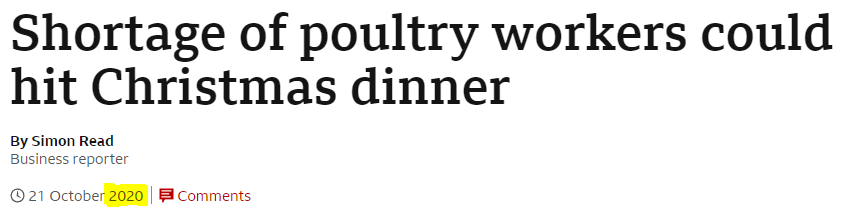
Christmas is getting earlier each year, as is the Christmas scare story. Today - the day of the Summer Solstice - sees this headline on the BBC News website:
This may sound familiar though from BBC News website articles of yore:

Buried in Manchester


I've just been reading a Twitter thread by ex-BBC/ex-Channel 4 reporter Michael Crick:
  • Oldham child sex exploitation report is extraordinary: “Offender A worked for Oldham Council between 1998 and 2006. He was employed as a welfare rights officer in the welfare rights unit of the council seconded to the Oldham Pakistani Community centre”.
  • “In May 2012 he was found guilty of two rapes, aiding and abetting rape, sexual assault and trafficking for the purposes of sexual exploitation […] offender A lived in Oldham and was a member of the Oldham Labour Party”.
  • And: “At the end of Sept 2008, the Probation Service notified Oldham Council that offender A had been charged with sexual assault. No action was taken by Oldham Cl to undertake a safeguarding assessment of Off A following this information or to liaise with colleagues in GM Police.”
  • “Furthermore, it was known by the police that offender A was a council employee and insufficient enquiries were made into whether his role gave him access to vulnerable adults and children.”
  • “… throughout this period, legitimate concerns on the part of both the council & the police that high-profile convictions of predominantly Pakistani offenders across the country could be capitalised on by a far-right agenda & lead to the victimisation of the Pakistani community”.
  • Jim McMahon, Labour’s Shadow Defra Secretary, who was leader of Oldham Council from 2011 to 2016, clearly has some very difficult questions to answer.
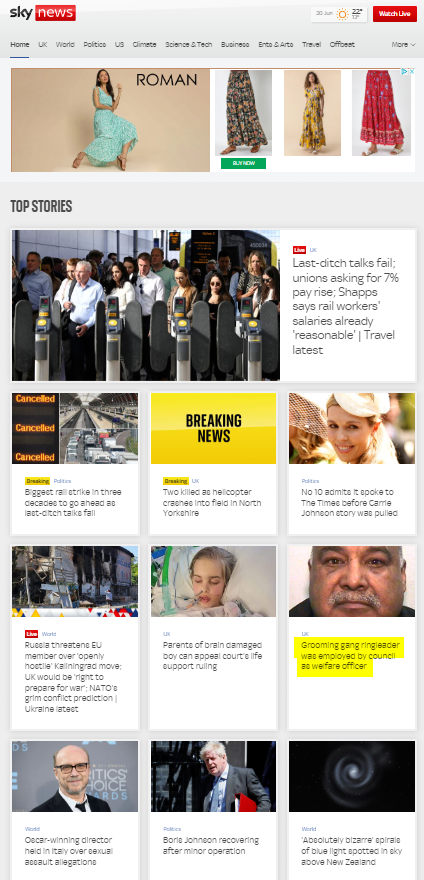
Turning to the broadcast media, Sky News have a long, prominent report about it on their website's home page:
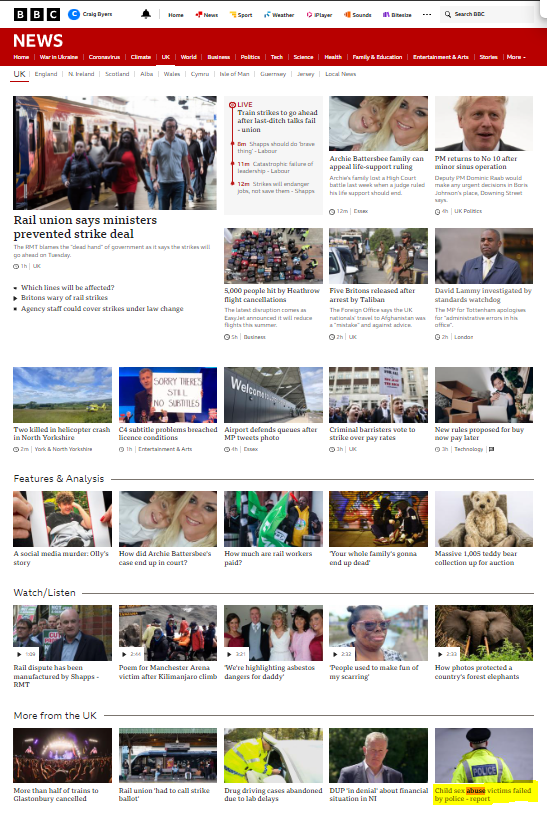
The BBC, in contrast, isn't presently reporting the story at all on their news website's home page. You have to go to their UK page to find it, and it's right at the very end of their long list of stories:
We're in very familiar territory here.

UPDATE

Newsniffer reveals an interesting series of edits to the BBC report. 

Those of us who have monitored the BBC over the last decade and more used to comment on how the BBC, if forced to name the ethnic backgrounds of most of the perpetrators, would use the ambiguous, somewhat misleading term 'Asian/Asians'. 

Later versions of today's BBC report note that the inquiry specifically called this out:
The report pointed out that while most arrests for child sex offences by GMP in the period between September 2009 and July 2010 then identified the alleged offenders as being Asian, they were likely to have generally related to British men of Pakistani or Bangladeshi heritage. 

What is astonishing here is that the earliest versions of the BBC report show the BBC still doing precisely that, just as they always used to do - thus showing just the kind of mindset and massaging of language the inquiry criticised:

The independent inquiry was set up after allegations circulated on social media that Oldham Council was covering up what it knew about Asian grooming gangs in the town.

Then suddenly the BBC removed the word 'Asian' [click to enlarge]:


The article still had to go through a few more versions before they added 'the issue of grooming by "predominantly Pakistani offenders"' and removed the final use of 'Asian' in that old, familiar, misleading BBC kind of usage as...:
She went to Oldham police station to report being raped by an Asian man in October 2006 and was told to come back when she was "not drunk".
was edited and became:
She went to Oldham police station to report being sexually assaulted in October 2006 and was told to come back when she was "not drunk".
This was the moment they finally introduced the phrase "British men of Pakistani or Bangladeshi heritage" into the article when they quoted directly from the inquiry report criticising the use of the term 'Asian' and the lack of use of 'Pakistani' and 'Bangladeshi'.

So what we have here is truly remarkable: The BBC began by reporting this story in exactly the way the inquiry report criticised. Then they obviously panicked and began editing out 'Asian' and adding in 'Pakistani' and 'Bangladeshi'.

Thanks to Newsniffer though they've been caught in the act.

Goodall news


And so farewell to blog favourite Newsnight's Lewis Goodall, who is departing the BBC in September to join Jon Sopel and Emily Maitlis at Global. Mark Urban might be left switching having to switch off the studio lights at this rate. Steerpike at The Spectator pays handsome tribute to the departing Lewis:
Departing from the BBC means that now Goodall is, at last, free to share his political views that have been so well-concealed to date.

The top comment at Guido Fawkes hit the spot too:

I for one will be curious to learn what Lewis's real views are now that he will be no longer having to work under BBC impartiality rules.

Maybe LBC should add another B to their name and become LBBC? 

Macron's 'win'


There was an interesting edit made overnight to the BBC's main report on the French general election. Early versions said that President Macron's “centrist Ensemble coalition has won Sunday's parliamentary elections”. The BBC has now removed that statement.

Sunday, 19 June 2022

To infinity and...er...right down the rating plughole


American superhero films and TV series aren't my cup of tea, but the BBC has been repeatedly popping up on my Twitter feed recently promoting a Disney+ TV series called Ms Marvel. 

Even though I've been dozing for months, the sheer frequency of those BBC tweets caught my attention, and yet another one popped up this evening, following one this morning.

I can't say I was puzzled as to why though, given the accompanying BBC blurb on those tweets. Their take on Ms Marvel was clearly all about identity politics and rejoicing in the fact that a female Muslim character - a Pakistani-American teenager called Kamala Khan - was made the main character ['superhero headliner'] in a Marvel Cinematic Universe (MCU) TV series.

I've done a little digging into the matter regarding the BBC News website and found that they've been enthusiastically following this for a while, plugging the identity politics/Go Muslims! angle - e.g.:
Marvel reveals Muslim comic-book superhero, Kamala Khan
07/11/2013

Ms Marvel: Muslim superhero film 'in the works', Marvel says - BBC …
14/05/2018

Ms Marvel: Trailblazing Muslim superhero goes gaming
01/07/2020

Marvel has cast its first onscreen Muslim superhero!
01/10/2020

Ms Marvel on TV: A 'bold move for Marvel to diversify their characters'
02/10/2020

Ms. Marvel: First trailer revealed - what do we know
16/03/2022

Ms Marvel: We meet the MCU's first Muslim superhero!
06/06/2022

Why Marvel has struck gold with Muslim superhero Ms Marvel
07/06/2022

Ms Marvel: Critics praise Disney's 'joyful' first Muslim superhero story
09/06/2022
Ms Marvel: 'I felt I belonged on set'
https://www.bbc.co.uk/news/av/newsbeat-61828735
19/06/2022

And this is where reality rides in on a horse of bold colours...

Moving away from the BBC's cheerleading on Newsround and Newsbeat and Twitter and the BBC website to the real world of what audiences actually want to watch, it's clear that the viewing public aren't anywhere near so enthusiastic. 

To put it mildly.

The programme has massively flopped in the ratings so far, scoring a new low for any MCU-branded programme by a vast margin. 

Its premiere sank to way under a million viewers - astonishingly, a bare half of the previous lowest-rated Marvel TV flop to date.  

So, presumably being seen to be unwanted and woke, Ms Marvel has 'gone broke' and absolutely bombed. 

The series might be fun and delightful - as per the friendly critics and the BBC - but the public clearly aren't inclined to watch it, for whatever reasons.

My guess then is that the BBC will now keep quiet about Ms Marvel flopping with the public...at least until Twitter/their US media allies starts blaming the audience's disinclination to watch it on racism. Then the Beeb is bound to lurch back into action.

Of one mind


A couple of tweets on my Twitter feed reminded me of Radio 4's The World This Weekend, which I've long thought took itself far too seriously and fell into bias with great regularity as a result.
Austin Williams, director of Future Cities: First ten minutes of The World This Weekend is an uncritical stage for an environmental lobbyist.
Repeat ad nauseum.
Does anyone at the BBC worry about journalistic standards and open enquiry? Clearly Jonny Dymond doesn't, but anyone?
Tim Montgomerie, pundit: Just listened to R4’s World This Weekend and struck again at the self-loathing running through BBC News. Yes, The West has polluted too much, but that same industrialisation road has given the whole world the medicine, tech, wealth etc that makes solutions and progress possible.
I've given it a listen myself now and I can see what they mean.

The opening headlines quoted two women reacting to the outcome of the latest Bonn climate climate conference. The first quote said:
It really feels like the richer world has decided to abandon those who are facing devastation to deal with thing on their own.
The second quote then reinforced the first quote:
The world's economy is very dislocated, on the back of Covid, on the back of an inflation crisis, and so can we continue to negotiate the things that have to happen from a climate perspective? That's the big test. Can we walk and chew gum at the same time?
Those quotes came from people interviewed later, and when the main segment of the programme came we heard from three likeminded people in total: the UN's climate change chief, Patricia Espinosa; someone the programme introduced as 'an environmental lawyer' but which Wikipedia also calls a 'climate activist', Farhana Yamin; and an academic and climate change negotiator who sounded no less of a climate activist, Rachel Kyte.

This is typical of BBC bias on subjects of this kind, where everyone says the same thing - including the presenter.

Tim Montgomerie's point holds up too. Here are two comments/questions from presenter Jonny Dymond that show what Tim calls 'the self-loathing running through BBC News':
But Bonn broke up without the agreement the countries most vulnerable to climate change had hoped for, for assistance from the rich world - which has, after all, fed the fires of global warming - in dealing with the rising seas, floods and droughts that now batter those most vulnerable countries ever more regularly and fiercely.
How big a deal is it? I mean, is it a more important deal, to be brutal about it, that poor countries get shafted? - which is probably something we've known about for decades now.

The BBC certainly knows how to hector. Why can't it just report the news and keep its opinions to itself?

Saturday, 18 June 2022

Comparing GB News with Newsnight


For lots of reasons I've not seen much of GB News or the BBC for months, but I actually sat down today and watched last night's Newsnight on BBC Two and - live - this afternoon's GB News with Nana Akua.

Such a random snapshot proved useful because last night's Newsnight dealt with much the same topic as GB News's 'Great British Debate': the Rwanda/Channel-crossing migrants issue: so it made easy a simple exercise to compare and contrast them.

And the contrasts couldn't be clearer.

Nana's GB News debate saw Nana, the presenter, lay out the pros-and-cons of the debate, but she also declared her own hand. On the question 'Should illegal migrants be tagged like criminals?' she said:
'...But critics say that the plan treats those fleeing persecution as criminals...Well, they are, aren't they? They crossed the Channel illegally. Sorry, did I say that out loud?
She then interviewed Phil Brewer from the Human Trafficking Foundation, who disagreed with her. He argued that the tagging plan won't work and will impact badly on the mental health of the Channel-crossing people being tagged.

What was so pleasing here was that Nana didn't just let him talk but was clearly happy to let him do so, despite her not sharing his point of view. He wasn't interrupted or belittled. He was simply listened to. And he listened to her in return. And Nana left it up to GB News viewers to listen and decide too. 

It was all about listening to open-minded people with strong views listening with an open mind to each other.

Then came Kevin Saunders, former Chief Immigration Officer at UK Border Force, who was pro-tagging and, with caveats, pro-Rwanda option echoed Nana's sentiments. Nana didn't disguise the fact that she agreed with him. It was all in the open.

And Kevin quoted the Full-Fact approved stat that some 70 per cent of those crossing the Channel are fighting-aged men aged 18-40. Newsnight's Lewis Goodall, in contrast, ignored that and made more of the the Full-Fact approved stat that the large majority of 'asylum seekers' crossing the Channel are given asylum in the UK, thus showing that they aren't mere economic migrants.

Then on GB News came a discussion on the issue featuring comedian Leo Kearse and broadcaser Lois Perry. Nana continued to make plain her own views to viewers, but kept outlining both sides. Lois and Leo aired their views, sometimes disagreeing, sometimes agreeing, though they broadly agreed with Nana.

Standing back and judging, this was clearly a debate with a bias - a bias in favour of tagging and the Rwanda plan. But the bias was openly presented and the dissenting voice was treated no differently to the agreeing voices and given full freedom to make his points uninterrupted and in just as friendly a spirit.

Compare that to last night's Newsnight and you'll find yourself in a very different place.

The starting point here was a report from Newsnight policy editor Lewis Goodall. It used Lucy Halliday from Care4Calais, an opponent of the government's Rwanda plan, as a 'talking head'. Next came a sympathetic 'asylum seeker' who says he fled the Taliban in Afghanistan. And then a lawyer working for the 'asylum seekers', Jacqueline McKenzie of Leigh Day solicitors. 

It was one of those BBC reports that spoke with one voice on one side of the argument.

And then it was back to the Newsnight studio for Lubna Shuja of the Law Society, who sounded unsympathetic to the Rwanda plan, and former Labour home secretary David Blunkett, who also disagreed with it.

Watching Newsnight again, after a few months' abstinence, brought it home to me just how one-sided the BBC can be when it really puts its mind to it.

Though Mark Urban, presenting, struck a detached tone, everything else felt like a campaign video.

Lewis Goodall, reporting, came across as a man on a mission, a campaigner telling you what you must believe if you're a good person like him.

And that's what's so galling. Lewis Goodall, someone who uses long threads on Twitter to garner 'likes' from left-leaning types, gets to play the righteous voice of impartial BBC authority on Newsnight and Twitter. 

And Newsnight gets away with presenting the most one-sided airing of a matter of public controversy imaginable with no dissenting voices whatsoever. 

All at the public's expense.

Seriously, give me the honest bias and openness to other points of view of GB News any day over the narrow, preachy 'curating' of stories and opinions by the 'impartial' BBC.

BBC Distrust


Recently - including when defending itself against claims of bias - the BBC has prayed in aid certain polling data which 'proves' that the public still broadly trusts it.

The BBC has, of course, been highly selective in the data it cites.

So the corporation won't be pleased - to put it mildly - that the latest Reuters Institute Digital News Report shows that trust in BBC News has fallen 20 percentage points in the last five years.

That a massive drop.
As Guido Fawkes points out, “According to the Reuters Institute distrust of the BBC has more than doubled in the last 4 years”, and “the majority of those who distrust the BBC [53%] are Conservative.” 

And as one of Guido's Twitter commenters put it, “If anyone involved in running the BBC does not understand the devastating implications of that, the organisation is truly lost.”

What will make the BBC squirm most here is that this is from Reuters, so they can't just dismiss it.

And it gets worse...

One curious thing about the findings is that the 'overview' from Reuters tries to put a brave face on the BBC findings, despite showing them to be devastating. 

What caught my eye was seeing the name of the main man who wrote it, and headed the report: Nic Newman. 

I immediately recalled a BBC reporter called Nic Newman. 

And, lo and behold, on looking into it with a quick search, the Nic Newman behind this Reuters report is indeed the very same Nic Newman who used to work for the BBC as a strategist/journalist. 

[We Beebwatchers have long memories]. 

So, to pile on the agony for the BBC, it's a former 'one of their own' who has shown such a huge fall in public trust in the BBC. 

Is the c-word highly controversial?


Costing some £5 million, the BBC's highly controversial News at Ten/News at Six studio revamp, aimed at attracting a younger audience, was the main topic on this week's Newswatch as viewers objected to the cost of it - especially as it was carried out at the same time as the BBC has been pleading poverty and making cuts.

By describing it as 'highly controversial' there, I was of course trying to make it look bad.

As regulars will know, I've long had a bee in my bonnet about the BBC's used of the c-word. 

Now, sometimes 'controversial' can be used to describe something that is indeed 'controversial' - i.e. with an air of objectivity - but it can also be used as a negative label to predispose an audience against something or someone - i.e. in a biased fashion.

This week, the man on the new highly controversial BBC curved catwalk himself, Huw Edwards, presented Wednesday's News at Ten and read out a bit about the government's Rwanda plan, saying that “the UK Government says it remains committed to its highly controversial plan of taking some migrants to Rwanda”. 

So not even merely 'controversial' but “highly controversial”. 

If he had said 'the UK Government says it remains committed to its plan of taking some migrants to Rwanda', would that have less impactful? 

It would certainly have told us the news, shorn of any suspicion that “highly controversial” was being used there to convey a partial point of view, that the Rwanda plan is a bad thing.

At least the BBC are consistent. Using TVEyes to look back to the News at Ten on the day the Rwanda deal was announced in April [the 14th], the newsreader that day - I'm assuming Huw - described it as “a highly controversial change to UK immigration policy”.

Am I right to have such a long-lived bee in my bonnet about this? Is it the BBC casting the Rwanda plan in a bad light through its use of a negative term?

“Another low”

 
I see a Guardian headline this evening: ‘Bolsonaro’s fingerprints are all over this’: how president’s war on Amazon played part in double killing. 

I've not been following this too closely, but when British journalist Dom Phillips and 'Indigenous expert' Bruno Pereira lost their lives, presumably murdered, I saw plenty of journalists expressing their horror.

Understandably. 

But some BBC journalists' comments went beyond what you'd have expected from BBC journalists. 

The BBC's South America correspondent Katy Watson has been one of those taking it personally and raging against Brazilian president on Twitter. “Another low”, she tweeted angrily about the elected Brazilian leader this week.

It's not the kind of BBC journalism we're meant to be used to, though I especially remember her for looking as if she'd genuinely been crying when reporting for the BBC on the night when Donald Trump won the election in November 2016 so it doesn't surprise me. 

It's 'feelings' journalism, and it's spreading. 

Fact-checking the BBC [2]


When I was a lad I listened to Radio 4's From Our Own Correspondent to learn about the world. 

Are there autodidactic lads and lasses out there doing the same today? Are there still teenagers noting down the facts in Kate Adie's introductions?

I ask because today's From Our Own Correspondent included a feature on Georgia [the country not the US state] and began with a few facts from Kate. I imagine a teenager somewhere noting down [1] that  Russia has “a land border with 14 countries” and [2] that “eight of these countries were once part of the old Soviet Union” and [3] that one of them is “the central Asian nation” of Georgia [4] “which sits between Russia, Turkey and Azerbaijan”.

If you were wondering the 14 countries with land borders with Russia are: Kazakhstan, China, Mongolia, Ukraine, Finland, Belarus, Georgia, Azerbaijan, Estonia, Latvia, Lithuania, Poland, Norway and North Korea.

And the eight of those that were once part of the old Soviet Union are: Kazakhstan, Ukraine, Belarus, Georgia, Azerbaijan, Estonia, Latvia and Lithuania.

However, the next bit is where Kate Adie's facts begin going awry. Georgia is not a “central Asian nation”. Central Asia covers the area east of the Caspian Sea to the borders of China and Mongolia. It covers five countries: Kazakhstan, Kyrgyzstan, Tajikistan, Turkmenistan and Uzbekistan, but not Georgia. Georgia is found in the Caucasus, at the intersection of Eastern Europe and Western Asia.

Our fact-hungry youngster would also be somewhat misled by Kate saying that Georgia “sits between Russia, Turkey and Azerbaijan” because there's a bordering country missing from that list. Georgia also has a 136 mile border with Armenia.
So my childhood self, if living and listening now, would need to be as sceptical of the BBC's facts as I am now I'm a lot older. Not everything you hear on the BBC, even from Kate Adie, is wholly accurate.

Fact-checking the BBC


Former ONS statistician Jamie Jenkins was watching a scary BBC report on climate change then took to Twitter:

Where are the BBC's own fact-checkers?

Red ink


The BBC's language police swung into action early today. 

There's a lead story on the BBC News website headlined Migrants: Some due for removal from the UK could be electronically tagged. Newsniffer reveals some telling edits.

The BBC has evidently been massaging the message:

I
became
II
became
III
became
IV
became

Friday, 17 June 2022

The BBC and Julian Assange


In the decade or so since this blog began many people's take on Julian Assange has changed. A decade or so ago he was reviled on blogs like this and treated favourably by the BBC. Now he's grudgingly admired on blogs like this and treated not so favourably by the BBC. And, for the record, I've undergone quite a change of view about him too. 

The news today that Priti Patel has given the go-ahead for Mr Assange to be extradited is receiving muted coverage from the BBC. The BBC News website briefly featured it on their home page, but it's slipped off into the remoter parts of the site already. A few years back they'd have kept it as a main story.

Here is BBC home and legal correspondent Dominic Casciani's 'analysis' for the BBC News website today. Please see how you read it, because I read it as [most unusually] sort-of backing Ms Patel, painting her as legally having no other alternative:
This decision is the most important stage so far in Mr Assange's long legal battle.

Judges in London have already ruled that the US's request was lawful and that the American authorities would care for him properly in prison.

Now, the home secretary has carried out her role in the complicated legal process by signing off the US request.

Her officials said she was legally bound to do so because Mr Assange does not face the death penalty - nor does his case fall into the other narrow range of categories for her to refuse to approve the transfer.

In practice, this means there is nothing to stop Washington sending a jet to pick up Mr Assange - unless he can win on appeal.

If his lawyers cannot get a hearing back before judges in London, he could petition the European Court of Human Rights.

Ten years ago it ruled extradition to the US would not breach human rights - but expect the Wikileaks founder to try fresh arguments not heard back then.
If, as I see it, the BBC has largely gone cold on Julian Assange, there are exceptions. The BBC's World Affairs Editor, a certain John Simpson, remains loyal and has come out for his publicly-declared friend once more today, ignoring the BBC's guidelines on commenting on matters of public controversy and tweeting:
Journalists in Britain and elsewhere will be very worried by the decision to extradite Julian Assange to the US — both for his own well-being & for the precedent it creates for journalism worldwide.

A tweet from ex-BBC/Newsnight whistleblower Meirion Jones tonight, meanwhile, casts a clarifying light on how things were a decade or so ago, when views of Julian Assange were rather different:

All media that were in on Wikileaks should be calling for Assange extradition to be stopped. That includes BBC - I know because I was courier between David Leigh's Kings Place bunker & Beeb World Affairs Unit for diplo leaks ahead of release 29/10/10.

Butterflies


First they altered the BBC Style Guide to re-write the meaning of the word “gay” to mean same-gender attracted, rather than same-sex attracted, then they used red ink and a rubber to censor the testimony of a female rape victim so as not to offend her male transgender attacker, and now we learn that the BBC hired a trans organisation called Global Butterflies to train BBC staff on trans matters. 

Global Butterflies told them to be 'allies' and use their influence to sway the public and politicians. 

This has understandably raised both eyebrows and hackles:
Mary Harrington: This is a scandal. The BBC is meant to be politically neutral, not hiring ideologues to catechise their HR teams on how to ensure all staff enforce only one one side of perhaps the most controversial and divisive political issue out there.
The fascinating complication in this latest story of trans activism sweeping the BBC is that it was a BBC programme that broke it, with Stephen Nolan continuing his charge against trans extremism at the BBC. 

The BBC is still evidently caught in something of a civil war on the issue. 

“Diversity? You're having a laugh!”


I've enjoyed many a Waldemar Januszczak documentary on art, including some for the BBC. He may hold views that make him 'very BBC', but he's not happy with the corporation at the moment, tweeting:
Yes - I'm on Sky Arts! The only arts channel left in Britain, now that the BBC is replacing BBC4 with the kiddy channel - BBC3. Think about that folks. ONE ARTS CHANNEL LEFT IN BRITAIN. Compare it to cooking, murder, property, costume drama etc. Diversity? You're having a laugh!

Well, Waldy, here at Is the BBC biased? we are now broadcasting Liszt's transcription for piano of my favourite Beethoven symphony, the Seventh, played by Cyprien Katsaris - a thing of beauty I've heard for the first time today. I've heard something very familiar with fresh ears, and without the need for ear-drops:

Tuesday, 14 June 2022

Sir Lenny leads the news


The first online dictionary definition of 'privilege' I came to this afternoon says:
privilege
[ˈprɪvɪlɪdʒ]
NOUN
a special right, advantage, or immunity granted or available only to a particular person or group
The BBC hangs on every word that Sir Lenny Henry, the knighted star of BBC television from The Black and White Minstrel Show to Comic Relief to My Name is Leon. 

He only has to make a comment about race and the BBC will make him a top headline story. 

He is truly privileged. 

At the moment his gripe about how there aren't many non-white faces at festivals like Glastonbury is the fifth most important story in the world.


The most popular comments in response to the BBC's tweet about this story aren't probably what the BBC wants to hear. One top comment runs as follows:
In a country that's 86% white, what does he expect? Just because we see a 50-50 mix on BBC & ITV entertainment and drama programmes and a majority of black people in adverts, does it mean it truly reflects the demographics of our society?
Over at the Daily Mail, the top comment below their report on this, with 25,467 'likes' to 230 'dislikes', reads:
Musical tastes aren't racism.

Taking ambiguity to new levels


For fans of confusing/misleading BBC headlines, this one - presently leading the BBC News website - is a gem:

That makes it sound as if Boris Johnson has his back up against the wall after his government's Rwanda plan fails in the courts [which, of course, it hasn't done].

Monday, 13 June 2022

A familiar tale


My Google News feed this afternoon was full of reports from countless UK news sites about Labour leader Sir Keir Starmer being investigated by the parliamentary standards watchdog over potential rule breaches on earnings and gifts. 

Only the BBC didn't appear in my feed. 

I checked and couldn't find it on the BBC News home page, though it was a lead story on both the ITV News and Sky News websites at the time [around 3pm]. 

I did find it on the BBC Politics page though. 

Now, at 5.30pm, I see the story IS now on the BBC News home page, as the next-to-last headline story.

So, in time-honoured BBC style, they will be able to say that they'd reported it on the main page of their news website  - should some accuser charge them with partisan underplaying of the story...

...And now, at 5.50pm, I've refreshed the BBC News home page and it's gone again.
 
Blink and you'll have missed it.

Something tells me the BBC doesn't want to put the spotlight on this story.