Saturday, 23 June 2018

Never happy


Rob Burley: BBC website must be on the blink: we’re leading with the People’s Vote march, yet also apparently engaged in an effort to suppress said march. What’s going on?
Alastair Campbell: OK to relegate to second story. Ring around a few more businesses who are busy moving jobs and investment. Need contacts?
Rob Burley: Watch out Alastair, if you’re not careful you might get a reputation for trying to manipulate the media to suit your agenda.

P.S.


I don't think Alastair Campbell is going to give up spinning against the BBC any time soon. And why should he? He's doing very well out of it. He was on BBC Two yesterday (The Daily Politics). He was also on Radio 4 (Any Questions). Jobs a good'un?

Two sides to every story


Lead story


Alastair Campbell & Co. have been banging on all week about the BBC 'failing' to cover today's anti-Brexit march so as to pressure the BBC into giving it massive coverage. And guess what? This morning the BBC News website is leading with that very march (even though it hasn't even started yet!). 


Does this prove that their dishonest campaign of bullying the BBC works? Or would the (anti-Brexit) BBC have led with it like they've done this morning (before it even happens) anyhow? 

We'll never know, of course, now.  Anyhow, it's leading the BBC News website.

and here's Rob:

Friday, 22 June 2018

Who Wants to be a Millionaire?


Which of the following do you think is the true version of the way the BBC framed its main story on tonight's BBC One late evening bulletin?

50:50.

Is it?:
BBC Newsreader: Two major employers in the UK criticise what they see as the slow progress of Brexit negotiations. Airbus, which employs 14,000 people here, and which has previously issued similar stark warnings about the risk of the UK not joining the euro and about the UK leaving the EU, says it will now have to reconsider its future if there's no Brexit deal. 
Talking head 1: This is just a businessperson sitting here today, explaining the risks we've evaluated for our business - I'm not a politician, and rather than Project Fear, this is dawning reality.  
Talking head 2: We are seeing a careful choreography re-run of Project Fear. Airbus and others seem to have been lined up - alongside ex PMs no doubt - to imply end of the world unless blah blah.
Meanwhile, BMW says the uncertainty over Brexit means the UK's car industry could be less competitive. As our economics editor Kamal Ahmed explains though, other big employers in Britain take a different view....
Or?:
BBC Newsreader: Two big employers in Britain issue stark warnings over the slow progress of Brexit negotiations. Airbus, which employs 14,000 people here, says it will have to reconsider its future if there's no Brexit deal. 
Talking Head 1: This is just a businessperson sitting here today, explaining the risks we've evaluated for our business - I'm not a politician, and rather than Project Fear, this is dawning reality. 
Meanwhile, BMW says the uncertainty over Brexit means the UK's car industry could be less competitive.
I don't think you'll need to ask the audience there.

Is the BBC biased against Jeremy Corbyn?


'Is the BBC biased against Jeremy Corbyn?' was the questioned asked by Roger Bolton on today's Feedback in the light of a three-part Radio 4 series called The Long March of Jeremy Corbyn.

We heard from four listeners:

  • My name is Karen Lakin. I listened with interest to 'The Long March of Jeremy Corbyn' this week and I was relieved by the balanced approach of the reporting. It highlighted to me the not-so-subtle misrepresentation of Jeremy. 
  • Duncan Shipley, Dalton. Hatchet job drivel dressed up as documentary show. Extremely weak.
  • Nick Hyder. 'The Long March of Jeremy Corbyn' is an essential listen.
  • Simon Warner. Although Steve Richards did make a worthy attempt to create a balance portrait of Jeremy Corbyn I rather felt as if the programme was light on centrist voices within the party. The usual suspects, like Owen Smith and Margaret Hodge, did stand-up and express a more negative reading of the Labour leader but the programme more generally relied on voices who were in favour of what he was doing - Len McCluskey, John McDonnell and so on.  

So plenty of praise there, including for the programme's impartiality, but also complaints of bias from both sides of the Labour divide - which cancelled each other out in true 'complaints from both sides' fashion. (Very nice for the BBC).

The overall effect (accidental? deliberate in the juxtaposition of self-cancelling voices?) was to make this programme sound as if it actually might have been impartial (as least as far as Labour's factions go). 

What followed was an interview with Steve Richards, transcribed below. It too had the effect of making it seem that The Long March of Jeremy Corbyn is a particularly fine piece of impartial BBC broadcasting (as least as far as Labour's factions go).

But what of the BBC as a whole?

Steve says the BBC failed to grasp the significance of Jeremy Corbyn to begin with. It underestimated him. Only the 2017 election changed that.

That seems true to me, though Brexit has probably had something to do with the fluctuations in the BBC's attitude to him too.

Steve also says that the BBC has been excellent at giving voice to the range of Corbyn supporters, thus changing the political debate....

....which is an interesting idea.

It's an idea that could easily (and mischievously) find itself recast to parody a familiar line of argument from the likes of Samira Ahmed & Co. about Nigel Farage and his (in)famous 31 appearances on Question Time: By so heavily platforming voices from the far-left, the BBC is guilty of normalising them.

I have to say though that I'm personally entirely comfortable with hearing the broadest range of views possible, and don't begrudge Owen, Ellie Mae, Rachel, former Newsnight Paul, Kerry-Anne & Co. their generous season tickets to appear on the BBC in the slightest. The more the merrier I say.

Roger Bolton (a man with a left-wing past) then pursued a fascinating line of argument over how the Left has been accustomed to seeing the BBC as a bulwark to balance out the right-wing press.

I think there's something in that too.

By implication, that's surely also why the further reaches of them are now so constantly angry at the BBC for not being sufficiently enthusiastic about/reverential towards oooh Jeremy Corbyn.

And that's surely why the likes of (far-left) Media Lens - very early, lonely pioneers of this kind of left-wing BBC-bashing - have always singled the BBC out, along with the Guardian and the Independent, for especially intense criticism. They seem to see them as 'traitors' - a soggy, left-liberal 'centre ground' constantly letting the Left down by not being even more biased in their direction than they already are.

(The newer crowd, however, appear more likely to unthinkingly accuse the BBC of being 'Tories' or 'right-wing', being less grounded in intellectual politics than those old-school Media Lens activist types.)

And something similar might well explain the remarkable Lord Adonis/Alastair Campbell double act and their stupendous campaign against the BBC's pro-Brexit (sic) bias.

Roger Bolton has cracked it!

Anyhow, that's more than enough of that. Here's the transcript:

ROGER BOLTON: The series has three different presenters. The first programme was presented by the political journalist Steve Richards, who two years ago was the man behind a previous series called simply The Corbyn Story. I asked him why he felt now was a good time for another programme. 
STEVE RICHARDS: I made a series of three programmes about Jeremy Corbyn at the end of his first year as Labour leader, and it seemed to me that at the end of the first year since the general election there was an equally compelling case to re-visit Jeremy Corbyn. It seems to me he is still living through the most extraordinary story in British politics since 1945 - the rise of this figure who had been on the backbenches now established as a leader after that election, which I consider to be a success for him even though he lost. And so, he is just fascinating and I wanted to follow through that curiosity for a second time. 
ROGER BOLTON: There's a lot of suspicion of though the BBC - not necessarily of you. A lot of emails to us talk about you being extraordinarily fair-minded - but that's not the BBC. I mean there are emails like, "I see the BBC has a whole series now of Corbyn-bashing", "hatchet job drivel dressed up as a documentary show", etc, etc. So there's a great suspicion. Do you think on the whole that the media have been, and the BBC has been, fair to Corbyn? 
STEVE RICHARDS: Well, it depends what you mean by 'fair'. I think at the beginning all media outlets, including the BBC, struggled to quite recognise the significance. That was up until the general election. I think he was viewed in the media through the prism of 'this is all gonna be heading for disaster'. I think since the election there has been a greater understanding of his significance. And the BBC now - and this I think is a healthy thing and one of the consequences of Corbyn - are very good actually at putting up a range of voices who are close supporters of his, and that has changed the political dialogue on the media.  Not surprisingly it did take time. 
ROGER BOLTON: But you'll never satisfy the Left in one way, will you? They look and say the media is biased against it. They look at the Daily Mail, they look at the Daily Telegraph, they look at the Sun, whatever, and, therefore, they look at the BBC, in a way, to counteract the balance. 
STEVE RICHARDS: Well, certainly those who thought my programme was biased against Jeremy Corbyn should listen to it again. I mean, the majority of contributions...Because we were trying to understand him you have to speak to those who are close to him and, therefore, the majority of the contributions were from people trying to shed light on him from a quite sympathetic perspective. But, you're right. The role of the BBC is not counter the Daily Mail. The role of the BBC is to be  balanced and, therefore, you have to include other points of view as as a matter of duty. But also it would be an inaccurate picture to present the current situation within the Labour Party as some sort of harmonious paradise. I mean, that would be wrong. So the BBC has duties of impartiality that are well known but you also got to tell the story as it is in reality. 
ROGER BOLTON: Do you prefer making these sort of documentaries to doing straight interviews, in the sense that a lot of our listeners say a lot of political interviewing has become 'bang bang', 'yes, no', 'polarised positions'? Do you prefer though gradual exposition and exploration of ideas? 
STEVE RICHARDS: I love doing considered political journalism, at a time when politics is so fast-moving, but I think the interviewing is also...I agree with some of those listeners who think it's too much of a sort of shootout at the O.K. Corral style of political interviewing. And I wish in some ways that the interviews we did for the series could be put on a website or something because the interviews themselves, I think, are quite interesting, because if you just have a conversation with these people they engage with you... 
ROGER BOLTON:  But don't you think there's an additional problem here? That those who were operating from outside what was the political consensus need more time to have their ideas expressed or exposed? 
STEVE RICHARDS: I completely agree. And they need to be tested over time. And you have to get through all the cliches about, you know, 'back in the 1970s', you know, in the context of, say, that Corbyn programme. It's much more complicated and interesting than that. And that does take time and it needs space, And, if you've got three minutes you just say to Corbyn or McDonnell, 'You know, so you want to take us back to 1970 with nationalisation?', they'll say 'No, no, we're not. We want to do this, this and this', and it's over. So, yeah. I haven't thought about it like that before but the old consensus was familiar terrain for the interview and the listener, and this is all new, and it needs space. 
ROGER BOLTON: Our thanks to Steve Richards. 

Thursday, 21 June 2018

Abstinence

I’ve been away for a month and I think I’ve discovered the cure for blogging about the BBC. Don’t watch it. 
Coming back after a break, it all seems so petty and superficial. Instead, I’ve been mostly watching Fauda on Netflix.
Now there’s a compelling set of back-to-backs to binge-watch. James Delingpole says it’s popular with the Palestinians as well as the Israelis. 
The BBC should buy it in for their BBC Four foreign language / double episode / Saturday night slot. 

As if!
   It doesn’t have a sanctimonious lefty agenda.

Bear pit

I’ve also been reading Melanie Phillips (£) about being ‘set up’ by the Question Time team, and I’ve heard people discussing the US’s decision to walk away from the UNHRC -  mostly to opine that the right way to deal with this corrupt outfit is to ‘stay and change it’. 

As if!
   UNHRC is like the Eurovision Song Contest. It has as much to do with Human Rights as Eurovision has to do with music. It won't change.


#Jew

I heard Will Self on the radio saying he’s reconsidering his resignation from being a Jew. Now he wants to be a Jew. I’d need to listen again to figure out if that’s a good thing or a bad thing, but I don’t know if I can be bothered.

She's not the messiah. She's (possibly) the new presenter of Question Time.


As ever, there's a fine piece by David Keighley over at The Conservative Woman discussing the BBC's obsession with quotas. 

David suspects that the BBC will go the whole hog and appoint either Mishal Husain or Samira Ahmed to replace David Dimbleby on Question Time - not because they're necessarily worth it but because they'd tick off at least three quota boxes in one fell swoop! Bingo!!!

(Would anyone be surprised if the BBC did that very thing, and did so for that very reason?) 

If so, Mishal's widely-slammed performance during the 2017 general election, pretty much acting as David Dimbleby's understudy, might still scupper her chances. 

So cool, calm and collected Samira it is then...

....(though she never seems very cool, calm and collected when she's tweeting about her pet hate Nigel Farage. I suspect he'll be getting far fewer invites to appear on QT if she gets the presenter's job)...

...and she really wants the job too. She's already tweeted her CV:


David also discusses the BBC head of comedy Shane Allen's comments that Monty Python wouldn't be commissioned by today's BBC because they are "six Oxbridge white blokes" - comments made as the BBC unveiled a series of new comedy programmes fronted by female and ethnic minority comedians.

One absolutely hideously white python, namely Basil Fawlty (who famously owned a Spanish waiter, so was #FBPE and multicultural even back then), doesn't seen overly impressed with the Shanester (as the BBC's master of hilarity surely calls himself):


It must be said that, with the exception of Mrs Brown's Boys (though it's not my personal cup of Mrs Doyle's tea), BBC TV comedy looks to have pretty much passed on. It's no more. It has ceased to be. It's expired and gone to fresher media outlets. It's a stiff, bereft of life. It rests in peace. If Shane hadn't nailed it to the BBC quota board, it would be pushing up the daisies. Its metabolic processes are now history. It's off the viewing public's radar. It's kicked the bucket, having last been seen alive in the days of Mrs Bucket. It's shuffled off 'is mortal coil, run down the curtain and joined the bleeding choir invisible on multicultural Songs of Praise. 

For my personal view on the Question Time issue, were you wondering, I'd scrap it. 

Sorry Samira.

P.S. If you wondering whether white, late middle-aged Shane Allen went to Oxbridge, well, no, he didn't. (I will admit to hoping that he did so I could make something of it). He went to Edinburgh University. And his track record, over many years before the BBC, sounds extraordinary. Was he really (as his BBC bio suggests) one of the creative minds behind Ali G, Brass Eye and Shooting Stars? 

Purification


A tweet today from the BBC's World Affairs Editor John Simpson....


....has drawn an understandable response. People are talking about the language of genocide. 

It's the shocking word "purification" which gives that Salvini quote such a Nazistic flavour. 

A stray comment on his Twitter thread led me to check the quote though. Googling the original, it reads: 
Ci vuole una pulizia di massa anche in Italia. Via per via, quartiere per quartiere, con le maniere forti se serve perché ci sono interi pezzi d'Italia fuori controllo.
The key word there is "pulizia". It's the word John Simpson translates as "purification". 

Pop it into Google Translate, however, and 'pulizia' translates as meaning 'cleaning' or 'sweeping', so the phrase (in full, and given in context) would now translate as:
It needs a mass cleaning (or sweeping) in Italy too. Street by street, neighbourhood by neighbourhood, with strong measures if needed, because there are entire parts of Italy out of control.
It's still a very strong statement, but it sounds a good deal less Nazi-like than "We need a mass purification", doesn't it?

Furthermore, if you put "We need a mass purification" into Google Translate it brings up, "Abbiamo bisogno di una purificazione di massa".

In other words, there's an Italian word which specifically means "purification", and that's "purificazione". And Matteo Salvini didn't use it.

I know Google Translate is hardly infallible but I've tried translating and re-translating these words and phrases back and forth and rechecking the source and I'm now certain that John Simpson was tweeting a mistranslation of Matteo Salvini here....

....and, very possibly, a deliberate mistranslation. Someone somewhere probably wanted to make Mr Salvini sound like a Nazi and, thus, render his statements abhorrent to all decent people. 

So where did John Simpson get his translation from? Was he tweeting 'fake news' to his followers? If so, was that out of laziness or malice? (I'd suspect laziness - and a willingness to believe the worst.)

Monday, 18 June 2018

"That is at best uncertain, at worst misleading"


"The Government claims some of the cash will come back from the EU. That is at best uncertain, at worst misleading..."

So said the BBC's political editor Laura Kuenssberg on tonight's BBC One News at Six, referring to Mrs May's 'Brexit dividend for the NHS' claim. 

No, Mr Campbell. I don't think the BBC is pumping out pro-Brexit propaganda for the Government. (And neither, if you're honest, do you). 

Has Anthony finally gone beserk?


Note the irrelevant disclaimer. 

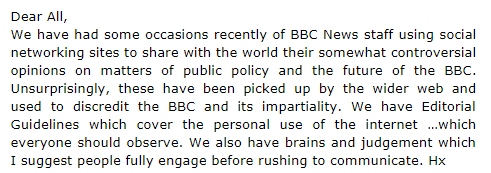
Long-term BBC watchers may recall the former Head of the BBC Multimedia Newsroom Mary Hockaday sending out an email to BBC staff in 2014:


Helen Boaden, then Head of BBC News, had sent out something similar in 2010: 


Do these emails from BBC high-ups come in four-year cycles? If so, we're due another this year - especially as more and more high-profile BBC journalists are saying things that brazenly compromise their impartiality.

For example, when I saw that Donald Trump had tweeted the following...


...I just knew that senior BBC US reporter Anthony Zurcher would "rush to communicate" his views on the matter on Twitter and tweet something that very sailed close to the wind, impartiality-wise. It turns out that I was actually only half-right. Anthony didn't just sail close to the wind, impartiality-wise, he crossed the line into outright sounding-off:


He sounds angry, doesn't he?.

He certainly doesn't sound impartial.

The current Head of BBC News is Fran Unsworth. How long will it be before she sends out that email again?

Sunday, 17 June 2018

Tweedledum and Tweedledee


By updating posts from earlier today (which I've subsequently buried under long new posts) I may have I may have inadvertently 'avalanched' myself and disguised the main point of today's posts. 

However much Tweedledum and Tweedledee (Lord Adonis and Alastair Campbell) may accuse the BBC of bias (from 'the other side'), their claims of bias (however frustrating they must be to some people who work at the BBC) are surely useful to the BBC as a whole as they seem to give credence to the 'we get accused of bias from both sides so we must be getting it about right' (complaints from both sides) argument. 

But in reality they don't give credence to the 'complaints from both sides' argument. 

Why? Because the claims of bias from Tweedledum and Tweedledee are demonstrably false. They are fit only for the bin (though they'll doubtless end up in a recycling bin and get recycled ad nauseam.)

There's no substance to them whatsoever. Disproving them is like shooting paraplegic fish in a tiny barrel. 

And worse, when closely examined, their fake claims of BBC bias actually steer us towards the monstrous crow of truth: that the BBC is biased in the exact opposite direction to that which Lord Adonis and Alastair Campbell claim it is.  

David Dimbleby to leave Question Time


So David Dimbleby, after 24 years at the helm, is leaving Question Time. 

Who will replace him? 

According to the BBC, Kirsty Wark is top of the list and "other suggested contenders" include John Humphrys, Huw Edwards, Jeremy Vine and Nick Robinson. (What a thrilling list!). 

Quite why Lord Adonis and Alastair Campbell aren't being suggested in that BBC report is surely prove of the BBC pro-Brexit bias. 

With all due respect to Lord and Alastair though, I'm predicting it will be a woman. The Guardian says there's pressure for it to be a woman, and I believe the Graun about that. The BBC is bound to give in to that kind of pressure (and feel smug about so doing). 

So who will it be? Kirsty? Emma Barnett? Victoria Derbyshire? Katty Kay? 

And who's off down the bookies tomorrow? I'm plumping for Victoria Derbyshire, main presenter of the effortfully worthy Victoria Derbyshire show.

Brexit dividend (3)


Alastair Campbell

I suppose we could just assert that all those wild claims of 'pro-government BBC bias' from the likes of arch-spinner Alastair Campbell (and myriads more on Twitter) over the corporation's reporting today of Mrs May's NHS funding/Brexit dividend pledge as simply the result of the partisan stupidity and utter mendacity of far too many people on Twitter (including Big Bad Al), but I think that blogs like this ought to at least try to do better than that. 

So here's a snapshot of this afternoon's coverage of the story...

You'll find below six lovingly-prepared transcripts of this afternoon's hourly BBC Radio 4 news bulletins. 

Do they prove pro-government bias from the BBC? 

I know I shouldn't ruin it for you with spoilers, but the answer is emphatically 'no'. 

When you see it laid out before you, in print, six hours of BBC Radio 4 reporting becomes sharper in focus. 

Every one of those six bulletins began by framing the story with criticism of Mrs May's Brexit dividend claim. 

All of them gave the the lion's share of the bulletin to reporting the views of critics of Mrs May and her Brexit dividend claim. 

And as for the clips from interviewees chosen, two were from Labour critics of Mrs May and one was from Paul Johnson of the IFS, also being unhelpful to Mrs May. The other (Helen Stokes-Lampard) fell closer to criticism than to praise. None was from someone defending/supporting Mrs May. 

Plus, the only Tory quoted (other than Mrs May) was Sarah Wollaston, who called Mrs May's comments "tosh". 

So there's no reasonable case to be drawn from this whatsoever that the BBC demonstrated a pro-government bias here. They most certainly weren't backing Mrs May and her Brexit dividend.

So does that prove then, as per 'complaints from both sides', that the BBC got it about right?

Well, no. In fact, far from proving that the BBC behaved impartially, I think these transcripts provide compelling evidence that the BBC was actually biased against the government (however right you or I might think they were to be so in this instance). 

The framing of the story and the choice of voices were so starkly 'one-directional' here as to leave a massive question mark hanging over Radio 4's impartiality this afternoon. 

Please read them for yourselves and see if you agree...

Update: Though it's aesthetically unpleasing, I've now coloured the transcript to more clearly show the balance (or imbalance) in the BBC's reporting. Blue is for bits that 'help' the Government. Red for bits that 'don't help' the Government. Uncoloured are the bits that are either obviously neutral or which can't easily be ascribed. As you'll see there's much more red than there is blue.


Midday
The head of the Institute for Fiscal Studies Paul Johnson has said there is no Brexit dividend to provide more money for the NHS. He was responding to Theresa May's announcement that NHS England will receive an extra £20 billion a year by 2023 in part because of money saved when Britain stops paying into the EU budget. Mr. Johnson said the exit bill and commitments to fund farmers meant that there was arithmetic no money. Labour also dismissed Mrs May's promise as a "hypothetical". The shadow foreign secretary Emily Thornberry has said it left too many questions unanswered.
Emily Thornberry: How are they going to pay for it? They say that they're going to increase taxes but we've yet to hear who's going to get their taxes increased and how. They say they going to increase borrowing but they haven't told us by how much, and they haven't told us what the effect will be. They've told us they're going to pay for from a Brexit dividend. We don't really know what that means because we don't know what the deal is going to be and what the overall effect on the economy is going to be and, actually, whether Brexit is going to end up costing us a great deal of money.
But the chair of the Royal College of GPs Helen Stokes-Lampard gave the announcement a cautious welcome.
Helen Stokes-Lampard: It's not quite as much as most health leaders have been asking for. The Institute for Fiscal Studies had been pushing for nearer 4% so that we can not just sustain the NHS but really push forward. But nobody's going to be turning their noses up at the 3.4% a year in real terms. So it's how we spend it that will matter.
Separately, the shadow health secretary Jon Ashworth said Labour would match the government's funding promise, which he described as "baseline".

1 o'clock
The economic thinktank the Institute for Fiscal Studies has questioned the idea of a Brexit dividend, raised by the Prime Minister when she promised an extra £20 billion a year for the NHS in England by 2023. Theresa May told the BBC's Andrew Marr Show that the country would be contributing a bit more, but she said it would also benefit from no longer sending vast amounts of money to the EU. The director of the IFS Paul Johnson said an extra £20 billion meant higher taxes and/or borrowing. Labour says it will match the government's pledge and go further. Here's our political correspondent Jonathan Blake.
Jonathan Blake, BBC: Making a link between increased funding for the NHS and savings as a result of leaving the EU allows Theresa May to say to Brexit supporters in her own party and beyond that the much-criticised promise on the side of the campaign bus has been met and that the government has gone further. But economists have rushed to point out that once the broader economic picture is taken into account the Government will have less money to spend in the short term after Brexit not more. The Conservative MP Dr Sarah Wollaston called the Brexit dividend claim "tosh" and accused Theresa May of taking the public for fools. Mrs May's suggestion that taxes will also have to rise to pay for this increased spending on the NHS is a significant statement for a Conservative Prime Minister.
Health bosses have welcomed the promise of extra funding, though a number have said more is needed. Concern has also been expressed about the absence of a commitment to provide more money for social care. Here's our health correspondent Dominic Hughes.
Dominic Hughes, BBC: Since the NHS was established 70 years ago its budget has risen by an average of 3.7% a year, but since 2010 that figure has been about 1.2%. At the same time demand for healthcare has been growing, so across the NHS there's a feeling that this settlement is just enough to stand still but it falls short of the 4% budget increase that most analysts felt would be needed to make up lost ground and bring about real change. Scotland, Wales and Northern Ireland will also get extra funds but the devolved administrations will decide how they're spent. This announcement leaves some big questions unanswered, not least the funding of social care, which has such a profound impact on the Health Service. Without those details there are no guarantees even this extra money will significantly ease the long-term pressures on the NHS.
2 o'clock
The Institute for Fiscal Studies has questioned the 'Brexit dividend' quoted by the Prime Minister in her promise of an extra £20 billion a year for the NHS in England by 2023. Theresa May said the country would be contributing a bit more but it would also benefit from no longer sending vast amounts of money to the EU. The director of the IFS, Paul Johnson, said the extra funding meant higher taxes and more borrowing.
Paul Johnson, IFS: If you look at the arrangement we come to with the European Union in terms of paying our exit bill or and if you add to that the commitments that the Government's already made to keep funding farmers and so on there is literally, arithmetically, no money. And, in addition, we know, because the Government's accepted this, that the public finances will be worse as a result of the Brexit vote, the OBR has said by £15 billion a year. It could be a bit more. It could be a bit less. 
Labour said its tax plans meant it would spend more on the NHS and social care.

3 o'clock
The director of the Institute for Fiscal Studies has questioned Theresa May's claim that an increase in NHS funding in England could be paid for with a post-Brexit windfall. Mrs May told the BBC that money saved by Britain leaving the EU would help to provide an extra £20 billion a year by 2023, but Paul Johnson told the BBC the UK's exit bill and a commitment to keep funding farmers meant there was arithmetically no money. The shadow health secretary Jon Ashworth said Labour would still spend more on the NHS than the government.
Jonathan Ashworth, Labour: Now the government have announced these new baselines for the NHS we'll match that. That is the baseline that will become accepted, but we're saying you can go further and if the government made the taxation changes we're prepared to make it could be giving even more to the NHS. So Labour will be spending more on the NHS the Tories even after these announcements today.
4 o'clock
There's been criticism of Theresa May's announcement that a Brexit dividend will help pay for an increase in NHS funding in England. Mrs May said an extra £20 billion a year by 2023 could be found partly because the UK would no longer be paying into the EU budget, but the Institute for Fiscal Studies insisted there would be no Brexit windfall because the UK faces a steep exit bill, and the shadow chancellor John McDonnell described the pledge as a publicity stunt. 

5 o'clock
A senior Conservative MP has dismissed as "tosh" Theresa May's claim that a Brexit dividend will help to boost funding for the NHS in England by £20 billion a year by 2023. Sarah Wollaston, who chairs the Health Select Committee, said people were being treated like fools. Mrs May said the country would benefit from no longer sending vast amounts of money to the EU, but the Institute for Fiscal Studies said the Government has accepted that the public finances would be worse as a result of Brexit. 

Questions, questions


Norm

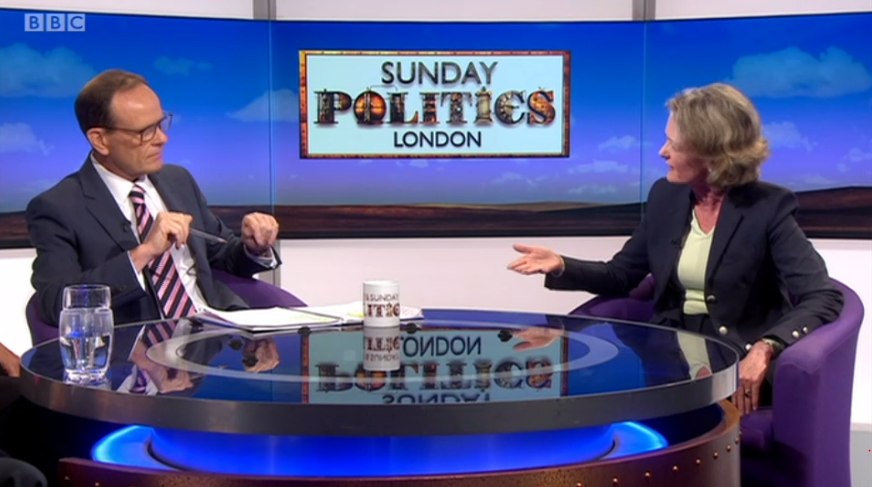
I usually try to post tidy-looking transcripts, but this one is too long and I'm running out of time today. So please find below a transcript of the part of today's London section of The Sunday Politics, hosted by our old friend Norman Smith. 

It's taken straight from TV Eyes, with a few corrections from me. I hope it's still easy to read. The bold bits are Norman Smith speaking. The non-bold bits are his various guests. I've indicated who is being questioned at which point by highlighting their names in red. 

I haven't marked out the interruptions though, but there were quite a few and you'll easily be able to guess where they came. (Look for the balance of bold lettering and non-bold lettering. The closer they are the more interruptions there were. And the longer the length of the non-bold lettering the more the interviewee got to make their point). 

This is for those of you here at ITBB who know a lot more about this than I do and will be able to spot any bias (or lack of bias) much better than me here.

So, dear reader....

Was Norman Smith as factually mistaken about everything as Elizabeth Campbell, from Kensington and Chelsea Council, implied in her often incredulous-sounding responses to his accusatory ('accuse-a-Tory'?) questions?

Did Norman go way too far for a BBC journalist in suggesting that Mrs May "misled" Grenfell survivors (i.e. lied)?

Did Norman's questioning of his two Labour guests provide proper balance? Was he as tough with them as with his Conservative guests? 

Here then is the transcript:


Joining us now is Elizabeth Campbell, from Kensington and Chelsea Council, who took over as leader in the immediate aftermath of the fire. Elizabeth Campbell, your predecessor when he quit, said he was resigning because of the perceived failings of the council. Now, do you think the failings of the council are perceived or real? Well, I think we have to wait for the inquiry. You don't know? Well, soon as I took over as leader the first thing I did was to apologise and to say that actually the council did not cope well enough in the face of an overwhelming national tragedy and I still hold to that. We obviously didn't cope well enough. But as to the details, that's what the inquiry's for. Let me put it to you - the failings are not historic in terms of the immediate aftermath, which many people would say the council failed to get a grip on the situation. They're current in terms of your failure to rehouse residents, and as you yourself promised to do within a year, something like half are still in temporary accommodation. Well, I don't accept that because about 90... But you've broken your promise. You said you would get them... Hold on, let me just finish. 90% of those who need to be rehoused have accepted permanent accommodation now. But the accommodation is not available or suitable. Again, I don't agree. Well, why are they not in the properties then? Because it's complicated. It's very complicated and it's difficult and, you know, having been at the commemoration hearings every day, if you've got a family and you've had the opening of the public inquiry, well, the commemoration hearings for two weeks, then you have the opening of the public inquiry, you've got Ramadan going on at the same time, and yesterday you had the first anniversary. Meanwhile, the children are doing A-levels. When people are ready to move they'll move and we are doing everything we can to support them, help them, to encourage them to take up the flats and properties that are available. Let me put it to you, the facts are against you. If you have a situation where you have 200 or so households and only 80 or so after a year have been permanently rehoused, how in any way can you be satisfied with that? I'm not satisfied with it but I'm saying that it's... There are reasons for it. These aren't just figures that you can just move from one side of the sheet to another. They're individuals and they will have individual reasons. And I'm saying that... Yesterday I was speaking to quite a lot of our staff in the resettlement team, the allocation team, we know everybody, we know them very well. OK, but let's get a sense then, here we are one year on, half have not been put in permanent housing. How long do you think will it be before you will be able to ensure all of them are in permanent housing? Well, I'd just like to pick you up on what you said. You said "When they will be put". It's not a question of us putting them in. Yes, but you know the You know the thrust of my question. Yeah, I do, but I think... I don't think it is about having fake deadlines. But if you are a resident you want to know when you can expect to move into a permanent home. That's not an unrealistic ambition. Well, 90% have accepted it. So when will they actually be in housing which they can go into? They will move when they are ready to move. Well, when you can supply housing that is fit to go in because as you will know there has been criticism that much of the housing you have bought is inadequate, requiring repairs, damp, not suitable for people with disabilities etc etc. Again, I think the story is more complicated than you make out. You know, we went out and we bought 307 properties so everyone would have a choice. Then we have a duty to make sure that those properties are absolutely the best they can be, whether that's from fire regulation, whether that's from gas, whether that's from electricity. If people came to us and said, "Actually, I don't want to have gas in this flat." We'd say, "Fine, OK, we will change it." This is about getting homes for people. It's not just properties. I understand it's complicated... And if people want to say to us, "OK, I'd like a new kitchen, or I'd like a different tile, or I want to change that carpet. You seem to be suggesting that somehow it's the residents who are the problem, that they're too picky and finickity about what they want. No, I haven't said that. I've said... You're saying if they want a different kitchen... I don't think that's being picky. I think if you've lost your home, I think that's fair enough. All right. All I'm saying is that we're doing absolutely everything we can to make sure that, you know, having lost everything that they can have a home that they wish to move into. OK. But if you are a resident you would accept that you would want to have some sort of timeline in which you would feel confident that your family could move into permanent housing. Can you give them any reassurance that by the end of next year or whatever this will be sorted? 90% have accepted their flats. You're not answering the question. I think I am. Because you're trying to say that it's their fault. If I'm a resident I would want to know when I can move into permanent housing - confident that I'd be able to get into it. You can move in when your flat is ready. 90% are ready to move into as well. So, the flats are there. It's up to us to try and encourage people, to support them. Having been to the commemoration hearings, having been to the services yesterday, imagine it was you, imagine you've been married 30 years and you've lost your wife and you're going out buying, I don't know, towels or things for your flat and you're moving in on your own. That's quite a difficult... Let me... Bob Blackwell, let me bring you in. I mean, Theresa May her record too does not stand close examination does it? Because in the immediate aftermath she said, "Don't worry, you will all be permanently rehoused within three weeks." I mean, what a preposterous thing to say! Well, I think Theresa as Prime Minister has apologised. Not for that. Not for that. Not for that. She's apologised for her reaction in the immediate aftermath. In the immediate aftermath. But not for misleading residents about when they would be rehoused. But I do think that we have to empathise with the survivors of this terrible tragedy. We have to remember that they've lost absolutely everything. I understand that. They literally walked out in the clothes that they were wearing and everything else is gone. Now, when you're under those circumstances I don't think there's any council in the country that could have coped with that. Do you think Kensington handled it well? No, I don't they handled it well but I don't think any council in the country could have handled it well. Can I suggest... What I do think is important, however, is that we've got to give the survivors both the appropriate amount of time to grieve for the ones they've lost, and also to get a settled home, which they can call home after their recovery. The point is that we cannot ask the council or the Government to force people to go into homes. But can I suggest to you...? They've got to be offered a home that is suitable for them that they will then be able to regard as home. I don't think you can fix times. All right, but can I suggest to you, there is an obligation on political leaders in the aftermath of such a tragedy to be honest, to be candid with the sort of scale of reconstruction, and time that will be involved? And I would suggest to you that Theresa May, in effect, misled residents by giving them false expectations of when they could expect to be rehoused. And the Government has continued to do so. We have had quotes from Sajid Javid saying - you will be in by Christmas. I mean, that actually is unfair on the residents. Well, I think the clear point here is that the most important thing was that properties were being offered by the council, with assistance from the Government, for those residents to move in. Now, if they felt that those properties were not acceptable to them, they were either in the wrong place or the wrong type, and they rejected them. I think the figures are something like 866 offers made by the council to the 203 households. OK, let me... If that is the case, a lot of those residents have said... It depends what they are being offered. .."Thank you for the offer but it's not acceptable." OK, let me just bring Clive Efford in. I mean, the response of Jeremy Corbyn, too, is questionable, isn't it? I mean, he politicised an already utterly devastating and fraught circumstance for the residents by suggesting that somehow this was the consequence of austerity - the fault of the Government. Well I think that... I mean, clearly this is a... ..as a result of a local authority that quite frankly refused to listen to its local residents. That's not... Hang on a second. These people were disenfranchised. But on this question of austerity, Jeremy Corbyn blamed it on austerity. They are a disenfranchised working class community in a Conservative Borough that disregarded them. And there is no getting away from this. This is a council that couldn't even pick up the phones the following day to answer the calls from other local authorities who were offering assistance. I mean, it was a disgraceful state of affairs. Do you see this... But just let me finish because you've made that accusation. And also the standard of the work that was done on that block, we can only wait for the outcome of the inquiry and police investigations, but I think we all know what the answer to that is going to be. So I think it's wrong to suggest that Jeremy Corbyn politicised this. OK, OK. Now let's hear from the local MP for Kensington, Labour's Emma Dent Coad. The council has to accept that they can't deal with it. They don't have the capacity to deal with it. And they have made some huge errors. They must either invite the Government in to help them or the Government send in commissioners now. They need expert help now to deal with this. The council has made some terrible mistakes by buying the wrong kind of housing for the right kind of people. And this has to be dealt with. Otherwise, people continue to languish in hotels. Trust me, I've been in some of those hotel rooms. You don't want to be in a Premier Inn for a year. Joining us now is James Murray, the Mayor's Deputy Mayor for Housing. James Murray, what on earth has Sadiq Khan been doing? He seems to have been invisible throughout all of this. Right from day one, Sadiq was down there meeting people affected in the local area. What has he actually been doing? Whilst he was out there meeting people who were affected, his team, me and the other people at City Hall were there helping out with the local council, with the other councils who were drawn in to help out, the Government and so on. People from City Hall were seconded to help out with the response effort. And over the last year we have put money in to helping Kensington and Chelsea to buy replacement social homes. The Mayor has launched a fund to help local businesses. The mayor has secure an extension for people who are survivors trying to secure indefinite leave to remain. So, there's been a lot of ways in which the Mayor has been involved The Mayor has also, I think, really found it important to to keep up the pressure on the Government and the council to make sure they don't continue to let down residents. OK. Elizabeth Campbell, have you found the assistance of the Mayor's Office useful? Well, I certainly haven't had any personal contact from Sadiq Khan at all. No personal contact at all? No. But, you know, fair enough... Well, there we are, James Murray, here you have the leader of the Council on the front line of this issue, haven't even heard from you. I don't want to make it too personal here. It's not personal, it's just, are you actually in contact with them? Elizabeth and I have had a number of meetings together. That's fair enough. I've had meetings with her and with her cabinet member for housing both in Kensington Town Hall and at City Hall. Sadiq has been out there being visible right from the very beginning, meeting people, making sure that he's a leader in the local community. There's a broader issue in terms of tower blocks in London. Why doesn't the Mayor issue some sort of instruction, guidance, ultimatum, call it what you will, to say - no more cladding on the side of tower blocks, and that cladding that is there in London should be removed? Because at the moment it seems a lot of tower blocks have still got this cladding. So, let's be really clear the difference here between the Mayor's planning policies, which he has responsibility for, and building regulations which are national regulations. And the Mayor has been absolutely clear the Government needs to get on and issue new building regulations that people can have full confidence in to make sure they ban combustible materials. That they say sprinklers should be mandatory over 18 metres. To say, let's ban desktop studies. The Mayor has been very clear that building regulations need to be updated by Government as quickly as possible to give people that confidence. In the meanwhile the Mayor has some control over planning policy in London and what he set out there in publishing his new draft London plan is a way in which planning policy can ensure higher standards of fire safety. Can you explain this, which I genuinely don't understand, why have tower blocks got flammable cladding on the side of them? That would seem barmy to me. The Mayor has made very clear that he thinks that the combustible material should be banned. As someone who is involved in housing, can you tell me why on Earth it was put on in the first place? There has been a system of building regulations and building control which has not been fit for purpose for some time. And so what the Government needs to do is make sure that all those existing buildings are made safe and to make sure the building regulations for the future are regulations that we can have full confidence in. OK. Bob Blackman, when we had this review, the Hackitt Review, published recently, which seems to have caused more confusion than illumination, saying we don't need to get rid of the cladding. The Government has to act on this? Absolutely. And I think that both the previous Secretary of State and the current Secretary of State have made clear that the desktop studies are going to be either barred completely or very much minimised in terms of their impact. One of the problems we have to face in these tower blocks is, of course, that the reason for the cladding being put on is because of leakage and also the fact that these blocks are often very cold. That's one of the reasons why this was put on. Unfortunately, one of the problems here is to assess at what level materials are combustible. Clearly, we've got to look at what the inquiry says and what the outcome is. The regulations I'm afraid have been neglected by governments for 20 years or more and need to be completely updated. Clive Efford, you touched on this a few moments ago but I want to ask both of you. Do you regard what happened at Grenfell as, in effect, a modern morality tale? About how the poor, the disenfranchised, are treated by those in power? We haven't got much time. Yes, I do. And I think in the aftermath of Lakanal and the report from Lakanal there is no justification for that cladding having been put on that block. Bob Blackman? I think we've got to review this to make sure this never happens again but it could unfortunately have happened in any of the boroughs, which have these high-rise blocks. That needs to be put right urgently so that people don't suffer such a terrible fate anywhere ever again. And, Elizabeth, do you think it is, in effect, a modern morality tale? I think that, as Bob has said, it's something that could happen anywhere. We weren't unique and we just have to be really open with the inquiry. We need to find out what happened. And we just need to make sure that it never, ever, ever happens to anyone else again. Well, that's all we have time for. My thanks to Elizabeth and James, and, of course, to Clive and Bob. And with that - it's back to Sarah. 

Set menu time


As you may know, I think that Radio 4's Sunday programme has a particularly pronounced liberal bias. I used to joke that it took its topics for discussion from a set menu. Among the items on that menu were "the usual airing of Muslim grievances" and "a call for something or other by a left-wing campaign group". This week's edition gave us items on Tax Justice Sunday, why Muslims are feeling victimised in Austria, an evangelical Christian's struggles with her sexuality (she's lesbian) and the Church's issues with LGBT rights, what difference having a female as head of Orthodox Judaism in the UK might make, Windrush and racism in the CofE, and why people in America think God has a feminine face...plus, in light of the Trump-Kim summit, an interview with a UK-based human rights advocate who fled North Korea. Very little of that dispels my impression about Radio 4's Sunday's bias. (Not that it wasn't interesting).

I particularly enjoyed the Tax Justice Sunday item - a joint interview with Methodist minister Rev David Haslam and Dr Jamie Whyte from the Institute of Economic Affairs. Ed Stourton's handling of it made me laugh. I think it's safe to say that he was more of Rev David's (pro-tax) party than Dr Jamie's (anti-tax) party.  (Listening to it brought back memories of that scene in The Simpsons where someone's monocle keeps dropping out through shock. Please listen for yourself. It begins at 11.56).  

Brexit dividend (2)


Contrary to an optimistic statement I made in the previous post, you should never put anything past Big Bad Al.

The former Labour spin supremo has been accusing the BBC of "Brexit Dividend propaganda" this morning. (Of course he has. He's got no shame!). It's "the Beeb playing along with Tory spin yet again" apparently. 

Unfortunately, he then goes and spoils his own spin by re-tweeting Paul Johnson of the IFS saying there isn't a Brexit dividend. And where was the IFS man saying that? Er, on the BBC. 

Indeed, the busy Mr. Johnson has been on both The Sunday Politics and the BBC News Channel this lunchtime rubbishing the claim of a Brexit dividend.


Ah, I see that Rob Burley and Alastair Campbell are back at it again!:


Yes, that's exactly what Polly Toynbee did. And anyone who reads the BBC Breakfast transcript in the previous will realise that BBC journalists haven't been far behind her either.

And the RB-AC exchange continues and it gets madder and madder (on AC's part anyhow):
Alastair Campbell: That was just before Mrs May was allowed to blather on about the Brexit dividend without being challenged on her own impact assessments re impact of all Brexit options on growth.
Rob Burley: What’s that scraping sound? Oh, someone’s moving the goalposts. Again...
Alastair Campbell: Answer the question. I’m sure there has been a long meeting to discuss how not to give it the light of day.
Rob Burley: Where are you on the moon landings?
This will probably go on for a while....

Update: And, yes, Tweedledum later joined it too:
Lord Adonis: Disgraceful BBC parroting of Mrs May’s fictional NHS ‘Brexit dividend’: proof of #BrexitBroadcastingCorporation Alastair Campbell: But @RobBurl said @pollytoynbee dissed it on Marr so it’s fine Andrew. A paper reviewer is now the official rebuttal of lies told by politicians on the national broadcaster. Strange times. Rob Burley: No, you said it wasn’t until late morning you heard the concept being questioned. I pointed out you were hours late. Toynbee questioned it and Marr voiced scepticism in the review and the interview. Sorry but the facts don’t fit the conspiracy/

Brexit dividend


Jonathan Blake

Wonder if Lord Adonis and Alastair Campbell will be retweeting Guido Fawkes today?  The latter writes, "Have to say the Number 10 press team have played a blinder this morning. First they got Marr to agree to an easy pre-record interview rather than a live. Then they got the BBC to lead all morning on the Brexit dividend rather than the fact that the money is actually coming from tax rises".

Is it fair to say that the BBC has acted as Mrs May's lapdog over this? Well, here's an example of how they've been reporting it - a BBC-on-BBC interview on Breakfast: 
Sally Nugent: We're joined now by our political correspondent Jonathan Blake. Jonathan, so we're hearing about this kind of...it's being framed as money as a result of Brexit, but it's really not as straightforward as that, is it?
Jonathan Blake: No. Things in politics are rarely as simple as the politicians might like to point out. And when the Prime Minister talks about the Brexit dividend, that is something which a lot of people argue doesn't really exist. The UK will stop paying into the EU budget after we leave the EU, but that money may well be accounted for elsewhere if the government wants to keep funding sectors such as agriculture which get funding back from the EU as a result. There is also the rebate that the UK gets back every year as well from its contributions. And the government's own spending watchdog, the Office for Budgetary Responsibility, has said that tax revenues will fall overall as a result of Brexit. The government has accepted that so we'll have less money to spend in general. Nevertheless, that's the detail. It's the message that matters for the government and for the Prime Minister to come out and clearly link the money she apparently thinks the UK will save as a result of leaving the EU to NHS funding is a very powerful thing for her to be able to do. It will please a lot of Brexiteers within her own party and beyond. It's not quite as much as many NHS leaders and campaigners had wanted.  And, as you heard just there, Labour are saying that the government has left the NHS in crisis and it will cost billions to recoup the amount they will have to borrow as a result of spending cuts. And even if we take into account the so-called Brexit dividend, the Prime Minister writing in the Mail on Sunday this morning, saying that alone will not be enough and we as a country will have to contribute a bit more. To translate that Prime Ministerial-speak for you: Taxes will have to go up to pay for this. 
Even Lord Adonis and Alastair Campbell would surely struggle to pretend that that was pro-government, pro-Brexit BBC reporting!

Incidentally, more than one person hereabouts said that the BBC News website completely ignored the the PM's "Brexit dividend" claim last night. Checking Newsniffer, the first version of the BBC's main online report on the story was published at 22:40 and, indeed, didn't mention the "Brexit dividend". It was only at 23:55 that the phrase began appearing in the online report. (Thereafter it's been all over the BBC of course). Checking TV Eyes to see if the TV coverage was any quicker it turns out that Hugh Pym did use it at 22:18 on BBC One's main news bulletin. Make of that what you will!