Saturday, 18 September 2021

Back on my hobby-horse


The BBC's flagship international affairs programme Dateline London [the one hardly anyone in the UK watches] reminds us why the BBC is the BBC and not, say, GB News.

This week's guests - two of the mainstays of the programme, the third the BBC's Asia/Pacific editor - said many interesting things.

I was particularly intrigued by mainstay Ashis Ray saying that Pakistan played a major part in getting North Korea's nuclear programme going. 

But it's long been typical of the programme that the majority of the people who the BBC invites to appear on the programme end up saying pretty much the same thing on most subjects, and there's too much agreement.

It's an extension of BBC groupthink.

One example...

What with all that's been going on with Joe Biden's hapless, dubiously honest administration at the moment, quite why this week's trio of guests kept taking potshots at Donald Trump seemed odd - especially as it's been eight months since Mr Trump was last in office. 

And, even odder, they barely even mentioned Joe Biden and gave him a free pass.

The reason is pretty obvious though, surely. 

These invited BBC guests have a particular outlook on the world - one shared by the biased BBC - and when they all get together they naturally bond by doing familiar mutual-grooming things...

...and also by very much not talking about certain other, uncongenial things - like how 'Crap hat. No rabbit' Magic Joe has been.

So what's more natural, when appearing on the BBC's Dateline, than to have a dig at the previous US president? 

Mutually-reinforcing digs at The Donald have been as regular on Dateline as even numbers in a list of numbers for well over five years now, and they've scratched themselves to happiness so many times that today's outbursts were merely par for the course. 

In presenting a weekly snapshot of world opinion, Dateline remains very selective. If there's just one Indian regular guest for well over a decade, for example, let him be strongly anti-Modi and not for one second think of inviting a new, pro-Modi voice in all that time. 

Very BBC.

A second example....

On the question of the UK government and Covid, all sang from the same medical sick note. 

The two non-BBC mainstays said that the UK government is being reckless by being so soft. They both want face masks made mandatory in the UK. And the BBC Asia/Pacific editor [Celia Hatton] wants the UK to do its international duty and cough up money and vaccines to vaccinate the world's poor. 

And BBC presenter and blog favourite Martine Croxall added to the unanimity by posing her questions from the 'Is the UK government being reckless in taking a light touch approach to Covid given how bad things are already getting and how much worse it could get this winter?' angle,

Here are all her comments and questions on the matter:

  • Hello, and welcome to Dateline London. I'm Martine Croxall. This week we ask, has the UK Government announced enough measures to protect people from Covid, flu and a National Health Service crisis over the winter?
  • Boris Johnson has revealed a light touch plan A and a tougher plan B to tackle Covid in England this winter. And many suspect that the UK is bracing itself for another grim few months. But is his plan enough? Hospitalisations are up. Diagnosed cases of Covid are still high. Parts of the National Health Service already say that they are under strain. It is worth repeating that the different nations of the United Kingdom run their own Covid policies because health is part of their devolved powers. Henry, looking into what Boris Johnson is trying to do to get Britain through relatively unscathed this coming winter, how well does it look like he is doing?
  • Ashis, we have also seen several countries have been told that they are going to come off Britain's so-called red travel list, which will be music to their ears. A clear signal from the UK Government that they really do want to be open for business again but how wise is it, given the rates in some parts of the world? 
  • Celia, here in the United Kingdom, there has been a massive push for people to be vaccinated. Adults first, then older teenagers and now young teenagers, 12-15. We are seeing massive differences though around the world, particularly the parts of the world that you cover in how much vaccine is available. 

Such uniformity of thinking is very BBC, and the mirror image of the uniformity of thinking that sometimes afflicts GB News and this end of the social media spectrum - though, of course, neither of the latter are licence-fee funded so their biases are far less consequential.

I prefer Dateline London when the people invited to appear on it don't agree about everything. [Bring back Alex Deane!]. But editions where that happens have been the exception rather than the rule for well over a decade now. It's why the BBC is as bad as it is, and why urgent action is needed and why alternatives are vital.

Choosing the best guest


As I now get my news from many places, the remarkable tale of General Mark Milley apparently going behind President Trump's back to directly reassure the Chinese communist regime both before and after the 2020 US election is a story I've kept my eye on. 

It's not one that's interested the BBC News Channel much though. I can find only one discussion about it, when Christian Fraser interviewed an American security expert about it on 15 September at 9.30pm.

The American security expert fully backed General Milley's actions and repeatedly went on the attack about Donald Trump, so I smelt a rat and looked him up on Wikipedia. And Wikipedia - unlike the BBC - was very informative about his background:
Miles Taylor is an American former government official in the George W. Bush and Trump administrations, best known for his previously anonymous criticisms of Donald Trump.
In 2018, after being appointed DHS deputy chief of staff, Taylor wrote The New York Times op-ed "I Am Part of the Resistance Inside the Trump Administration" under the pen-name "Anonymous", which drew widespread attention for its criticism of Trump. In 2019, he published the book A Warning, later revealing himself to be "Anonymous" in October 2020 while campaigning against Donald Trump's reelection. 
In August 2020, while on leave of absence from his work at Google, he produced an ad for Republican Voters Against Trump, denouncing Trump and endorsing Joe Biden in the 2020 presidential election. Taylor was the first former Trump administration officials who endorsed Joe Biden.

Hm, the BBC certainly know how to select their guests.

It's a shame they can't give us a little context though about where that guest is 'coming from', especially if it's relevant - as it surely was here.

Different president, different reporting


Even since the Biden administration's bungled withdrawal from Afghanistan climaxed in the deaths of 13 US marines and some 200 others at Kabul airport at the hands of Islamic State's Afghan offshoot and the US quickly retaliated, claiming to have successfully struck two ISIS-K targets, doubts have been expressed about those targets. Were they really terrorists? 

We'll probably never know if those killed in the first, surprisingly swift strike were really senior IS commanders, as was claimed at the time, or were merely low-level IS members, or just unlucky locals killed by mistake, because the US has refused to provide any details. It happened out in the Afghan countryside, far from journalists' eyes.

The doubts about the second ''righteous strike'' [Mark Milley, US chairman of the Joint Chiefs of Staff] surfaced straightaway. I saw photos of the children killed in the attack within hours and some media organisations were on the case straightaway too saying that an innocent family had been hit, not IS-KP terrorists. From the first hours it looked to me as if the US had struck the wrong people. But the bullish Biden administration/Pentagon officials stuck to their line that it was IS terrorists on their way to attack the airport again who had been vaporised. Finally, the US has now admitted that they did indeed strike the wrong target. They actually hit an aid worker and a translator and another ally, and seven children. What the US military thought were weapons were actually water bottles.

Watching BBC News at Ten's brief coverage of the US admission last night and reading the BBC News website's report on the story, featuring 'analysis' from Barbara Plett-Usher, I was struck by how little they were tying the Biden administration to the story. It's as if they were downplaying the Biden administration's responsibility. No mention of Mark Milley. Just a passing somewhat positive reference in the online piece to Joe Biden.  [''The last US soldier left Afghanistan on 31 August - the deadline President Joe Biden had set for the US withdrawal.'']. And quotes from the US Defence Secretary being added to the online piece 9 hours later.

I think blog favourite Adrian Hilton sums it up well:
Adrian Hilton: If this appalling tragedy had occurred under Donald Trump, I'm sure UK media (esp. BBC News and Channel 4 News) would have apportioned blame directly at his feet, and given it hours of negative coverage. But under Joe Biden it's excusable; not newsworthy...'collateral damage'.
To put it another way: Just imagine what would have happened if Donald Trump had carried out the strikes, and seven children had been killed in a botched response to a terror attack which killed 13 Americans as a result of bottlenecking caused by the chaotic withdrawal from Kabul airport, accompanied by images of people falling from the wheel wells of aeroplanes. 

It speaks of biased reporting. 

And scanning the BBC's TV channels today for 'Biden', he's only being mentioned in connection with a pro-Trump/pro-Capitol protesters rally coming up this weekend and the French withdrawing their ambassadors to the US and Australia over Aukus.


UpdateNomia Iqbal's report on the BBC News Channel this morning ended by focusing on ''the US military'', not the Biden administration:
This awful mistake further dents the US military's reputation, that has already been damaged by its chaotic withdrawal from Afghanistan.

Sloppiness

 
Luxmy Gopal, not the first female newsreader

This week's Newswatch with Samira Ahmed began with viewers complaining about BBC journalistic ''sloppiness'' after the BBC News Channel's 4pm headlines on Wednesday said this:
The Prime Minister is re- shuffling his top team of government ministers. In the past few minutes, the former Trade Secretary Liz Truss has been appointed Foreign Secretary, the first woman to hold the role.
I checked that out at the time and found that the BBC corrected it within 7 minutes, noting that Labour's Margaret Beckett had got there first [in 2006]. 

It was a bit 'sloppy' but I didn't think it was worth pointing out here given the speed of the correction and the fact that such things can happen during 'breaking news'. 

I didn't realise till Newswatch though that this wasn't an isolated example. The mistake was repeated on the following morning's Today programme...
More ministerial appointments are expected to be announced today after Boris Johnson carried out an extensive cabinet reshuffle yesterday. Liz Truss became the first female Foreign Secretary after Dominic Raab was demoted to Justice Secretary.
...''and elsewhere'', as Samira put it.

Friday, 17 September 2021

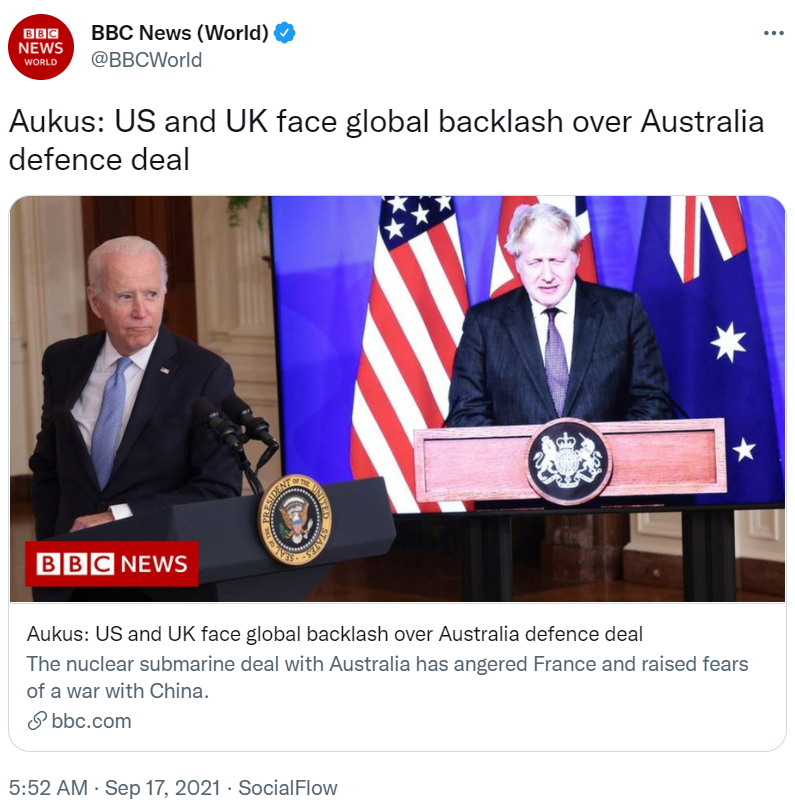
Aukus


The BBC's angle on Aukus this morning...


  • Funny that the story mentions only China and France but the headline suggests it is entire world. No wonder MSM is losing credibility.
  • 2 countries being upset is not "global." They are both on this globe, but that does not make this global. They are on two different continents and timezones, but again, it's not global.
  • BBC, which side are you on? There is no GLOBAL BACKLASH?? Do you side with CHINA?
  • There is NO backlash global. 

Update -  The political editor of The Sun isn't impressed:
Harry Cole: Some of the BBC headlines in the last 24 hours have made you double check which state broadcaster you are reading/watching. New pact endlessly reported through the prism of China’s hypothetical reaction rather than why it is needed.

Nor is Col. Richard Kemp: 

Richard KempIn so much U.K. and US media any positive move by our countries in defence of our national interests is slanted against us by default.

Out with Brexit, in with Climate


There's been an intriguing change to the BBC News website.

At the start of this year the BBC added "Brexit" to the category banner on its homepage:

  
The BBC has now removed it and replaced it with "Climate":


Leo Hickman, director/editor of Carbon Brief, is pleased
Significant development...BBC News has just added "climate" to the category banner on its homepage - and second only to coronavirus. The move came after it published the first article in its new "Life at 50C" series. A reminder that BBC News is one of the most read/watched – and, crucially, most respected and trusted – news organisation in the *world*, not just the UK. That's why this is so significant.

Thursday, 16 September 2021

3-against-1


When watching the TV or listening to the radio, I especially don't enjoy it when broadcasters set up 2-against-1 discussions/debates on a controversial subject.

It doesn't feel fair to me. 

Even worse is when the host of the programme takes the invited majority side and makes it 3-against-1. 

And my hackles really rise if that host then sends the bias sky-rocketing by either mainly or exclusively interrupting the one and only, single and unique dissenting voice, making it 3-against-1 with an added power imbalance against the 1.

And I find that grossly rude.

So let me confess: 

In first getting acquainted with GB News a while back, I was heavily disappointed to find GB News host Dan Wootton doing that very thing on a matter of controversy.

It was 2-against-1 guests, made 3-against-1 by Dan himself sharing the same view of the 2 against the 1, then Dan going after the lone dissenting 1 with contradictions and questions...

...and I thought to myself, ''I don't think I want to escape the BBC just to end up with a mirror image of the BBC - even if it's slightly better because its biased host isn't pretending to be impartial'' [or words to that effect].

And I wasn't thinking that because I agreed with the harassed dissenter. 

Far from it. In the discussion, I agreed with the 3 against the 1 and didn't particularly like the 1, who I felt wasn't right.

It just felt wrong though. 

----------------------

And I've held that view for about a month now regarding parts of GB News's output, but now I'm starting to think again...

My new thought is: Given how the BBC is, is that reasonable? Maybe a mirror image of it it necessary after all, especially as the BBC is publicly-funded and getting away with murder?

----------------------

And what provoked that re-think was last night's publicly-funded Newsnight on BBC Two.

This was the first discussion about Boris's reshuffle, hosted by Emily Maitlis

It was a classic biased BBC discussion.

It featured two Boris critics - Peter Kyle, Labour's Shadow Schools Minister, and someone Emily introduced as ''former Cabinet minister, now outspoken critic of this PM'' Anna Soubry - pitted against just one Boris supporter, Charles Walker, briefly former leader of the 1922 Committee.

That's Stage One. 

The obvious question already is: Why not just feature one guest from each side? Why not, say, just have either Mr Kyle or Ms Soubry face off against Mr Walker? Why stack it against Mr Walker with a 2-against-1 situation?

Then came Stage Two, as the biased host entered stage left, and intervened most aggressively against the single, dissenting voice - here Charles Walker. 

It was 3-against-1 time again,

Yes, it was pure Dan Wootton on GB News again, but from the opposite direction while - far worse - pretending to be impartial.

----------------------

Ironies abounded.

It began with Labour's Mr Kyle being given a long, free run to attack the Government. He got 1m 4s of uninterrupted ranting.

Then pro-Boris Charles Walker was brought in and Emily asked him about there being ''very little diversity of opinion'' in the new cabinet - which, in the first irony, is particularly rich coming from the present Newsnight team of left-liberal thinkalikes who think nothing of repeatedly labelling Nadine Dorries - the new culture secretary - a ''social conservative'' [as they did at least twice last night].

Hilariously, Mr Walker then 'did a June Sarpong' and replied listing all the racially diverse members of the present cabinet, and Emily - repeatedly interrupting him - told him, as if it was wrong, that he was ''talking about race'' rather than diversity of opinion [O irony upon irony!] - something Emily didn't want to do here but which Newsnight would undoubtedly have done if given even the remotest chance...

...except that they are famously one of the whitest, most right-on broadcasting teams at the BBC and that the Government puts them to shame as far as the identity politics 'putting diverse people in the top jobs' front goes.

Charles Walker barely got a sentence out before being quickly and repeatedly interrupted and contradicted by Emily, who seemed to be gunning for him. Her first interruption came 9 seconds into his first answer. [Note the contrast with Mr Kyle].

Anna Soubry was then brought in and soon fell out with Mr Walker. Ms Soubry said, ''Could you let me finish? You've spoken an awful lot, Charles'' - even though he hadn't been allowed to speak much at all.

I've counted it up and he got the same amount of time, prior to Anna entering, than Labour's Mr Kyle [around 1m 10s each] - though Peter Kyle got his free run while Charles Walker had to bat off Emily Maitlis's targetted-to-him questions and interruptions. And Anna went on to get plenty too.

Mr Walker, his hackles rising, asked why she was even on, given that she's no longer a member of Parliament. It's a good question, though we can easily guess the answer. Emily replied that she ''actually'' has ''been in cabinet''. Mr Walker replied that Ms Soubry ''wasn't in cabinet''.

''Let her finish her sentence, please,'' said Emily to Charles around this time - which was ironic given that Emily had repeatedly interrupted his sentences earlier. 

Anna Soubry, of course, unlike Charles, wasn't interrupted by Emily after 9s. She was also given free rein, only stopped by Charles Walker interrupting her. 

Anna then continued again, at length, ranting against Nadine Dorries. Emily let her finish her sentences. And on Anna Soubry was allowed to go, for an entire minute, raging against the new culture secretary. 

Charles Walker then defended Nadine Dorries and slammed Anna Soubry for not being ''nice'' - a section ending in all three guests speaking at the same time.

Emily then went on the attack against Charles Walker, gunning for him again. 

And Emily then did the BBC thing of playing devil's advocate for the one and only time, asking the Labour man a  half-hearted question about about how Boris is ''getting stuff done'' and doesn't looked ''scared of your party''.  Mr Kyle then delivered another long rant with the shortest interruption midway from Emily. And then Anna was given another long go. And then Mr Kyle returned again to add to his rant.

And finally Charles Walker was asked a long, complicated, heavily loaded by Emily - one with half a dozen questions embedded in it. He answered briefly. Then Mr Kyle leaped in and slagged off Michael Gove, uninterrupted.

And that was that.  

-----------------------

And after that, frankly, please give me openly biased Dan Wootton over 'claims to be impartial' Emily Mailis any day. 

It's the pretence of impartiality whilst being any but that really, deeply sticks in the throat.

Sunday, 12 September 2021

Echoes


As mentioned a couple of posts ago, I'm so grateful to you all for pointing out the BBC lowlights this week on the open thread. It's keeping the ITBB archive going. 

And the BBC have had quite a week of lowlights.

I


In my teenage years back in the 1980s, Paul Gambaccini was one of my heroes. His Radio One Saturday afternoon US chart show was something I never missed. 

Or hardly ever. And as I was in my early teens at the time and charts-obsessed, and would always be listening to it with my cassette recorder at the ready to catch every new entry on the UK and US charts, I could get quite ratty if Mum and Dad ever made me miss it. I remember going into a particularly huge 14-year old sulk on being taken off to see my gran in Kendal [Cumbrian home of the famous mint cake] one Saturday afternoon and missing the latest US Top 30 countdown from Mr G.

So I've always had a big soft spot for him. And he's always been the broadcasting pro's broadcasting pro. And I'm so glad he's come through all the horrors of hideous false allegations, and that he's now come out fighting, and is seeking redress. I wish him well.

It is intriguing though that he says he'll be coming for the BBC too one day for aiding and abetting such injustices because he does still work for the BBC. I only hope the BBC remember they still have a 'duty of care' towards him, consider their role in reporting [or mis-reporting] these stories, stick by him and avoid the pettiness that the BBC can often sink to when they feel threatened.


II

I'm not one for late nights, but even I stayed up to watch wonderful Emma Raducanu triumph in the tennis. 

She's so much more likeable a UK champion than Andy Murray, and everyone seems to be celebrating her today.

It's probably just a Twitter thing that the usual suspects have been scoring political points though. It's like an obsessive compulsion. 

I've at least left it a few hours before doing something similar and pointing out that Gary Lineker has been busy on Twitter scoring political points over Emma's victory, racialising her achievements and pushing pro-immigration, anti-government comments, and reinforcing crude ad hom attacks on Nigel Farage [with apologies for quoting the attack on Nigel that Gary joined in with, ''the nasty little turd'']. 

I've lost track of Gary's tweeting over recent months [not that I've ever paid much attention to him on Twitter], but to see him in full flow today has reminded me why he's so controversial as far as BBC impartiality goes. He remains very opinionated and politically-focused, and shouldn't have joined in that nasty attack on Nigel Farage. 

Anyhow, it was a triumph for Channel 4 too, ''humiliating'' the BBC by getting the rights to broadcast Emma's match. I hope everyone was watching that rather than Match of the Day. It's something sporting that will be remembered for a very long time. 

Update. And, being the BBC, here we go with the signalling retweets:


Why doesn't Sopes get back to reporting the lying, incompetent Biden administration? He should be rushed off his feet at the moment.

III

As Charlie noted, the BBC's first LBGT Correspondent Ben Hunte's short career at the BBC is ending. 

John Humphrys, on leaving the BBC, specifically named and shamed him for being a new breed of activist compromising BBC journalism. 

And Ben soon landed the BBC in trouble, with an impartiality-busting piece on transgender matters that saw complaints galore, and correction after correction, and BBC clarifications, and ECU rulings against it over endless months. 

He then seemed to have been sent off to Africa for months to do special reports. 


IV


I've read the thread and it looks like a particularly bad case of the BBC spreading disinformation by failing to check the facts. Please see what you think. 

V

The whole BBC 'allyship' thing may make your jaw drop for not being satire. But it's another bizarre sign of where we are. I'll quote Charlie's accurate summary:
Reported in The Telegraph tonight. You couldn’t make it up! BBC staff have been offered an “allyship” test which identifies whether they are more privileged than their colleagues, as part of diversity training. The manual also sets out seven types of allies that staff can become in the workplace. One of them, the “upstander”, is someone who “shuts down, reports and pushes back on offensive jokes and inappropriate comments, even if no one’s hurt by them”. This type of ally should “check in privately with anyone who’s been offended” by the joke and “don’t just be a bystander”. Another ally type is a “champion”, who “voluntarily defers to colleagues from underrepresented groups in meetings, events and conferences”. Voluntarily deferring to underrepresented groups - the BBC do this already anyway.

In tackling this kind of nonsense, the BBC is a big part of the problem. They aren't just buying the Emperor's new clothes, they're selling them on too.

Backlashes, peace, submission and the BBC


Radio 4's Sunday had a very Sunday take today.

I saw a tweet which summed it up very well:
David Robertson: The weekend of 9/11, the thought crossed my mind that the BBC’s right-on religious affairs programme would use it to talk about Islamaphobia. But no, surely they wouldn’t be so crass? It was worse. No mention of victims. No commemoration. Just Islamaphobia in Bradford.
That said, there was even more, as there was also a piece on how Sikhs got mixed up in the original 'backlash against innocent Muslims' after  9/11. 

The 'backlash' angle has been a classic BBC kneejerk take on such events for twenty years now. It seems to be their default angle.

The piece David mentions was a massive, uncritical plug - an advert, pure and simple - for Peaceophobia, a Bradford-based theatrical self-declared ''unapologetic response to rising Islamophobia around the world''. 

[So much for the BBC not featuring third-party advertising].

The piece featured someone explaining the title. She said that, as 'Islam' means 'peace', if you're 'phobic' about Islam you're also 'phobic' about peace.

Though doesn't 'Islam' actually mean 'submission'? 

'Submission' is something people might rightly be 'phobic' about, surely?

Poison blades in shoes and BBC gossip


Thank you for your comments on the Open Thread. You've covered - and nailed - so much of the ground I would have covered, including the departure of BBC lifer Fran Unsworth.

Today's Sunday Times - featuring that photo of Ms Unsworth which always draws Rosa Klebb comparisons in comments fields - includes lots of BBC insider gossip, including claims that Tim Davie is glad to see her go because she's “stuck in her ways” and part of the “malaise” at the corporation.

Friends of Tim also give us some juicy quotes, including saying that he's engaged in “constant fire-fighting” and that “he feels he opens Pandora’s box every day, and only the bad stuff ever comes out”. 

As far as the general exodus of BBC lifers go, any BBC source quips “More people are leaving the BBC than Afghanistan.”

And who's going to replace Francesca as Director of News and Current Affairs at SPECTRE the BBC? 

The piece names four people: present Deputy director of news Jonathan Munro, Senior controller of news output and commissioning Jamie Angus, Digital director of BBC News Naja Nielsen, and Commissioning editor for factual and arts at Channel 4 Shaminder Nahal. 

Mr Munro has 'issues' involving the debacles over Cliff Richard and Martin Bashir while Mr Angus is considered “lightweight”. Cue two more insider gossip quotes:
On Jamie Angus: “He’s a dilettante. When he was at the World Service, and your job is to know this stuff, I remember him saying he hadn’t heard of Waziristan, which was where bin Laden was hiding at the time.”

On Jamie Angus and Jonathan Munro: “Angus is a man who has risen without trace and Munro is a man who should have sunk without trace”.
Ms Nielsen is a recent arrival from Danish broadcasting, and “relatively unknown.” while Ms Nahal has all the baggage of being associated with left-wing Channel 4 and was jointly responsible for Black to Front, the channel's recent racist day when only black people appeared on the channel. “We were tired of taking small steps, say Vivienne Molokwu and Shaminder Nahal”, Broadcast reported her saying two days ago.

Especially as she previously worked for Newsnight, I'd place my money on Ms Nahal.

In which Nick Robinson avoids answering the question


The Telegraph features a letter from Nick Robinson replying to criticism from Lord Howard
SIR – I’m sorry that Michael Howard is turning off his radio. He will have missed some illuminating and civilised conversations this week on Today – with the head of MI5 and Tony Blair examining the fallout from 9/11; the Archbishop of Canterbury on climate change and the Health Secretary on the crises in the NHS and social care.

The joy of live radio is that it can move us – bringing joy when we hear of Emma Raducanu’s success; tears when we hear the memories of those haunted by 9/11 and, yes, sometimes anger when we shout at the radio at a politician who is being evasive or an interviewer who interrupts too much.

We presenters don’t always get it right but we do our best to balance allowing those we interview to get their message across and holding them to account. 
I hope Lord Howard will be back listening soon and, perhaps, back in the studio too, where he has always robustly answered, rather than ignored, challenging questions.
I had to chuckle at Nick's closing paragraph because he, Nick Robinson, didn't ''robustly answer'' the nub of Lord Howard's criticism of him. Or to put it another way, he, Nick Robinson ''ignored'' the ''challenging'' point at the heart of Michael Howard's piece:
The final straw, for me, was Nick Robinson’s interview with Nadhim Zahawi, the vaccine minister, on Tuesday of this week. Tuesday was, of course, the day when the Government announced its proposals for the reform of social care.
But as Mr Robinson well knew, the details had to be announced to Parliament before they could be broadcast. Indeed, had this convention been broken and caused a reprimand from the Speaker, the BBC’s journalists would have been the first, gleefully, to point to the Government’s discomfort.

Yet when Mr Zahawi attempted to explain this and said that he had come on to the programme to discuss the £5.4 billion which had just been announced for the NHS, Mr Robinson said that this was a complete waste of time and threatened to end the interview there and then.

You and I may think that listeners would have been very interested in how this money was going to be spent but not a single question was addressed to that topic. Instead Mr Robinson spent the whole interview berating the minister for not doing what Mr Robinson knew full well he couldn’t do.

So why did Nick Robinson avoid answering that? Was it a little too close to the bone?

Sunday, 5 September 2021

Deobandis in the UK


This feels like a traditional Sunday of years gone by here at ITBB, with me getting hung up on Radio 4's Sunday and posting piece after piece about it and having little time left for anything else. So on I go...

To do it credit, this morning's programme also featured a fascinating survey of opinion by the BBC itself of British Muslim opinion regarding the Taliban victory in Afghanistan.

They talked to imams and worshippers at Deobandi mosques - for understandable reasons, as Deobandis are the main group of Muslims living here in the UK, and the Taliban are also Deobandis. So it's important to know what such a large swathe of British Muslim opinion thinks.

The message couldn't have been clearer from every voice featured. The UK's Deobandis are feeling positive about/hopeful for the incoming Taliban government in Afghanistan. They are hoping for the best. And they are glad that The West [i.e. us] have been kicked out.

Curiously, every one of the British Deobandis they spoke to was a man - which might have pleased any passing Taliban Radio 4 listeners tuning in for The Archers.

This section of the programme did feature one woman though. The programme also interviewed the UK's small Shia community in the form of a female human rights campaigner. She, in contrast to the abounding Deobandis, was fearful.

My main thought here though is that the BBC will surely take note of the main mood among the UK's Muslims, as found here by Radio 4's Sunday

As the UK's mass of Deobandis are apparently intensely relaxed and happy about the Taliban's triumph, the BBC might very well adjust its reporting to reflect that sentiment on 'social cohesion' grounds.


And that makes me feel deeply queasy, because I fear we've brought foreign wars and foreign warriors ready to fight those wars to our shores and, alas, as a result, we'll inevitably pay a very heavy price for that in the long run.

And the BBC should be doing everything in its power as a Charter-bound protector of British democracy to prevent that. 

And the last thing it should be doing is to pander to the apparently huge pool of extremist Muslim opinion now dwelling in our midst, as per the BBC's Sunday

Is the BBC biased against Jehovah’s Witnesses?


Talking of this morning's Sunday on Radio 4, it also covered the latest Independent Inquiry into Child Sexual Abuse Report, which moved beyond the IICSA'S previous inquiry into abuse in the Anglican and Roman Catholic churches to embrace pretty much every other major Christian sect and all the  major world religions.


To repeat myself from yesterday:

I did a count of the mentions made of each religion/sect during the reports about this on each of the 10pm TV bulletins last night -

Sky News
Christian churches - 2
Judaism - 2
Islam - 2
Jehovah's Witnesses - 2

ITV News
Roman Catholicism - 1
Anglicanism - 1
Methodism - 1
Baptists - 1
Islam - 3
Judaism - 2
Sikhism - 1
Jehovah's Witnesses - 3

BBC News
Jehovah's Witnesses - 3
Roman Catholicism - 3
Anglicanism - 3
Judaism - 1

Only the BBC didn't mention Islam there.


But a peculiar feature of the broadcast media's coverage of this report was shared by all three of those UK broadcasters: They all mainly focused on the Jehovah’s Witnesses, despite the JWs not being singled out in any way as The Worst in the report

I thought at the time that this was probably just the broadcasters being cowardly and going for the safest option. 

After all, what are the JWs going to do? NOT ring the doorbell at Broadcasting House in protest? Send BBC home affairs reporter Tom Symonds of the BBC a few copies of The Watchtower [for it was he, rather than the reclusive Mark Easton, who did that BBC's report]? Boycott the BBC's Christmas Day Call the Midwife special?

And then came this morning's Sunday on BBC Radio 4, and it also focused on the Jehovah’s Witnesses.

The report is publicly available. I spent an hour reading quite a bit of it, and it's very much not mainly about the Jehovah’s Witnesses, despite what you may have seen on the BBC, Sky and ITV. It features four horrific case studies involving [a] Orthodox Jews, [b] Muslims, [c] Methodists and [d] Jehovah’s Witnesses. 

It focused on pretty much every religion and major sect.

To repeat myself repeating myself, what have the JWs done to deserve being singled out by the UK's main broadcasters, other than being safe targets / the easiest option? And if that's why, what does that say about our broadcasters? Are they nothing more than cowards?

This where I'm supposed to note that I'm not in any way affiliated with the Jehovah’s Witnesses. But that's not strictly true. I used to walk to primary school every day with a JW girl who lived on my street and I knew not to send her a Christmas present. And in my militant, Richard Dawkins-inspired, atheist mid-20s I once kept a very pleasant JW man - a teacher - on the doorstep for nearly two hours debating Biblical inerrancy and pointing out every contradiction between Biblical accounts I knew. In the end he said I had an answer for everything and said he had to go. And - having repented of my ways, at least as far as discombobulating kindly believers goes - I chuckled during lockdown on hearing that JWs weren't going to be ringing my doorbell. 

Gordon's alive!!!


This blog started with a series a posts detailing patterns of bias on BBC Radio 4's weekly 'politically left-of-centre and socially liberal' religion-focused Sunday programme.

And here's a new one: They like giving Gordon Brown a platform to promote his causes.

Despite it being a weekly programme featuring very few politicians, the son of the manse has been granted the Sunday bully pulpit no less than three times over the past year, pushing his agenda with the BBC's help.

Last October he was on demanding that the government 'must act to prevent the loss of a million young people to the job market'.

This May he was on advocating for G7 leaders to 'prioritise vaccines for developing countries ahead of the G7 summit'.

And today he was back saying that world leaders need to act now to end the 'moral outrage' that 'rich countries are amassing huge stockpiles of Covid vaccines they don't need'.

It's all very Sunday. In the years that I've covered them, they've always had their favourites and put them centre-stage

And that Crash Gordon is now their living saint among UK politicians brings me full circle as a blogger, as I began writing about and counting, counting, counting BBC bias during the Gordon Brown era. 

How lovely.

Don't be beastly to the Pakistanis!


There was a fascinating interview overnight on the BBC featuring Professor C. Christine Fair. Unfortunately it also got a bit feisty when the BBC began to panic over Professor Fair's analysis and Philippa Thomas rallied to Pakistan's defence. Professor Fair was soon being talked over and eventually faded out and cut off. Here, unredacted, is the full interview, preserved for posterity: 

Philippa Thomas: Right, let's speak now to Christine Fair, Professor of Security Studies at Georgetown University in Washington. Professor Fair, thank you very much for being with us. What you make of Faiz Hameed's visit to Kabul?
Christine Fair: First of all, thank you for having me. So I don't really make anything special out of this. I think for those of us that have been watching these affairs and Afghanistan evolve, not in the last 10 or 20 years, but actually the last, I mean, going back to 1973, this has been Pakistan's project. Without Pakistan the Taliban would be a nuisance, it wouldn't be the competent and capable terrorist organisation that is. So this is, in some ways for Pakistan, sealing the deal. You know, there are a lot of fissions across the different shuras of the Taliban, but the most important shura is the shura in Rawalpindi.
Philippa Thomas: Pakistan, of course, denies that it has created the Taliban or it supports it militarily behind the scenes in anyway. 
Christine Fair: Yeah, well, Pakistan gets away with lying largely because most people don't confront them. You know, various foreign ministers, various Pakistan army chiefs, presidents, prime ministers have come and gone before various shows like your own and they make these outrageous statements and most people are just too polite to question them. And then this just becomes part of their ossified fiction. But I've written an entire book on the Pakistan army using primary sources. And, you know, the Pakistanis first began the jihad in 1973. It didn't happen after the Soviets invaded Afghanistan, as is popularly believed. It actually began under Zulfikar Ali Bhutto. And even though the Pakistanis will make those claims, there's also those who very forthrightly admit it. MALIA LODI [spelling?], who has long been the amanuensis of the ISI with lipstick, you know, she'll very forthrightly say that the Taliban have long been supported by the Pakistanis...
Philippa Thomas: [interrupting] So...what...
Christine Fair: The Pakistanis...
Philippa Thomas[interrupting] What...what then do you think is the interest of the Pakistan government, and the intelligence agencies, when it comes to IS fighters, when it comes to al-Qaeda? Do they have a joint interest maybe with the Taliban in suppressing these other groups? 
Christine Fair: So, first of all, I think one just has to understand what Pakistan's interest in Afghanistan is writ large, and Pakistan inherited this notion of strategic depth from the British. The Pakistan army is a product of the British army in India, and so from the earliest months of the Pakistani state it has had a continuation of interests in Afghanistan. And the Afghans themselves did not help their own position by denouncing the Durand  Line, by interfering in Pakistan's restive Baluchistan province, so we cannot see this is something new. It is really important that we understand that this is part of...it's in Pakistan's strategic culture. So...
Philippa Thomas[interrupting] So I just want to...
Christine Fair: So the question that you have, the question that you have posed about Islamic State and Al-Qaeda. Right? 
Philippa Thomas: Yeah.
Christine Fair: So this is a complicated question because part of those organisations also advance Pakistan's interest. I think there's a lot of misunderstanding about the Islamic State - Khorasan Province that somehow it's joined tightly at the hips of the organisation that al-Baghdadi built, and that really isn't true. There were some early communications between them, but the differences...
Philippa Thomas[interrupting] OK, sorry, I want in the time that we have I also want to say, so you have a great deal of historic knowledge of what has happened, and Pakistan and Afghanistan. Given where we are now presumably it's in Pakistan's interest that there is stability, that there is not continued fighting in Afghanistan, or do you see that differently?
Christine Fair: No, no, this is also another myth. What Pakistan has objected to over the last 20 years is the emergence of a stable Afghanistan that is opposed to Pakistan...
Philippa Thomas[interrupting] But an unstable Afghanistan...
Christine Fair: ...and is friendly to India.
Philippa Thomas[interrupting]...surely means more refugees trying to get across the border to Pakistan. How is that in Pakistan's interests? 
Christine Fair: Yeah, right, so this is also a myth that I think Pakistan is very good at peddling. What Pakistan wants more than anything is an instability that it can manage, and also Pakistan will use the refugee story as a part of its usual rent-seeking strategy. You see, Pakistan likes to be thought of as the fire brigade when Pakistan is in fact the arsonist.
Philippa Thomas[interrupting] And Pakistan...
Christine Fair: Pakistan will monetise this. 
Philippa Thomas[interrupting]...of course would absolutely deny that, 
Christine Fair: How do you...how do you...
Philippa Thomas: And I want to come back to your phrase...let me come back to your phrase...
Christine Fair: Yes.
Philippa Thomas: ...''an instability that it can manage''.
Christine Fair: Correct.
Philippa Thomas: Even if, even if...if that is the case that is an immensely risky strategy?
Christine Fair: Pakistan has always been risk-acceptant. There has never been a risk-averse Pakistan, whether you're looking at incredibly outrageous terror attacks in India or whether you are looking at the support for the Taliban in the 1990s and all that that brought about. Look, even the fact that Pakistan harbours virtual petting zoos of terrorists in its own country, with the hope that they will only...
Philippa Thomas[interrupting] Christine, Christine Fair...
Christine Fair: ...only kill their neighbours is a risky strategy.
Philippa Thomas: As we cannot, as we cannot...We don't have a Pakistani diplomat or official to speak with us now, I'm going to say again...
Christine Fair[interrupting] Well, thank goodness you don't...
Philippa Thomas: No, I'm going to say again....
Christine Fair[interrupting] ...because he would pedal this fiction.
Philippa Thomas: ...that I know they firmly, they firmly deny that they have created the Taliban, and that they are the prime mover behind the Taliban...
Christine Fair[interrupting] To be fair, to be fair...
Philippa Thomas: ...and we have given you space to put your point of view, and we are going to leave it now, but thank you for being with us and for putting your point of view...
Christine Fair[interrupting] You are doing their propaganda...[faded out and cut off by the BBC]
Philippa Thomas: And there you go, and there is much more on what is happening in Afghanistan and the region and everything around that, on the BBC website of course.

Dame Jenni Murray on Emma Barnett's salary


Hell hath no fury like a Woman's Hour presenter scorned, as Dame Jenni Murray is proving.
 
She has been interviewed by the Sunday Telegraph's Louise Burke today and vents her spleen in fine fashion, coming close to sounding like a DEFUND THE BBC campaigner:
How does she feel about earning less than her replacement? ‘Well that really pisses me off,’ she says. ‘I was talking to an old colleague the other night and she was saying how horrified she is at what’s being paid now. We worked so hard and had high profiles, but we didn’t earn anything like [that]. It’s more than irritating. It’s infuriating actually. I don’t think, no matter how good they are, they are worth all that money. It’s a public broadcasting service. I’ll be hacked off when I still have to pay my licence in four years [after turning 75].’ She starts laughing.

Not that she's bitter of course, perish the thought:

So, dare I ask, does she still listen to the show? ‘I have long had a habit of getting up in the morning and putting the radio on and it’s always Radio 4,’ she humours me. ‘But I deliberately switch off just before 10 o’clock.’

It's not mentioned in the interview but I'm guessing Dame Jenni's secretary rang at that point saying, 'Sorry to interrupt, Dame Jenni, but there are several cats on the line wanting their meows back'. 

Sunday morning reading


I

The Mail on Sunday quotes Sir Iain Duncan Smith not so quietly ripping into the BBC's Covid coverage:

The vaccines are really good at stopping hospitalisation and death, yet every night we report the infection rate – why?

Why does the BBC throw over every single bit of data, when Covid is about sixth on the death toll? Can we have the death toll for pneumonia while we're at it? 

Cancer, heart disease, liver problems? Why are we continuing with the Covid stuff on the BBC and the main news channels? It frightens people.

Older people are still asking, 'Are we allowed to hug now?' Even when they have had all the jabs.

We have people who are now scared of normal life.

We certainly don't do it for flu, and we don't do it for cancer. 

Either we go the whole hog and every night publish a list of how you're going to die, or not at all. Covid isn't the major reason for death.

II 

The same paper also reports Peter Hitchens's rare victory over the BBC Complaints department. 

It concerned an episode from a Radio 4 series Mayday: The Canister on the Bed, broadcast on 20 November 2020. The BBC summarised the case like this:
The programme, part of a series on aspects of the conflict in Syria, dealt with the chemical weapons attack at Douma, which it described as “one of the most contested events in the war”, and included an account of the role subsequently played by a former inspector with the Organisation for the Prohibition of Chemical Weapons (OPCW), known pseudonymously as Alex, who had expressed concerns about the OPCW’s conclusions on the matter. The journalist Peter Hitchens complained that the programme had been inaccurate in insinuating that Alex’s disclosures had been motivated by a reward of $100,000 offered by WikiLeaks, that he believed the attack had been staged, and that he had made his views known only through “a select few journalists who share the Russian and Syrian state views on the war”. The ECU considered the complaint in the light of the BBC’s editorial standards of due accuracy.

And the BBC upheld Mr Hitchens's complaint, concluding that this episode in Chloe Hadjimatheou's Orwell Prize short-listed series [a] did indeed make an “insinuation” against Alex and that [b] the evidence for that insinuation wasn't strong enough to warrant the programme calling Alex's motives into question. It also found that [c] the programme's claim that Alex “believed the attack was staged” wasn't justified by strong enough evidence and [d] the programme mischaracterised Alex’s dealings with journalists, saying he had collaborated with journalists who held broadly the same views on the war as the Russian and Syrian governments, whereas he had in fact “also collaborated with journalists of whom that could not be said (Mr Hitchens among them)”.

The ECU found that, although they were limited to one aspect of a investigation into a complex and hotly contested subject, these points represented a failure to meet the standard of accuracy appropriate to a programme of this kind. The ECU noted that a posting about one point of the complaint had been made on the Corrections and Clarifications page of bbc.co.uk but, as it was not reflected in the extended version of the programme which continued to available on BBC Sounds and the website of the series, it did not suffice to resolve the issue in question.
And what Further Action has been taken? Well, “the finding was reported to the Board of BBC News and discussed with the programme-makers in question.” 

That'll teach 'em!

Saturday, 4 September 2021

''Watch the video for yourself''


I found this interesting from someone all the leading lights at the BBC Disinformation Unit follow.
 

SEPTEMBER 1 

  • New fact check: A viral photo makes it look like President Biden checked his watch during a ceremony honoring U.S. service members killed in Kabul. But that's misleading.
  • The way Biden honored the 11 caskets presented at Dover Air Force Base on Sunday was similar to how Trump paid respects to fallen service members during his presidency.
  • Biden checked his watch, but he did so after the ceremony had ended. Watch the video for yourself: https://c-span.org/video/?514338-1/president-biden-pays-respect-us-service-members-killed-afghanistan

SEPTEMBER 3

  • As many of you already know, this story has been corrected. Biden checked his watch multiple times during the ceremony. I regret the error.
  • Journalists and fact-checkers are human (yes, even me!) We make mistakes. When we do, we correct them and try to make it right.
  • It's easy to dunk on journalists when we get things wrong. I get it – to many, we're just another name on a screen. But behind that screen is a person trying to do their best.

It would make for a great BBC Trending/Disinformation Unit article.

Who are the militants in Afghanistan [and India]?


BBC World News, broadcast overnight on BBC One, looks to be recognising the new Taliban regime, even if the UK government hasn't yet.

Here BBC newsreader Karin Giannone describes the people opposing the Taliban as 'militants':
Now there are reports of from Afghanistan of heavy fighting between Taliban forces and militants who oppose the Islamist takeover around the Panjshir Valley.

The Daily Express today has it the other way round, with the Taliban remaining ''the militants'' and the forces of former vice-president Amrullah Saleh and Ahmad Massoud in the Panjshir Valley being ''resistance fighters'':

The Taliban have clashed with a group of resistance fighters in Afghanistan's Panjshir province as the final stronghold against the militants hangs in the balance. 

---------------- 

On a possibly related theme, this glowing headline following the death of a leading pro-Pakistan, Islamist Kashmiri separatist hasn't gone down well in India, where he's a highly controversial figure - understandably so given his pronouncements about Osama bin Laden and the Mumbai attackers:

The introductory paragraph goes on to say: 

Kashmir's top separatist leader Syed Ali Shah Geelani, who spearheaded the resistance movement against Indian rule, has died, aged 92. 

This is the language of approval. 

Here's a flavour of the reaction:

  • As expected, the BBC turns Syed Ali Shah Geelani into a freedom fighter when even Al Jazeera refers to him as "separatist". Is the BBC completely tone deaf when it comes to reporting? What's the reason behind this sustained anti-India stance? What kind of biased journalism is this?
  • Geelani fought to make Kashmir a totalitarian Islamist hellhole. He was partially responsible for massacres and ethnic cleansing of Kashmiri Hindus. He was an enemy of freedom. BBC's headline is unbelievable but reflects their anti-India and anti-Hindu bias.
  • If Geelani was a Hindu, the tone of the article would have been very different. 
  • Interesting. BBC News calls a Talibani-style terrorist Geelani a freedom fighter. The way it is BBC will stitch a burqa for the British queen. 

A ''virtue advertisement'' from the BBC


Even The Guardian is joining in, describing the new-look Question of Sport as ''a vapid BBC reboot'' and ''a howler''. Mark Lawson's review points out the typical BBC cack-handed virtue-signalling too:

The balance of the team feels off. [Paddy] McGuinness, who has telling moments of apologising that the script or format need more work, introduces the Olympic hockey gold medallist Sam Quek as “the first ever female captain” on the show. The producers leave in the audience applause for this virtue advertisement. Yet with former rugby union international Ugo Monye as the other captain and Barker replaced by McGuinness, there is still only one woman in the top trio, as has been the case for the past quarter of a century.


June Sarpong's salary


Looking back again....

It was a year ago, in September 2020, that we posted about the then mystery surrounding the salary of June Sarpong, the BBC's first Director of Creative Diversity. 

At that stage she'd been employed by the BBC for some 10 months but her salary was unknown. Her official BBC page at the time read ''June Sarpong's annual remuneration will the published shortly''.

Of course, it's become common knowledge since the BBC published its annual report in July this year that June Sarpong, the BBC's part-time Director of Creative Diversity, earns £267,000 for three days work per week - far more than the Prime Minister. The revelation has provoked widespread consternation and controversy.

There's something else though, and it happened between last September and this July. I half-saw at the time something, somewhere, about it being revealed that she was earning quite a lot less than £100K from a BBC job and have confirmed that now via the Wayback Machine

This has a snapshot of her official page from 24 December 2020 and reads ''Annual remuneration as of April 2020: £75,000'', something I presume it continued to say till this July. 

It's quite intriguing, isn't it, how long it took - nearly two years - for her £267,000 salary for a part-time job to be fully revealed? Were the BBC hiding it? 

UPDATE 

You do have to give it to June, she's very good at adding diversity to her business portfolios too. Bill Rodgers, as ever, has his eye on the ball:
Part-time BBC diversity supremo June Sarpong is still busy with business in the rest of her week. She's got a new company, called Womanly, set up in March, with four trademarks registered in May last year.

In May, she registered a trademark for The Africa Company, to be used with toiletries, cleaning products, food supplements and vitamins, tea, coffee, food products, beer and non-alcoholic beverages, and an online e-commerce platform. In July came a trademark for Kente Cola, seeking registration for non-alcoholic beverages.

Friday, 3 September 2021

Partly Upheld


At the height of the BLM protests last year the BBC's News at Ten broadcast a report about the Bengal Famine that proved highly controversial, especially regarding accusations against Winston Churchill.

Both last Monday's Today programme and last Monday's BBC One News at Ten featured reports by BBC journalist Yogita Limaye, and she clearly felt no obligation whatsoever to show fairness and impartiality. 
Her pieces were nothing more than concerted efforts to brand Winston Churchill a racist and hold him responsible for the 1943 Bengal Famine.
It generally aroused concerns that the activist foxes were taking over the chicken coop. 

Well, the BBC's Executive Complaints Unit has finally got round to ruling on complaints about this report - and by 'finally' I mean it's taken over 13 months to resolve - and it's partly exonerated Yogita Limaye's piece. But only partly. And what it upholds is that in the ECU’s judgement...:
...more exploration of alternative views of Churchill’s actions and motives in relation to the Bengal famine was required to meet the standard of impartiality appropriate to a report in a news bulletin of this kind. This aspect of the complaint was upheld
Or to put it another way, it wasn't fair and it wasn't impartial.

Marching in lockstep

 
A photo by Sopes from the south of France yesterday


It looks to have very much died away now, but the US liberal media's early spasm of fury at President Biden for leaving Afghanistan was much remarked upon by their critics. 

One piece, which I can't now place, observed that the last time the US liberal media very briefly put aside political partisanship was when their bogeyman Donald Trump bombed the Assad regime in April 2017 to their great approval.

It made me think about how Jon Sopel shocked many by strongly and repeatedly attacking Joe Biden for pulling out of Afghanistan. 


I've now just accidentally come across one of our posts here at ITBB from April 2017. It took me aback on re-reading it because I must admit I'd half-forgotten it, even though I wrote it. As now with Jon Sopel, so then too: the BBC marched arm-in-arm with their US liberal media equivalents. 

Most strikingly, the Washington Bureau Chief of the BBC, Paul Danahar, responded to a tweet announcing 'US launches military airstrikes in Syria' and wrote:
It should have been done by Obama. Those opposed to Trump should not oppose this just because he did it.

As a point of view, that couldn't be clearer.

And many of his staff - from Katty Kay to Kim Ghattas to Barbara Plett Usher - joined in the chorus of approval.

Looking back, isn't that a truly remarkable thing for the supposedly impartial boss of the BBC's US news output to state publicly? 

-----------------

And it's striking that this same Paul Danahar has just been promoted to the post of BBC Foreign Editor, replacing Andrew Roy. 

We've quite an archive of pieces about him. Being opinionated isn't something that's new as far as he goes. He presided over the BBC's Middle East coverage [i.e. was Jeremy Bowen's boss] before taking charge of the BBC's US coverage, and was just as free with his views then.